Department of Cellular and Molecular Medicine, Lerner Research Institute of Cleveland Clinic Cleveland, OH, USA.
Front Chem. 2015 Dec 16;3:68. doi: 10.3389/fchem.2015.00068. eCollection 2015.
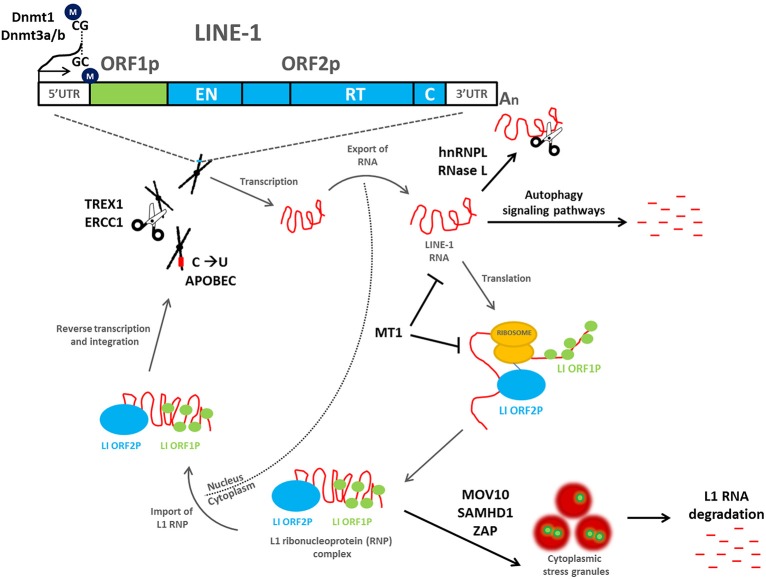
Retrotransposons are repetitive DNA sequences that are positioned throughout the human genome. Retrotransposons are capable of copying themselves and mobilizing new copies to novel genomic locations in a process called retrotransposition. While most retrotransposon sequences in the human genome are incomplete and incapable of mobilization, the LINE-1 retrotransposon, which comprises~17% of the human genome, remains active. The disruption of cellular mechanisms that suppress retrotransposon activity is linked to the generation of aneuploidy, a potential driver of tumor development. When retrotransposons insert into a novel genomic region, they have the potential to disrupt the coding sequence of endogenous genes and alter gene expression, which can lead to deleterious consequences for the organism. Additionally, increased LINE-1 copy numbers provide more chances for recombination events to occur between retrotransposons, which can lead to chromosomal breaks and rearrangements. LINE-1 activity is increased in various cancer cell lines and in patient tissues resected from primary tumors. LINE-1 activity also correlates with increased cancer metastasis. This review aims to give a brief overview of the connections between LINE-1 retrotransposition and the loss of genome stability. We will also discuss the mechanisms that repress retrotransposition in human cells and their links to cancer.
逆转录转座子是重复的 DNA 序列,它们位于人类基因组的各个位置。逆转录转座子能够自我复制,并通过称为逆转录转座的过程将新的拷贝移动到新的基因组位置。虽然人类基因组中的大多数逆转录转座子序列是不完整的,无法移动,但包含约 17%人类基因组的 LINE-1 逆转录转座子仍然活跃。细胞抑制逆转录转座子活性的机制的破坏与非整倍体的产生有关,非整倍体是肿瘤发展的潜在驱动因素。当逆转录转座子插入新的基因组区域时,它们有可能破坏内源性基因的编码序列并改变基因表达,这可能对生物体产生有害后果。此外,LINE-1 拷贝数的增加为逆转录转座子之间发生重组事件提供了更多机会,这可能导致染色体断裂和重排。各种癌细胞系和从原发性肿瘤切除的患者组织中 LINE-1 的活性增加。LINE-1 的活性也与癌症转移的增加相关。
这篇综述旨在简要概述 LINE-1 逆转录转座与基因组稳定性丧失之间的联系。我们还将讨论抑制人类细胞中逆转录转座的机制及其与癌症的关系。