Liu Ying, Lu Zheming, Xu Ruiping, Ke Yang
Key Laboratory of Carcinogenesis and Translational Research (Ministry of Education), Laboratory of Genetics, Peking University Cancer Hospital and Institute, Beijing, China.
Anyang Cancer Hospital, Henan Province, China.
Oncotarget. 2016 Feb 2;7(5):5852-64. doi: 10.18632/oncotarget.6809.
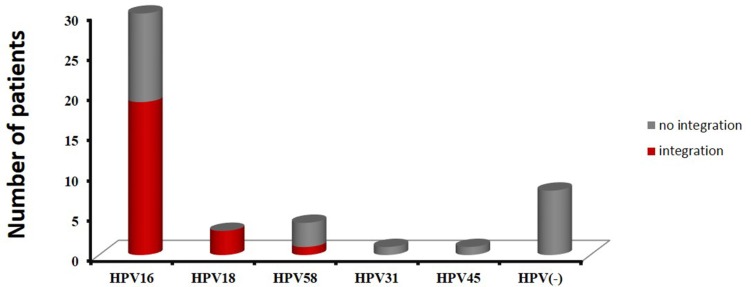
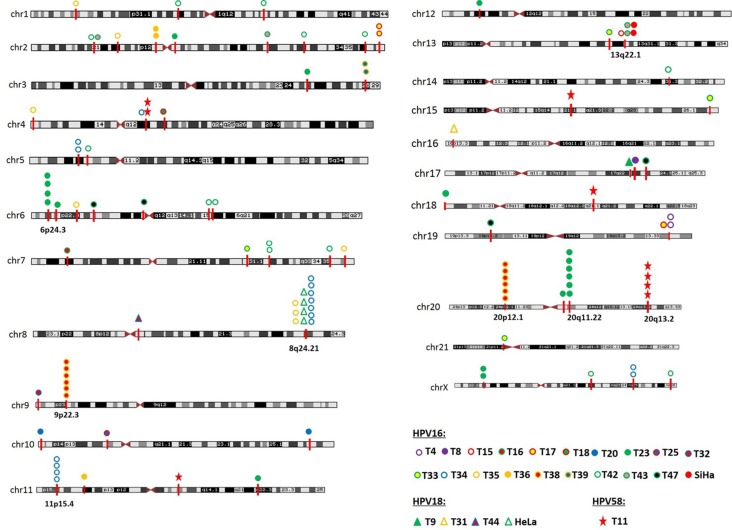
Integration of human papillomavirus (HPV) DNA into the host genome can be a driver mutation in cervical carcinoma. Identification of HPV integration at base resolution has been a longstanding technical challenge, largely due to sensitivity masking by HPV in episomes or concatenated forms. The aim was to enhance the understanding of the precise localization of HPV integration sites using an innovative strategy. Using HPV capture technology combined with next generation sequencing, HPV prevalence and the exact integration sites of the HPV DNA in 47 primary cervical cancer samples and 2 cell lines were investigated. A total of 117 unique HPV integration sites were identified, including HPV16 (n = 101), HPV18 (n = 7), and HPV58 (n = 9). We observed that the HPV16 integration sites were broadly located across the whole viral genome. In addition, either single or multiple integration events could occur frequently for HPV16, ranging from 1 to 19 per sample. The viral integration sites were distributed across almost all the chromosomes, except chromosome 22. All the cervical cancer cases harboring more than four HPV16 integration sites showed clinical diagnosis of stage III carcinoma. A significant enrichment of overlapping nucleotides shared between the human genome and HPV genome at integration breakpoints was observed, indicating that it may play an important role in the HPV integration process. The results expand on knowledge from previous findings on HPV16 and HPV18 integration sites and allow a better understanding of the molecular basis of the pathogenesis of cervical carcinoma.
人乳头瘤病毒(HPV)DNA整合到宿主基因组中可能是宫颈癌的驱动性突变。在碱基分辨率水平上鉴定HPV整合位点一直是一项长期存在的技术挑战,这主要是由于游离型或串联形式的HPV造成的敏感性掩盖。目的是使用创新策略增强对HPV整合位点精确定位的理解。利用HPV捕获技术结合下一代测序,研究了47例原发性宫颈癌样本和2种细胞系中HPV的流行情况以及HPV DNA的确切整合位点。共鉴定出117个独特的HPV整合位点,包括HPV16(n = 101)、HPV18(n = 7)和HPV58(n = 9)。我们观察到HPV16整合位点广泛分布于整个病毒基因组。此外,HPV16经常发生单个或多个整合事件,每个样本的整合事件数从1到19个不等。病毒整合位点分布在除22号染色体外的几乎所有染色体上。所有携带超过四个HPV16整合位点的宫颈癌病例临床诊断为III期癌。在整合断点处观察到人类基因组与HPV基因组之间共享的重叠核苷酸有显著富集,表明其可能在HPV整合过程中起重要作用。这些结果扩展了先前关于HPV16和HPV18整合位点的研究发现,有助于更好地理解宫颈癌发病机制的分子基础。