Karkey Abhilasha, Jombart Thibaut, Walker Alan W, Thompson Corinne N, Torres Andres, Dongol Sabina, Tran Vu Thieu Nga, Pham Thanh Duy, Tran Thi Ngoc Dung, Voong Vinh Phat, Singer Andrew C, Parkhill Julian, Thwaites Guy, Basnyat Buddha, Ferguson Neil, Baker Stephen
Oxford University Clinical Research Unit, Patan Academy of Health Sciences, Kathmandu, Nepal.
MRC Centre for Outbreak Analysis and Modelling, Department of Infectious Disease Epidemiology, School of Public Health, Imperial College London, London, United Kingdom.
PLoS Negl Trop Dis. 2016 Jan 6;10(1):e0004346. doi: 10.1371/journal.pntd.0004346. eCollection 2016 Jan.
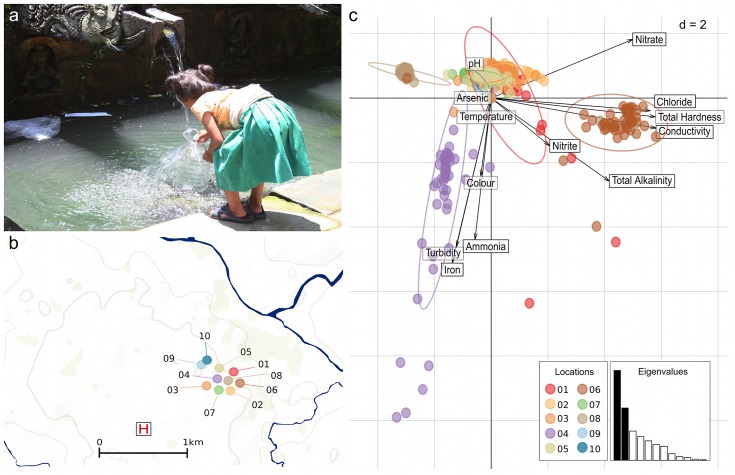
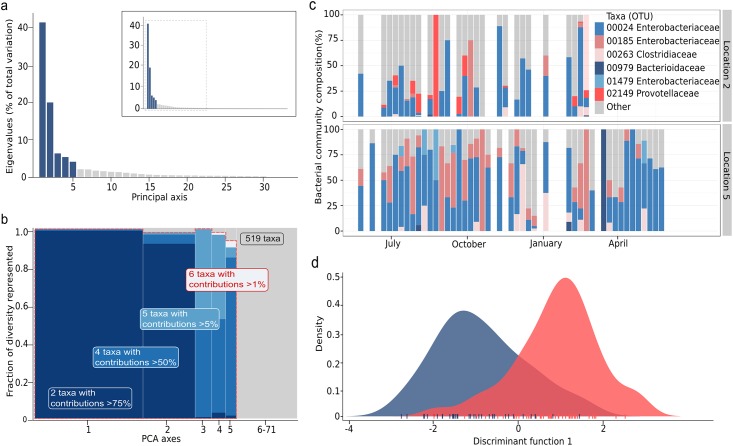
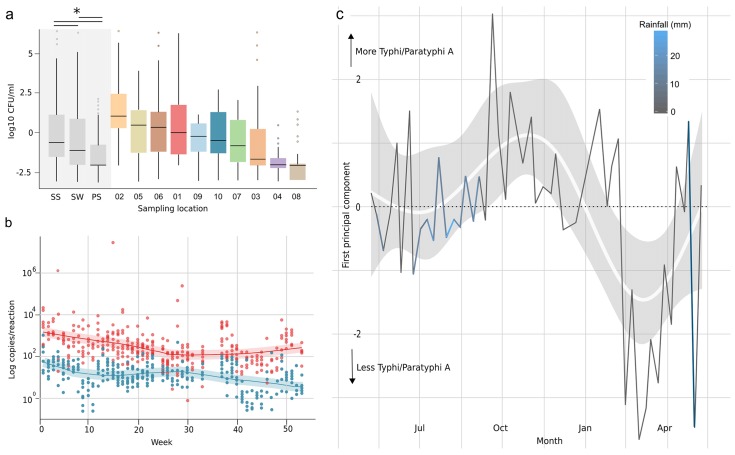
One of the UN sustainable development goals is to achieve universal access to safe and affordable drinking water by 2030. It is locations like Kathmandu, Nepal, a densely populated city in South Asia with endemic typhoid fever, where this goal is most pertinent. Aiming to understand the public health implications of water quality in Kathmandu we subjected weekly water samples from 10 sources for one year to a range of chemical and bacteriological analyses. We additionally aimed to detect the etiological agents of typhoid fever and longitudinally assess microbial diversity by 16S rRNA gene surveying. We found that the majority of water sources exhibited chemical and bacterial contamination exceeding WHO guidelines. Further analysis of the chemical and bacterial data indicated site-specific pollution, symptomatic of highly localized fecal contamination. Rainfall was found to be a key driver of this fecal contamination, correlating with nitrates and evidence of S. Typhi and S. Paratyphi A, for which DNA was detectable in 333 (77%) and 303 (70%) of 432 water samples, respectively. 16S rRNA gene surveying outlined a spectrum of fecal bacteria in the contaminated water, forming complex communities again displaying location-specific temporal signatures. Our data signify that the municipal water in Kathmandu is a predominant vehicle for the transmission of S. Typhi and S. Paratyphi A. This study represents the first extensive spatiotemporal investigation of water pollution in an endemic typhoid fever setting and implicates highly localized human waste as the major contributor to poor water quality in the Kathmandu Valley.
联合国可持续发展目标之一是到2030年实现安全和负担得起的饮用水的普遍供应。在尼泊尔加德满都这样的地方,这个目标最为相关,加德满都是南亚一个人口密集且伤寒热流行的城市。为了了解加德满都水质对公共卫生的影响,我们对10个水源的每周水样进行了为期一年的一系列化学和细菌学分析。我们还旨在检测伤寒热的病原体,并通过16S rRNA基因检测纵向评估微生物多样性。我们发现,大多数水源的化学和细菌污染超过了世界卫生组织的指导标准。对化学和细菌数据的进一步分析表明存在特定地点的污染,这是高度局部性粪便污染的特征。降雨被发现是这种粪便污染的关键驱动因素,与硝酸盐以及伤寒杆菌和甲型副伤寒杆菌的证据相关,在432份水样中,分别有333份(77%)和303份(70%)可检测到它们的DNA。16S rRNA基因检测勾勒出了受污染水中一系列粪便细菌,形成了复杂的群落,再次显示出特定地点的时间特征。我们的数据表明,加德满都的市政供水是伤寒杆菌和甲型副伤寒杆菌传播的主要媒介。这项研究是在伤寒热流行地区对水污染进行的首次广泛的时空调查,并表明高度局部化的人类排泄物是加德满都谷地水质差的主要原因。