Ford Michael J, Hempelmann Jennifer, Hanson M Bradley, Ayres Katherine L, Baird Robin W, Emmons Candice K, Lundin Jessica I, Schorr Gregory S, Wasser Samuel K, Park Linda K
Conservation Biology Division, Northwest Fisheries Science Center, National Marine Fisheries Service, National Oceanic and Atmospheric Administration, 2725 Montlake Blvd E, Seattle, Washington, 98112, United States of America.
Center for Conservation Biology, Department of Biology, University of Washington, Seattle, Washington, 98195, United States of America.
PLoS One. 2016 Jan 6;11(1):e0144956. doi: 10.1371/journal.pone.0144956. eCollection 2016.
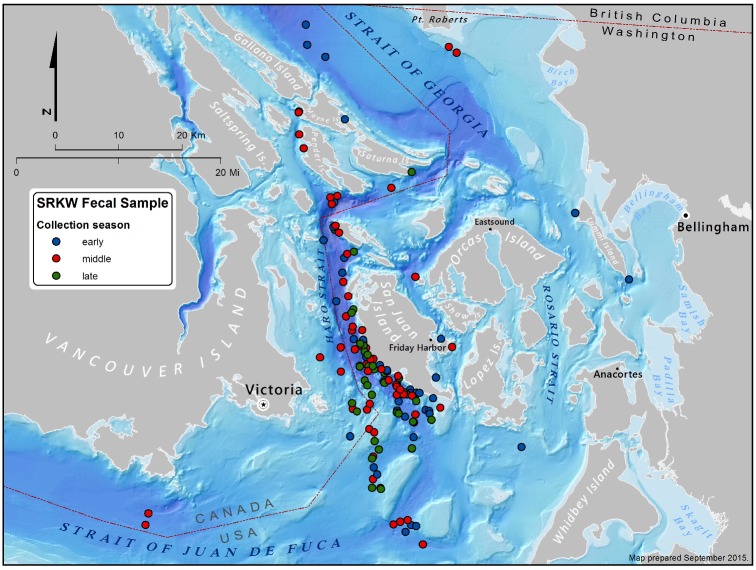
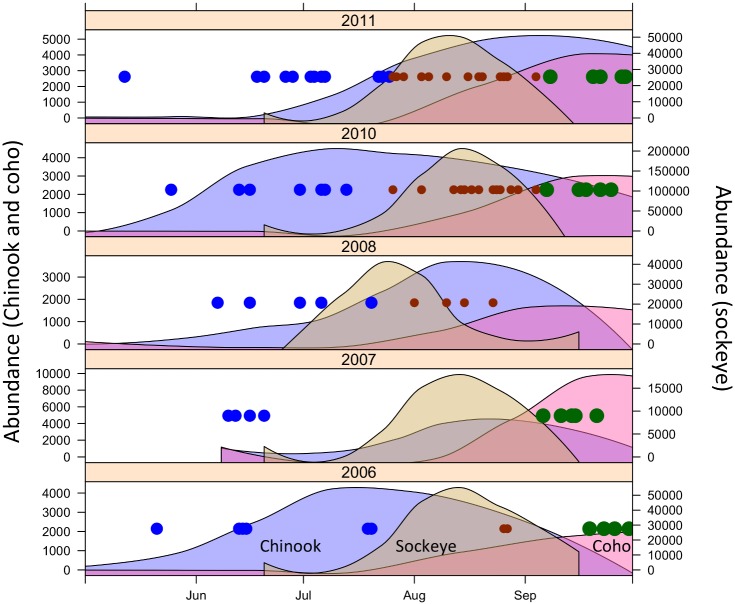
Estimating diet composition is important for understanding interactions between predators and prey and thus illuminating ecosystem function. The diet of many species, however, is difficult to observe directly. Genetic analysis of fecal material collected in the field is therefore a useful tool for gaining insight into wild animal diets. In this study, we used high-throughput DNA sequencing to quantitatively estimate the diet composition of an endangered population of wild killer whales (Orcinus orca) in their summer range in the Salish Sea. We combined 175 fecal samples collected between May and September from five years between 2006 and 2011 into 13 sample groups. Two known DNA composition control groups were also created. Each group was sequenced at a ~330bp segment of the 16s gene in the mitochondrial genome using an Illumina MiSeq sequencing system. After several quality controls steps, 4,987,107 individual sequences were aligned to a custom sequence database containing 19 potential fish prey species and the most likely species of each fecal-derived sequence was determined. Based on these alignments, salmonids made up >98.6% of the total sequences and thus of the inferred diet. Of the six salmonid species, Chinook salmon made up 79.5% of the sequences, followed by coho salmon (15%). Over all years, a clear pattern emerged with Chinook salmon dominating the estimated diet early in the summer, and coho salmon contributing an average of >40% of the diet in late summer. Sockeye salmon appeared to be occasionally important, at >18% in some sample groups. Non-salmonids were rarely observed. Our results are consistent with earlier results based on surface prey remains, and confirm the importance of Chinook salmon in this population's summer diet.
估计饮食组成对于理解捕食者与猎物之间的相互作用从而阐明生态系统功能至关重要。然而,许多物种的饮食很难直接观察到。因此,对在野外收集的粪便进行基因分析是了解野生动物饮食的一个有用工具。在本研究中,我们使用高通量DNA测序来定量估计濒危野生虎鲸(Orcinus orca)种群在萨利希海夏季活动范围内的饮食组成。我们将2006年至2011年这五年间5月至9月收集的175份粪便样本合并为13个样本组。还创建了两个已知DNA组成的对照组。使用Illumina MiSeq测序系统对线粒体基因组中16s基因的一个约330bp片段对每个组进行测序。经过几个质量控制步骤后,将4,987,107条个体序列与一个包含19种潜在鱼类猎物物种的定制序列数据库进行比对,并确定每个粪便衍生序列最可能的物种。基于这些比对,鲑科鱼类占总序列的比例超过98.6%,因此也是推断饮食中的主要成分。在六种鲑科鱼类中,奇努克鲑占序列的79.5%,其次是银鲑(15%)。在所有年份中,出现了一个明显的模式:奇努克鲑在夏季早期的估计饮食中占主导地位,而银鲑在夏末的饮食中平均贡献超过40%。红鲑在某些样本组中偶尔也很重要,占比超过18%。非鲑科鱼类很少被观察到。我们的结果与早期基于水面猎物残骸的结果一致,并证实了奇努克鲑在该种群夏季饮食中的重要性。