George Michael D, Baker Joshua F
Division of Rheumatology, University of Pennsylvania, Philadelphia, PA, USA.
Philadelphia VA Medical Center, Philadelphia, PA, USA.
Curr Rheumatol Rep. 2016 Jan;18(1):6. doi: 10.1007/s11926-015-0550-z.
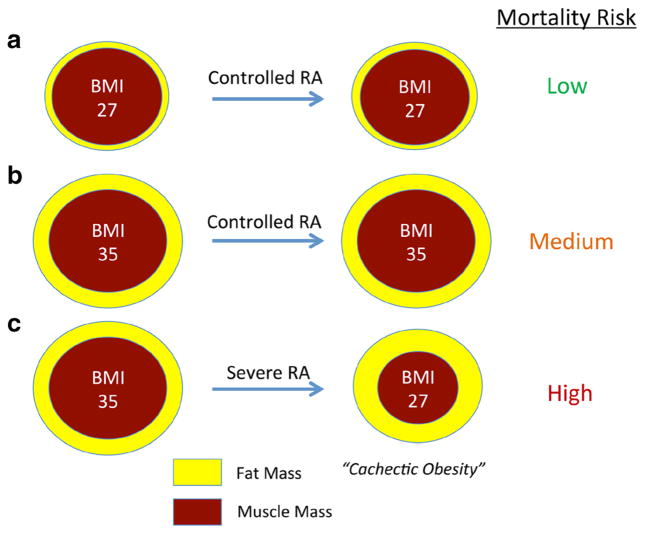
With the prevalence of obesity increasing dramatically worldwide over the past several decades, an increasing body of literature has examined the impact of obesity in the context of rheumatoid arthritis (RA). Epidemiologic studies suggest that obesity may be associated with a modestly increased risk for the development of RA, although these studies have shown conflicting results. Among patients with established RA, obesity has been observed to be associated with greater subjective measures of disease activity and poor treatment response, but also with a decreased risk of joint damage and lower mortality. A comprehensive evaluation of the influence of obesity on the measurement of disease, response to therapies, and long-term prognosis is critical in order to understand these observations. This review therefore focuses on recent observations, potential explanations for these findings, and implications for clinicians and investigators caring for and studying patients with RA.
在过去几十年里,全球肥胖症患病率急剧上升,越来越多的文献探讨了肥胖症在类风湿关节炎(RA)背景下的影响。流行病学研究表明,肥胖症可能与RA发病风险略有增加有关,尽管这些研究结果相互矛盾。在已确诊RA的患者中,肥胖症与更高的疾病活动主观指标和较差的治疗反应相关,但也与关节损伤风险降低和死亡率降低有关。全面评估肥胖症对疾病测量、治疗反应和长期预后的影响对于理解这些观察结果至关重要。因此,本综述重点关注近期观察结果、这些发现的潜在解释以及对照顾和研究RA患者的临床医生和研究人员的启示。