Hyett Matthew P, Parker Gordon B, Guo Christine C, Zalesky Andrew, Nguyen Vinh T, Yuen Tamara, Breakspear Michael
School of Psychiatry, University of New South Wales, Black Dog Institute Building, Prince of Wales Hospital, Hospital Road, Randwick, NSW 2031, Australia; QIMR Berghofer Medical Research Institute, 300 Herston Road, Herston, QLD 4006, Australia.
School of Psychiatry, University of New South Wales, Black Dog Institute Building, Prince of Wales Hospital, Hospital Road, Randwick, NSW 2031, Australia; Black Dog Institute, Prince of Wales Hospital, Hospital Road, Randwick, NSW 2031, Australia.
Neuroimage Clin. 2015 Oct 24;9:660-7. doi: 10.1016/j.nicl.2015.10.011. eCollection 2015.
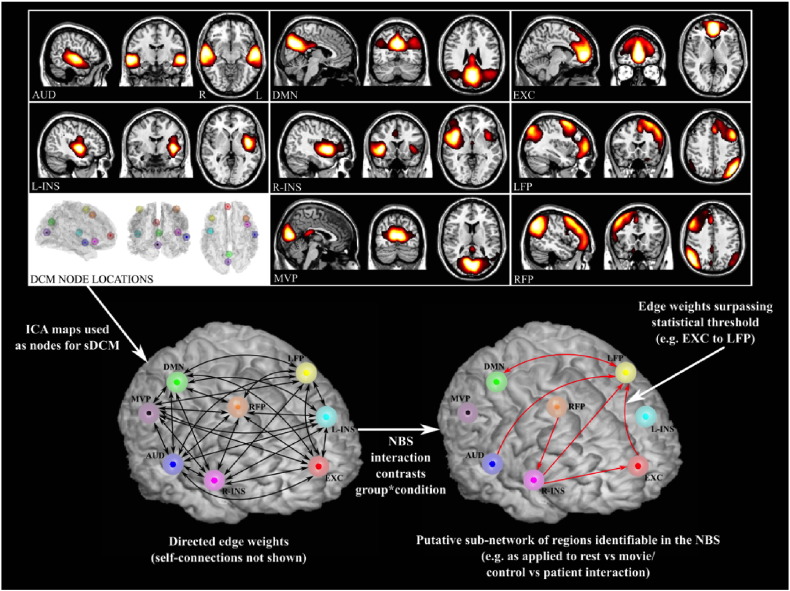
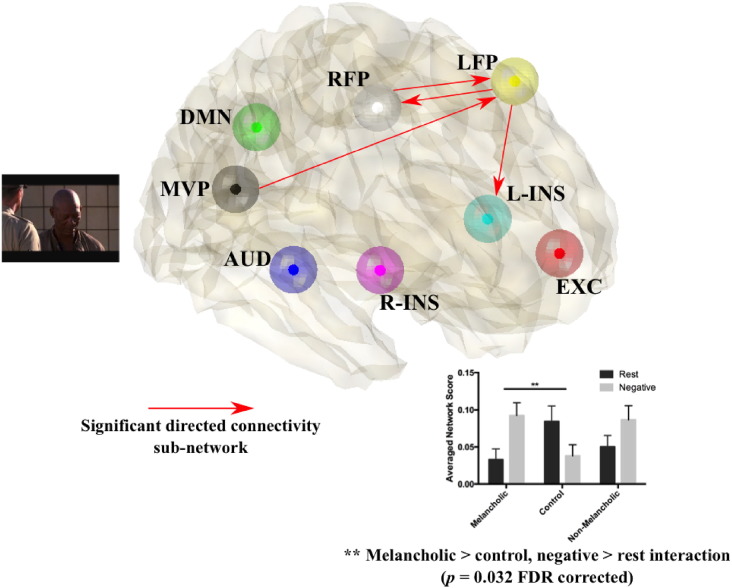
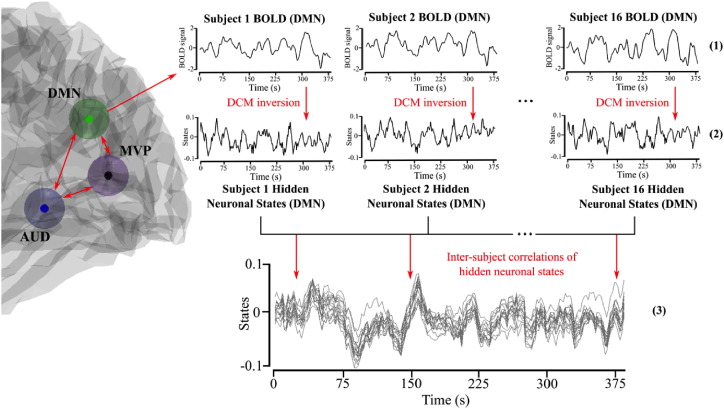
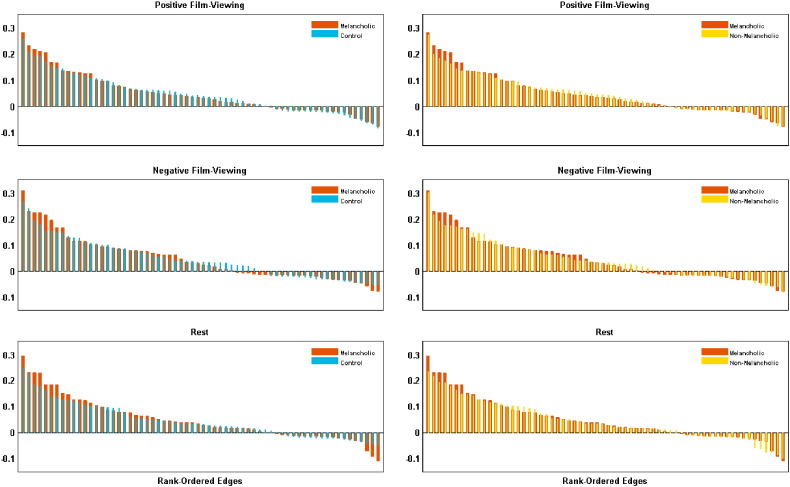
Impairments in attention and concentration are distinctive features of melancholic depression, and may diminish the ability to shift focus away from internal dysphoric states. Disrupted brain networks may underlie the inability to effectively disengage from interoceptive signals in this disorder. This study investigates changes in effective connectivity between cortical systems supporting attention, interoception, and perception in those with melancholic depression when shifting attention from rest to viewing dynamic film stimuli. We hypothesised that those with melancholia would show impaired attentional shifting from rest to emotional film viewing, captured in neuronal states that differed little across conditions. Functional magnetic resonance imaging (fMRI) data were acquired from 48 participants (16 melancholic depressed, 16 non-melancholic depressed, and 16 healthy controls) at rest and whilst viewing emotionally salient movies. Using independent component analysis, we identified 8 cortical modes (default mode, executive control, left/right frontoparietal attention, left/right insula, visual and auditory) and studied their dynamics using dynamic causal modelling. Engagement with dynamic emotional material diminished in melancholia and was associated with network-wide increases in effective connectivity. Melancholia was also characterised by an increase in effective connectivity amongst cortical regions involved in attention and interoception when shifting from rest to negative film viewing, with the converse pattern in control participants. The observed involvement of attention- and insula-based cortical systems highlights a potential neurobiological mechanism for disrupted attentional resource allocation, particularly in switching between interoceptive and exteroceptive signals, in melancholia.
注意力和专注力受损是忧郁症性抑郁症的显著特征,可能会削弱将注意力从内心烦躁状态转移开的能力。大脑网络紊乱可能是这种疾病中无法有效脱离内感受信号的基础。本研究调查了忧郁症性抑郁症患者在从休息状态转移到观看动态电影刺激时,支持注意力、内感受和感知的皮层系统之间有效连接的变化。我们假设,忧郁症患者从休息状态转移到观看情感电影时会表现出注意力转移受损,这体现在不同条件下差异不大的神经元状态中。在休息状态和观看情感突出的电影时,对48名参与者(16名忧郁症抑郁症患者、16名非忧郁症抑郁症患者和16名健康对照者)进行了功能磁共振成像(fMRI)数据采集。使用独立成分分析,我们识别出8种皮层模式(默认模式、执行控制、左右额顶叶注意力、左右脑岛、视觉和听觉),并使用动态因果模型研究它们的动态变化。忧郁症患者与动态情感材料的互动减少,且与全网络有效连接的增加有关。忧郁症的另一个特征是,从休息状态转移到观看负面电影时,参与注意力和内感受的皮层区域之间的有效连接增加,而对照组参与者则呈现相反的模式。观察到基于注意力和脑岛的皮层系统的参与,凸显了忧郁症中注意力资源分配中断的潜在神经生物学机制,特别是在内感受和外感受信号之间切换时。