Baghirova Sabina, Hughes Bryan G, Hendzel Michael J, Schulz Richard
Department of Pharmacology, Cardiovascular Research Centre, Mazakowski Alberta Heart Institute, University of Alberta, Edmonton, Alberta, Canada.
Department of Pharmacology, Cardiovascular Research Centre, Mazakowski Alberta Heart Institute, University of Alberta, Edmonton, Alberta, Canada; Department of Pediatrics, Cardiovascular Research Centre, Mazakowski Alberta Heart Institute, University of Alberta, Edmonton, Alberta, Canada.
MethodsX. 2015 Nov 7;2:440-5. doi: 10.1016/j.mex.2015.11.001. eCollection 2015.
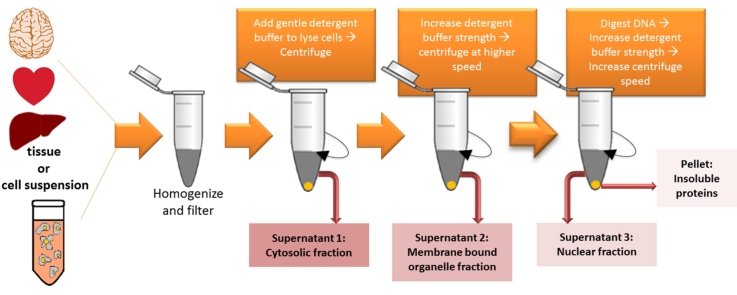
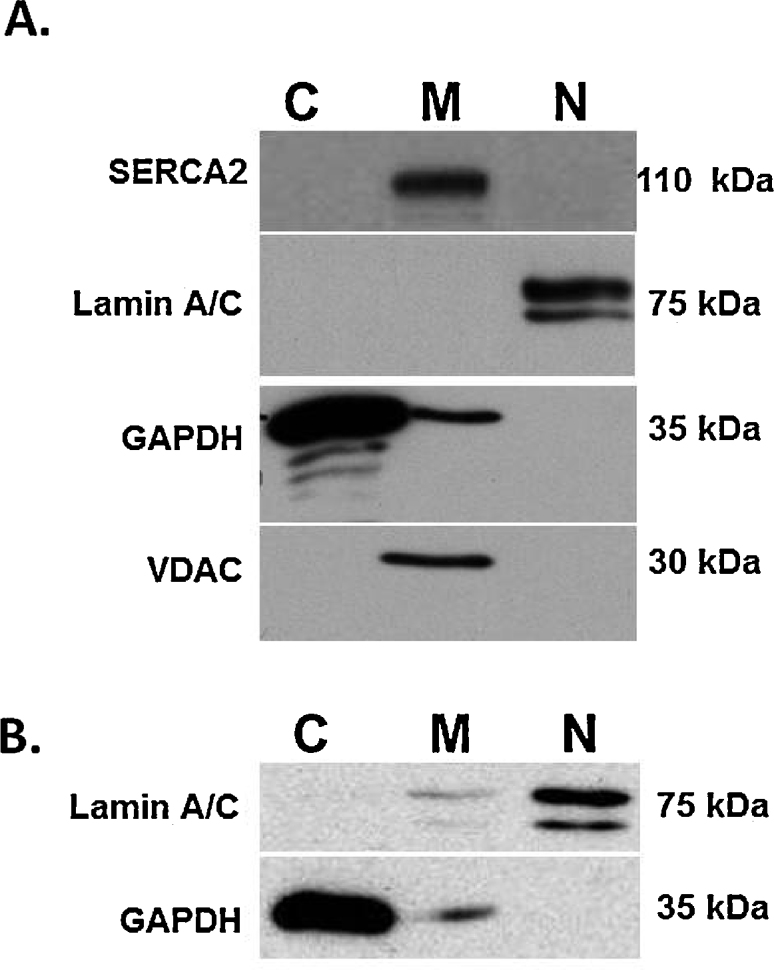
Many types of studies require the localization of a protein to, or isolation of enriched protein from a specific cellular compartment. Many protocols in the literature and from commercially available kits claim to yield pure cellular fractions. However, in our hands, the former often do not work effectively and the latter may be prohibitively expensive if a large number of fractionations are required. Furthermore, the largely proprietary composition of reagents in commercial kits means that the user is not able to make adjustments if, for example, a particular component affects the activity of a protein of interest. The method described here allows the isolation of purified proteins from three cellular fractions: the cytosol, membrane-bound organelles, and the nucleus. It uses gentle buffers with increasing detergent strength that sequentially lyse the cell membrane, organelle membranes and finally the nuclear membrane.•Quick, simple to replicate or adjust; this method does not require expensive reagents or use of commercial kits•The protocol can be applied to tissue samples or cultured cells without changing buffer components•Yields purified fractions of cytosolic, membrane bound and nuclear proteins, with the proper distribution of the appropriate subcellular markers: GAPDH, VDAC, SERCA2 and lamin A/C.
许多类型的研究需要将蛋白质定位到特定的细胞区室,或从特定的细胞区室中分离富集的蛋白质。文献中的许多方案以及市售试剂盒都声称能够获得纯的细胞组分。然而,在我们的实践中,前者往往效果不佳,而如果需要大量分级分离,后者可能成本过高。此外,商业试剂盒中试剂的成分大多是专利性的,这意味着用户无法进行调整,例如,如果某个特定成分影响了目标蛋白质的活性。本文所述方法能够从三个细胞组分中分离纯化蛋白质:胞质溶胶、膜结合细胞器和细胞核。该方法使用温和的缓冲液,其去污剂强度逐渐增加,依次裂解细胞膜、细胞器膜,最后裂解核膜。
快速、易于重复或调整;该方法不需要昂贵的试剂,也无需使用商业试剂盒
该方案可应用于组织样本或培养细胞,无需改变缓冲液成分
可获得胞质、膜结合和核蛋白的纯化组分,且适当的亚细胞标志物(甘油醛-3-磷酸脱氢酶、电压依赖性阴离子通道、肌浆网钙ATP酶2和核纤层蛋白A/C)分布恰当