Division of Physical Medicine & Rehabilitation, University of Utah, Salt Lake City, Utah, USA.
Department of Orthopaedic Surgery, University of Utah, Salt Lake City, Utah, USA.
Orthop J Sports Med. 2015 Dec 10;3(12):2325967115620365. doi: 10.1177/2325967115620365. eCollection 2015 Dec.
The majority of studies on concussion in the National Football League (NFL) focus on testing, evaluation, and outcomes. Meanwhile, there is a paucity of research on how a team's style of play influences the risk of concussion.
Style of play, such as offensive and defensive strategies, is associated with the rate of concussions in the NFL.
Descriptive epidemiology study.
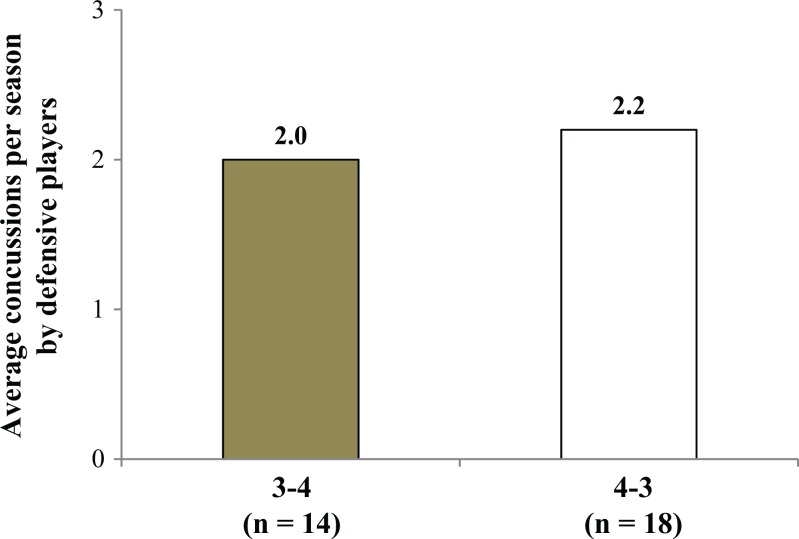
The current study retrospectively analyzed data from the 2012 to 2014 NFL regular seasons. Reported numbers of concussions were stratified by each team and each position and were compared based on style of play, including offensive scheme (West Coast offense, Air Coryell offense, or other offensive schemes) and defensive alignment (3-4 or 4-3), attempts statistics, per-drive statistics, and offensive and defensive productions, along with strength of schedule (SoS) and team quality measured by simple rating system (SRS). Data analyses included descriptive statistics, 1-way analysis of variance, correlation analysis, and regression analysis.
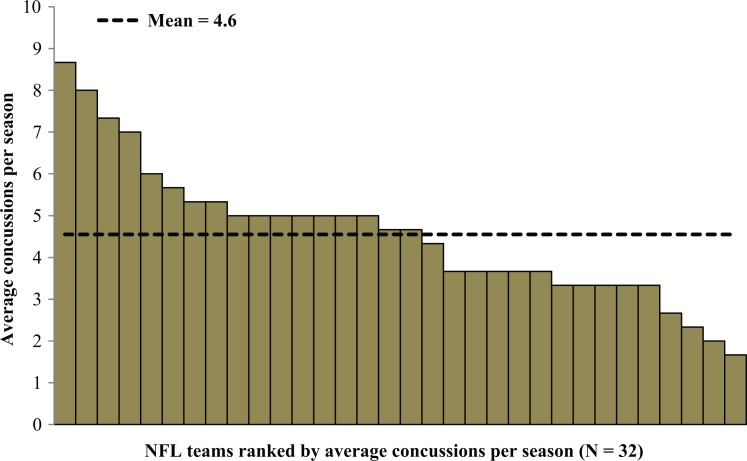
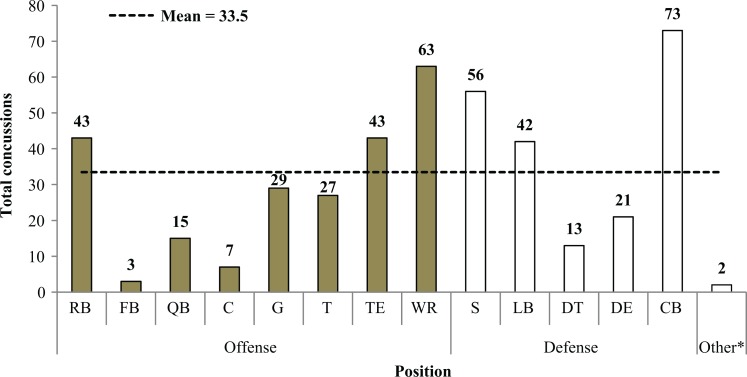
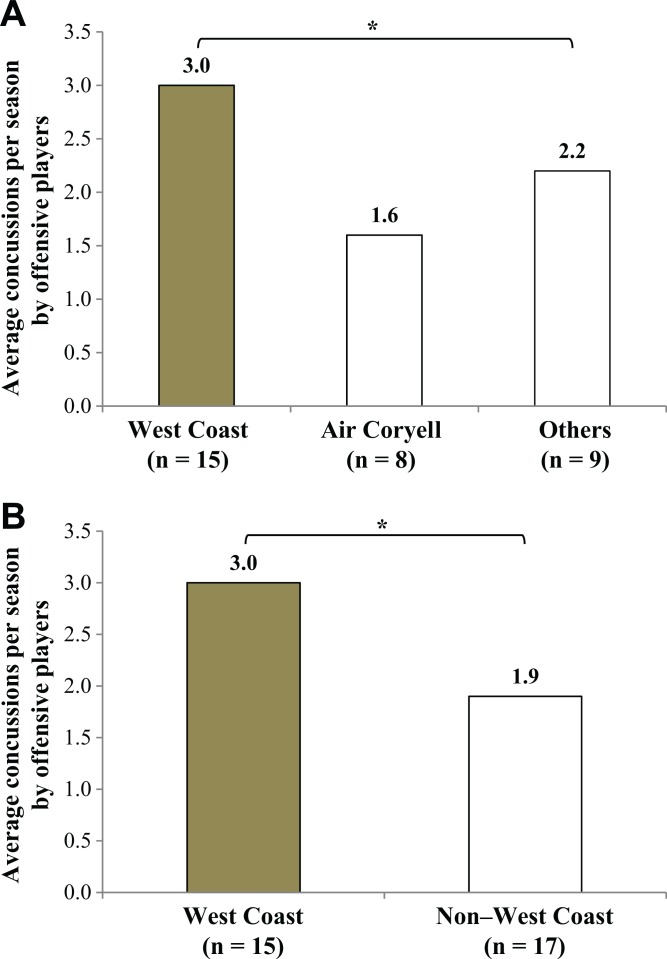
There were 437 documented concussions during the 2012 to 2014 NFL regular seasons, with a mean 4.6 concussions per season per team. In general, players most involved in pass plays reported more concussions. The number of concussions sustained by offensive players was significantly higher among the teams adopting the West Coast offense (mean, 3.0) than among those utilizing the Air Coryell offense (mean, 1.6; P = .006) or those with non-West Coast offenses combined (mean, 1.9; P = .004). The multiple regression analysis revealed that the West Coast offense or not, SoS, and SRS explained 25.3% of the variance in the number of concussions by offensive players. After accounting for SRS, the West Coast offense was found to be a significant predictor of the number of concussions (P = .007), while there was a tendency for SoS to be inversely associated with the number of concussions (P = .105). None of the variables for attempts statistics, per-drive statistics, and offensive production were significantly associated with the number of concussions in the regression analysis.
In the NFL, players most involved in pass plays appear to be at increased risk for concussions. The West Coast offense may be associated with a greater risk of concussion. Furthermore, teams with easier schedules may have more players sustaining concussions.
大多数关于美国国家橄榄球联盟(NFL)脑震荡的研究都集中在测试、评估和结果上。然而,关于球队的比赛风格如何影响脑震荡风险的研究却很少。
比赛风格,如进攻和防守策略,与 NFL 脑震荡的发生率有关。
描述性流行病学研究。
本研究回顾性分析了 2012 年至 2014 年 NFL 常规赛的数据。根据比赛风格,将报告的脑震荡次数按每个球队和每个位置进行分层,包括进攻方案(西海岸进攻、空气 Coryell 进攻或其他进攻方案)和防守阵容(3-4 或 4-3)、进攻尝试次数、每驱动次数、进攻和防守产量,以及赛程强度(SoS)和简单评级系统(SRS)衡量的球队质量。数据分析包括描述性统计、单向方差分析、相关分析和回归分析。
在 2012 年至 2014 年 NFL 常规赛期间,共有 437 例确诊脑震荡,平均每个赛季每个球队有 4.6 例脑震荡。一般来说,参与传球比赛的球员报告的脑震荡次数更多。采用西海岸进攻的球队的进攻球员脑震荡次数明显高于采用空气 Coryell 进攻的球队(平均 3.0 次)和采用非西海岸进攻的球队(平均 1.9 次)(P=0.006)。多元回归分析显示,西海岸进攻或非西海岸进攻、SoS 和 SRS 共同解释了进攻球员脑震荡次数的 25.3%。在考虑了 SRS 后,西海岸进攻被发现是脑震荡次数的一个显著预测因子(P=0.007),而 SoS 则与脑震荡次数呈负相关趋势(P=0.105)。尝试次数统计、每驱动次数统计和进攻产量的变量在回归分析中均与脑震荡次数无显著相关性。
在 NFL 中,参与传球比赛的球员似乎更容易发生脑震荡。西海岸进攻可能与更大的脑震荡风险有关。此外,赛程较轻松的球队可能会有更多的球员发生脑震荡。