Riemer Stefanie, Ellis Sarah L H, Ryan Sian, Thompson Hannah, Burman Oliver H P
Animal Behaviour, Cognition and Welfare Research Group, School of Life Sciences, University of Lincoln, Joseph Banks Laboratories, Beevor Street, Lincoln, LN6 7DL, UK.
Anim Cogn. 2016 May;19(3):471-81. doi: 10.1007/s10071-015-0947-0. Epub 2016 Jan 7.
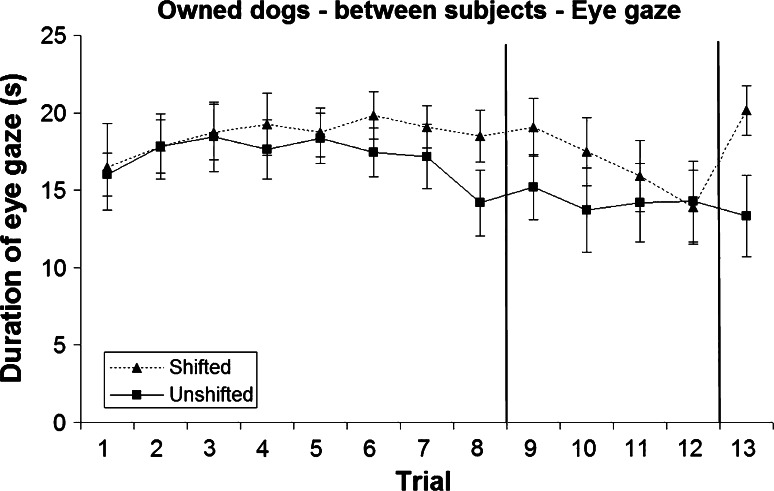
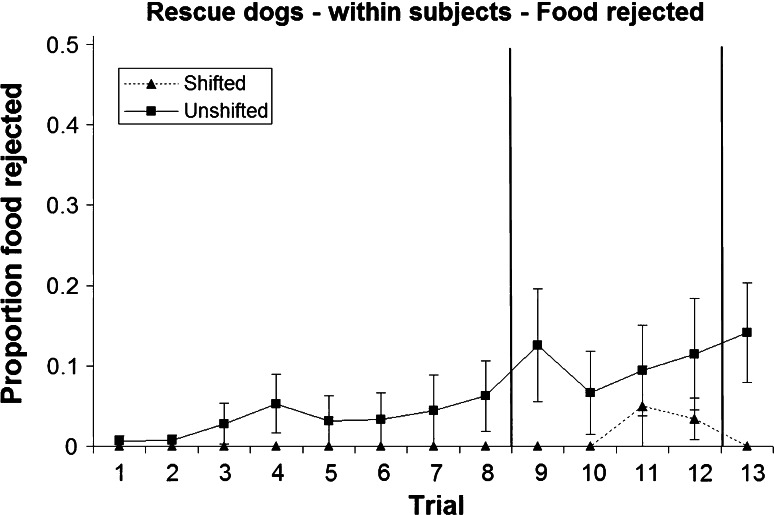
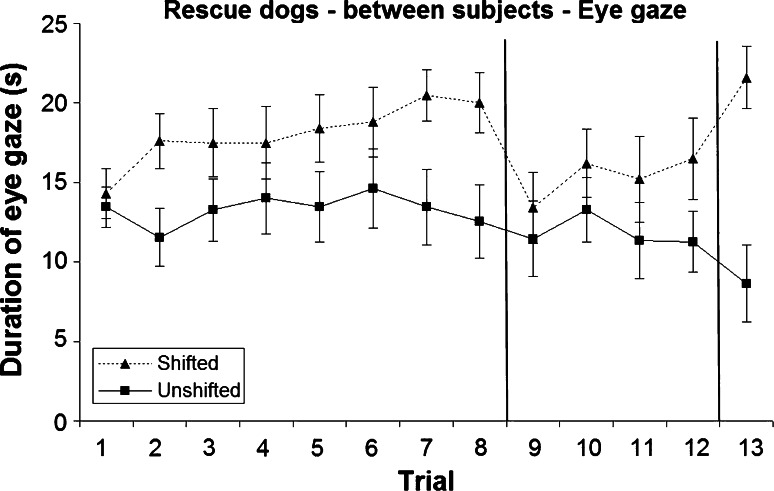
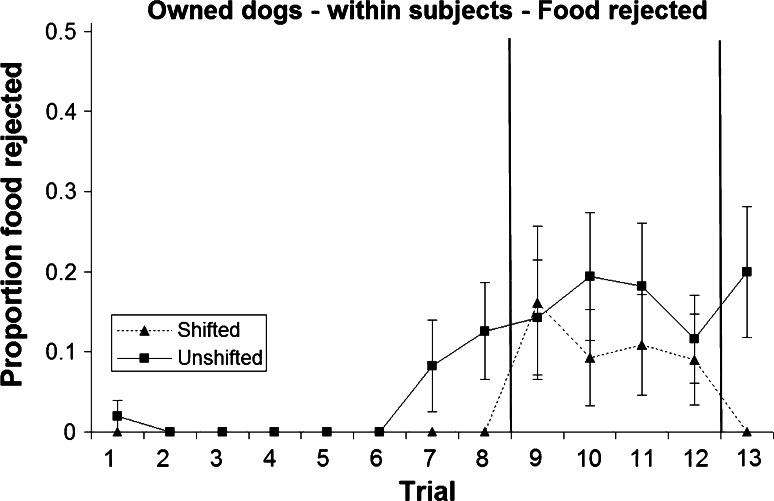
When an anticipated food reward is unexpectedly reduced in quality or quantity, many mammals show a successive negative contrast (SNC) effect, i.e. a reduction in instrumental or consummatory responses below the level shown by control animals that have only ever received the lower-value reward. SNC effects are believed to reflect an aversive emotional state, caused by the discrepancy between the expected and the actual reward. Furthermore, how animals respond to such discrepancy has been suggested to be a sign of animals' background mood state. However, the occurrence and interpretation of SNC effects are not unequivocal, and there is a relative lack of studies conducted outside of laboratory conditions. Here, we tested two populations of domestic dogs (24 owned pet dogs and 21 dogs from rescue kennels) in a SNC paradigm following the methodology by Bentosela et al. (J Comp Psychol 123:125-130, 2009), using a design that allowed a within-, as well as a between-, subjects analysis. We found no evidence of a SNC effect in either population using a within- or between-subjects design. Indeed, the within-subjects analysis revealed a reverse SNC effect, with subjects in the shifted condition showing a significantly higher level of response, even after they received an unexpected reduction in reward quality. Using a within-, rather than a between-, subjects design may be beneficial in studies of SNC due to higher sensitivity and statistical power; however, order effects on subject performance need to be considered. These results suggest that this particular SNC paradigm may not be sufficiently robust to replicate easily in a range of environmental contexts and populations.
当预期的食物奖励在质量或数量上意外减少时,许多哺乳动物会表现出连续负对比(SNC)效应,即工具性反应或消费性反应低于仅接受较低价值奖励的对照动物所表现出的水平。SNC效应被认为反映了一种厌恶情绪状态,由预期奖励与实际奖励之间的差异引起。此外,动物对这种差异的反应方式被认为是动物背景情绪状态的一个标志。然而,SNC效应的发生和解释并不明确,并且在实验室条件之外进行的研究相对较少。在此,我们按照本托塞拉等人(《比较心理学杂志》123:125 - 130,2009年)的方法,采用一种允许进行受试者内和受试者间分析的设计,在SNC范式中对两组家犬(24只家养宠物犬和21只来自救助 kennels 的犬)进行了测试。我们发现,在使用受试者内或受试者间设计时,两组犬中均未发现SNC效应的证据。事实上,受试者内分析揭示了一种反向SNC效应,即使在奖励质量意外降低后,处于奖励变化条件下的受试者仍表现出显著更高的反应水平。在SNC研究中,使用受试者内而非受试者间设计可能更具优势,因为其具有更高的敏感性和统计效力;然而,需要考虑顺序效应对受试者表现的影响。这些结果表明,这种特定的SNC范式可能不够稳健,难以在一系列环境背景和群体中轻易复制。