Center for Brain, Behavior, and Cognition, Pennsylvania State University, University Park PA, USA ; Department of Ecosystem Science and Management, Pennsylvania State University, University Park PA, USA.
Front Hum Neurosci. 2013 Jul 4;7:328. doi: 10.3389/fnhum.2013.00328. eCollection 2013.
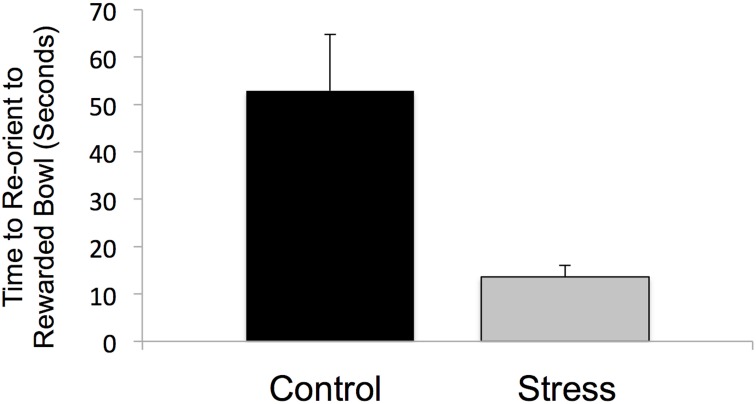
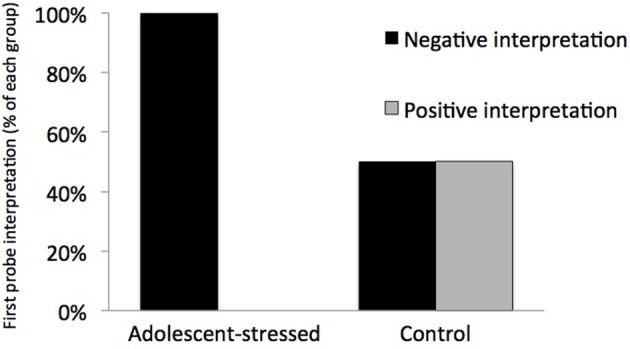
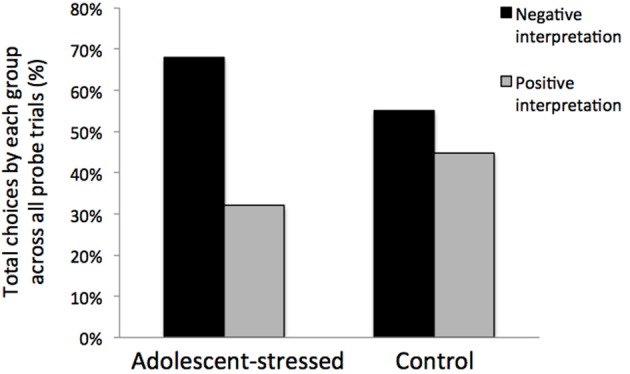
Animals that experience adverse events in early life often have life-long changes to their physiology and behavior. Long-term effects of stress during early life have been studied extensively, but less attention has been given to the consequences of negative experiences solely during the adolescent phase. Adolescence is a particularly sensitive period of life when regulation of the glucocorticoid "stress" hormone response matures and specific regions in the brain undergo considerable change. Aversive experiences during this time might, therefore, be expected to generate long-term consequences for the adult phenotype. Here we investigated the long-term effects of exposure to chronic unpredictable stress during adolescence on adult decision-making, coping response, cognitive bias, and exploratory behavior in rats. Rats exposed to chronic unpredictable stress (e.g., isolation, crowding, cage tilt) were compared to control animals that were maintained in standard, predictable conditions throughout development. Unpredictable stress during adolescence resulted in a suite of long-term behavioral and cognitive changes including a negative cognitive bias [F (1, 12) = 5.000, P < 0.05], altered coping response [T (1, 14) = 2.216, P = 0.04], and accelerated decision-making [T (1, 14) = 3.245, P = 0.01]. Exposure to chronic stress during adolescence also caused a short-term increase in boldness behaviors; in a novel object test 15 days after the last stressor, animals exposed to chronic unpredictable stress had decreased latencies to leave a familiar shelter and approach a novel object [T (1, 14) = 2.240, P = 0.04; T (1, 14) = 2.419, P = 0.03, respectively]. The results showed that stress during adolescence has long-term impacts on behavior and cognition that affect the interpretation of ambiguous stimuli, behavioral response to adverse events, and how animals make decisions.
动物在生命早期经历不良事件时,其生理和行为往往会发生终身变化。人们广泛研究了早期生活中应激的长期影响,但对仅在青春期经历负面经历的后果关注较少。青春期是生命中一个特别敏感的时期,糖皮质激素“应激”激素反应的调节成熟,大脑的特定区域发生了相当大的变化。因此,在这段时间内的不愉快经历可能会对成年表型产生长期影响。在这里,我们研究了青春期暴露于慢性不可预测应激对大鼠成年决策、应对反应、认知偏差和探索行为的长期影响。暴露于慢性不可预测应激(例如隔离、拥挤、笼子倾斜)的大鼠与在整个发育过程中保持在标准、可预测条件下的对照动物进行了比较。青春期的不可预测应激导致了一系列长期的行为和认知变化,包括负面的认知偏差[F(1,12)=5.000,P<0.05]、应对反应改变[T(1,14)=2.216,P=0.04]和决策加速[T(1,14)=3.245,P=0.01]。青春期暴露于慢性应激还导致了冒险行为的短期增加;在最后一次应激源 15 天后的新物体测试中,暴露于慢性不可预测应激的动物离开熟悉的避难所并接近新物体的潜伏期缩短[T(1,14)=2.240,P=0.04;T(1,14)=2.419,P=0.03]。结果表明,青春期的应激对行为和认知有长期影响,影响对模糊刺激的解释、对不良事件的行为反应以及动物如何做出决策。