Liu Li, Liu Yuchen, Zhang Tianbiao, Wu Hanwei, Lin Muqi, Wang Chaoliang, Zhan Yonghao, Zhou Qing, Qiao Baoping, Sun Xiaojuan, Zhang Qiaoxia, Guo Xiaoqiang, Zhao Guoping, Zhang Weixing, Huang Weiren
Key Laboratory of Medical Reprogramming Technology, Shenzhen Second People's Hospital, The First Affiliated Hospital of Shenzhen University, Shenzhen, China.
Shantou University Medical College, Shantou, China.
J Exp Clin Cancer Res. 2016 Jan 8;35:3. doi: 10.1186/s13046-015-0279-6.
The synthetic biology technology which enhances the specificity and efficacy of treatment is a novel try in biomedical therapy during recent years. A high frequency of somatic mutations was shown in the human telomerase reverse transcriptase (hTERT) promoter in bladder cancer, indicating that a mutational hTERT promoter might be a tumor-specific element for bladder cancer therapy. In our study, we aimed to construct a synthetic combination module driven by a super artificial hTERT promoter and to investigate its influence on the malignant phenotypes of bladder cancer.
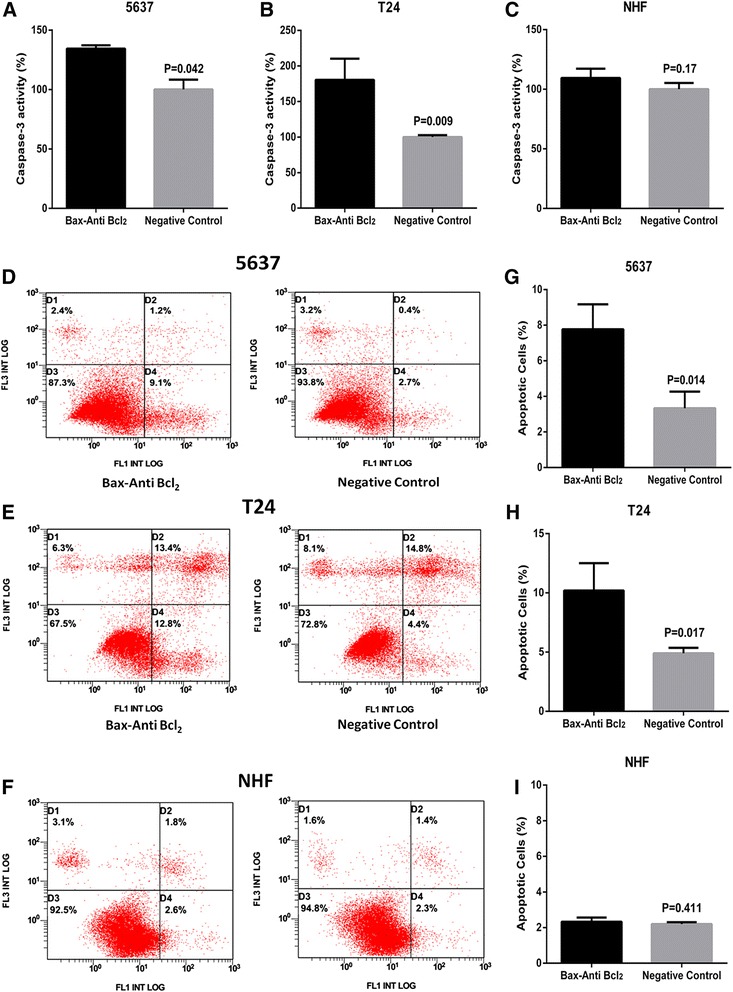
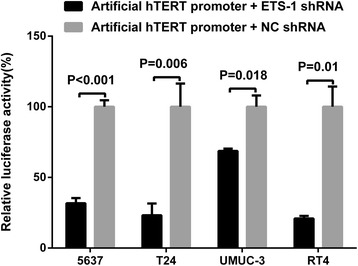
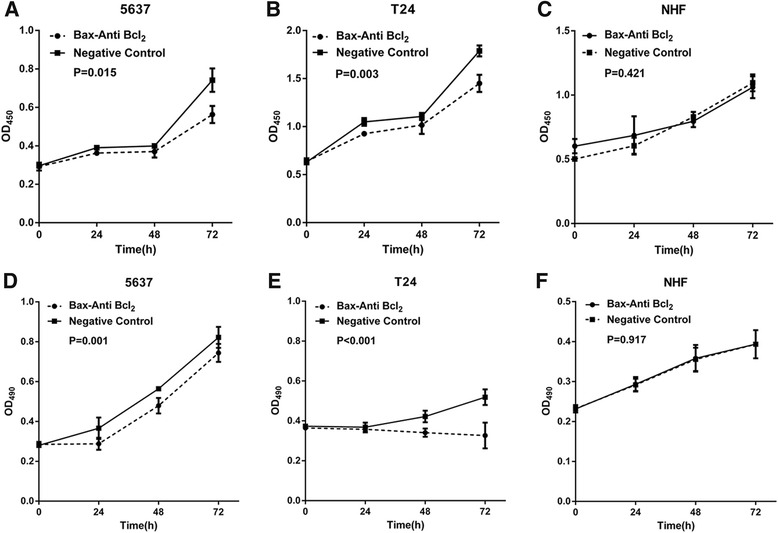
The dual luciferase assay system was used to verify the driven efficiency and tumor-specificity of the artificial hTERT promoter and to confirm the relationship between ETS-1 and the driven efficiency of the artificial hTERT promoter. CCK-8 assay and MTT assay were used to test the effects of the Bax-Anti Bcl2 combination module driven by the artificial hTERT promoter on cell proliferation. Simultaneously, the cell apoptosis was detected by the caspase 3ELISA assay and the flow cytometry analysis after transfection. The results of CCK-8 assay and MTT assay were analyzed by ANOVA. The independent samples t-test was used to analyze other data.
We demonstrated that the artificial hTERT promoter had a higher driven efficiency which might be regulated by transcription factor ETS-1 in bladder cancer cells, compared with wild-type hTERT promoter. Meanwhile, the artificial hTERT promoter showed a strong tumor-specific effect. The cell proliferation inhibition and apoptosis induction were observed in artificial hTERT promoter- Bax-Anti Bcl2 combination module -transfected bladder cancer 5637 and T24 cells, but not in the module -transfected normal human fibroblasts.
This module offers us a useful synthetic biology platform to inhibit the malignant phenotypes of bladder cancer in a more specific and effective way.
增强治疗特异性和疗效的合成生物学技术是近年来生物医学治疗中的一种新尝试。膀胱癌中人类端粒酶逆转录酶(hTERT)启动子存在高频体细胞突变,表明突变的hTERT启动子可能是膀胱癌治疗的肿瘤特异性元件。在我们的研究中,旨在构建由超级人工hTERT启动子驱动的合成组合模块,并研究其对膀胱癌恶性表型的影响。
采用双荧光素酶检测系统验证人工hTERT启动子的驱动效率和肿瘤特异性,并确认ETS-1与人工hTERT启动子驱动效率之间的关系。采用CCK-8法和MTT法检测人工hTERT启动子驱动的Bax-Anti Bcl2组合模块对细胞增殖的影响。同时,转染后通过caspase 3 ELISA检测和流式细胞术分析检测细胞凋亡。CCK-8法和MTT法的结果采用方差分析。其他数据采用独立样本t检验进行分析。
我们证明,与野生型hTERT启动子相比,人工hTERT启动子在膀胱癌细胞中具有更高的驱动效率,这可能受转录因子ETS-1调控。同时,人工hTERT启动子显示出强烈的肿瘤特异性效应。在转染了人工hTERT启动子-Bax-Anti Bcl2组合模块的膀胱癌5637和T24细胞中观察到细胞增殖抑制和凋亡诱导,但在转染该模块的正常人成纤维细胞中未观察到。
该模块为我们提供了一个有用的合成生物学平台,以更特异性和有效地抑制膀胱癌的恶性表型。