Dáder Beatriz, Fereres Alberto, Moreno Aránzazu, Trębicki Piotr
Institute of Agricultural Sciences. Spanish National Research Council. Calle Serrano 115 dpdo, 28006 Madrid, Spain.
Grains Innovation Park. Department of Economic Development, Jobs, Transport and Resources. 110 Natimuk Road, Horsham VIC 3400, Australia.
Sci Rep. 2016 Jan 8;6:19120. doi: 10.1038/srep19120.
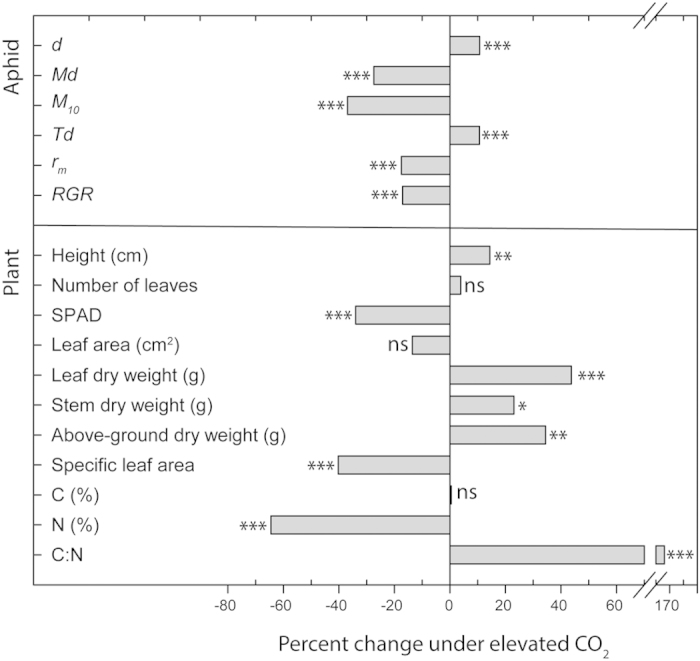
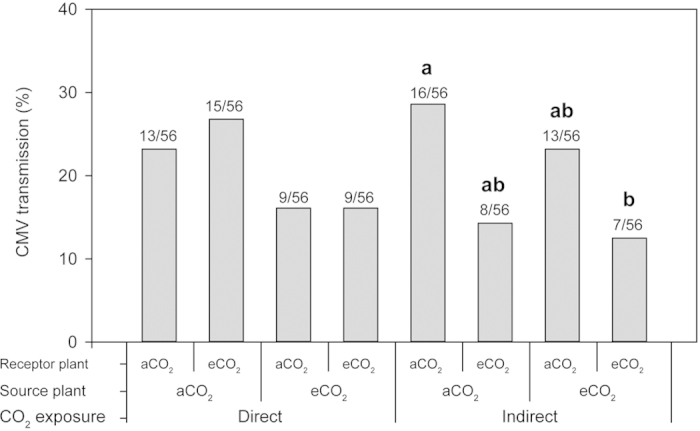
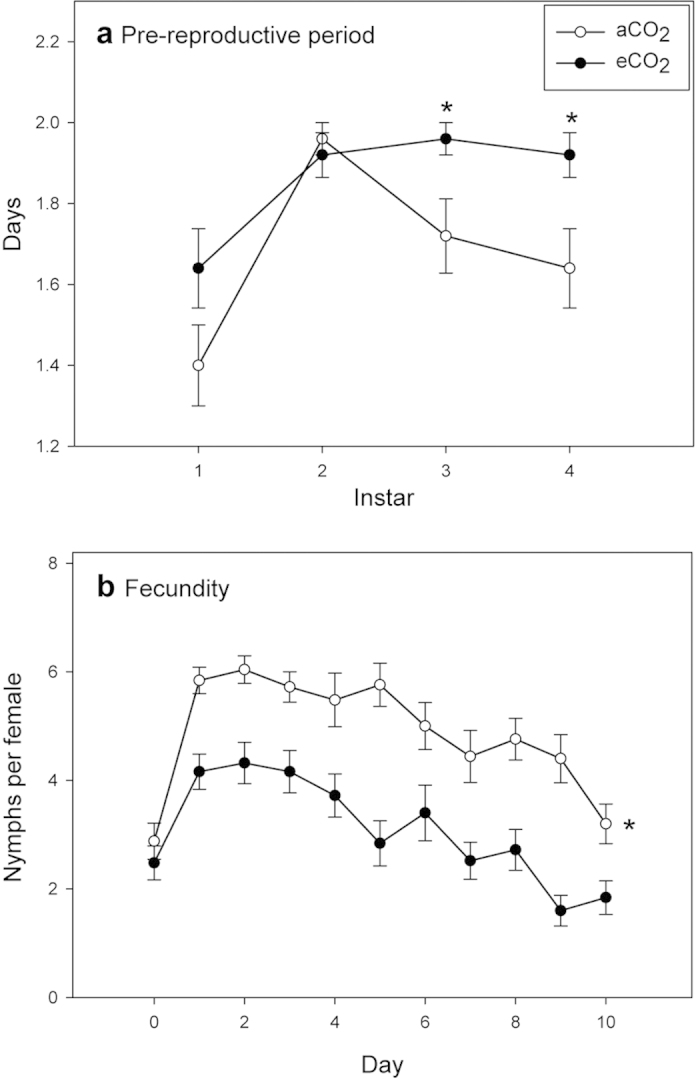
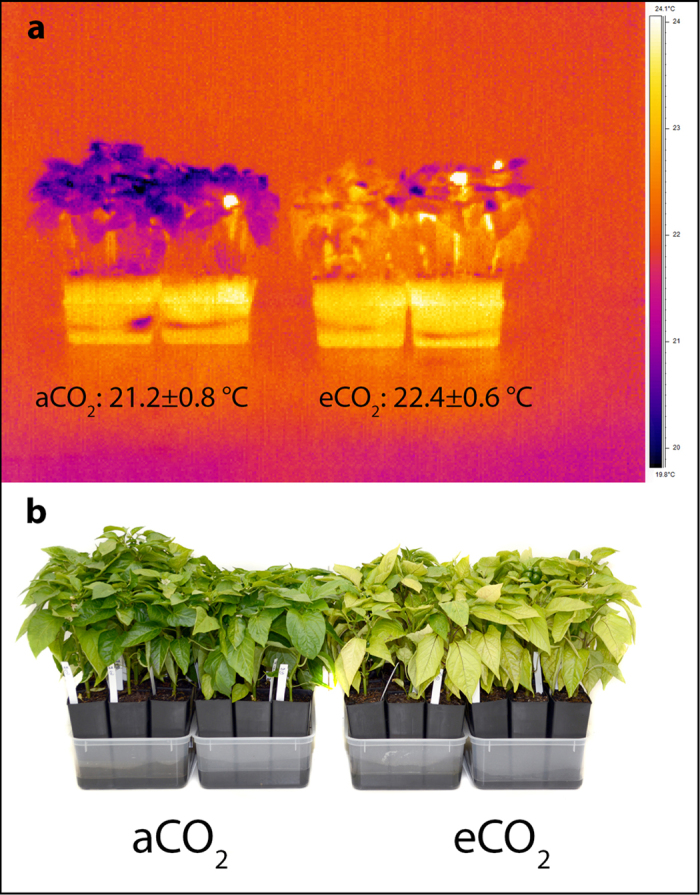
Increasing atmospheric carbon dioxide (CO2) impacts plant growth and metabolism. Indirectly, the performance and feeding of insects is affected by plant nutritional quality and resistance traits. Life history and feeding behaviour of Myzus persicae were studied on pepper plants under ambient (aCO2, 400 ppm) or elevated CO2 (eCO2, 650 ppm), as well as the direct impact on plant growth and leaf chemistry. Plant parameters were significantly altered by eCO2 with a negative impact on aphid's life history. Their pre-reproductive period was 11% longer and fecundity decreased by 37%. Peppers fixed significantly less nitrogen, which explains the poor aphid performance. Plants were taller and had higher biomass and canopy temperature. There was decreased aphid salivation into sieve elements, but no differences in phloem ingestion, indicating that the diminished fitness could be due to poorer tissue quality and unfavourable C:N balance, and that eCO2 was not a factor impeding feeding. Aphid ability to transmit Cucumber mosaic virus (CMV) was studied by exposing source and receptor plants to ambient (427 ppm) or elevated (612 ppm) CO2 before or after virus inoculation. A two-fold decrease on transmission was observed when receptor plants were exposed to eCO2 before aphid inoculation when compared to aCO2.
大气中二氧化碳(CO₂)浓度的增加会影响植物的生长和代谢。间接而言,昆虫的表现和取食会受到植物营养品质和抗性特征的影响。本研究探讨了在环境二氧化碳浓度(aCO₂,400 ppm)或升高的二氧化碳浓度(eCO₂,650 ppm)条件下,烟蚜在辣椒植株上的生活史和取食行为,以及二氧化碳浓度升高对植物生长和叶片化学性质的直接影响。eCO₂显著改变了植物参数,对蚜虫的生活史产生了负面影响。它们的繁殖前期延长了11%,繁殖力下降了37%。辣椒固定的氮显著减少,这解释了蚜虫表现不佳的原因。植株更高,生物量和冠层温度更高。蚜虫向筛管分子中的唾液分泌减少,但韧皮部取食没有差异,这表明适合度降低可能是由于组织质量较差和碳氮平衡不利,且eCO₂不是阻碍取食的因素。通过在病毒接种之前或之后,将源植物和受体植物暴露于环境二氧化碳浓度(427 ppm)或升高的二氧化碳浓度(612 ppm),研究了蚜虫传播黄瓜花叶病毒(CMV)的能力。与aCO₂相比,当受体植物在蚜虫接种前暴露于eCO₂时,观察到传播率下降了两倍。