Kohrs Christin, Angenstein Nicole, Brechmann André
Special lab Non-invasive Brain Imaging, Leibniz Institute for Neurobiology, Magdeburg, Germany.
PLoS One. 2016 Jan 8;11(1):e0146250. doi: 10.1371/journal.pone.0146250. eCollection 2016.
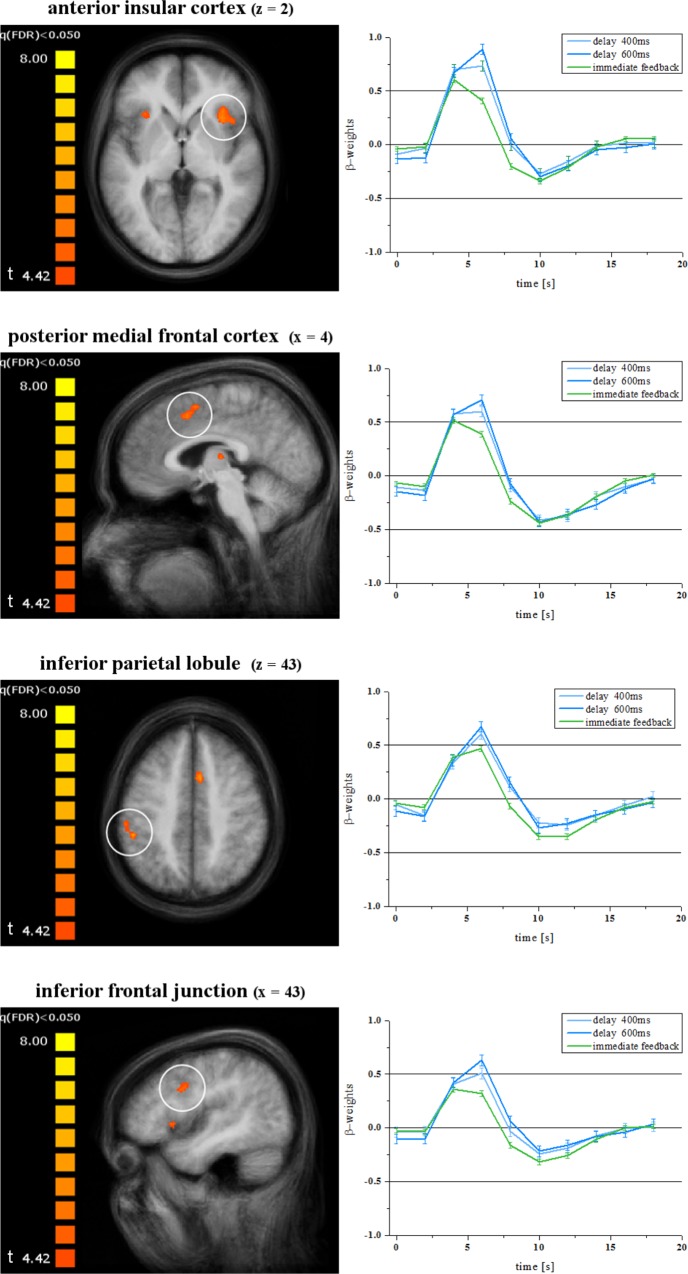
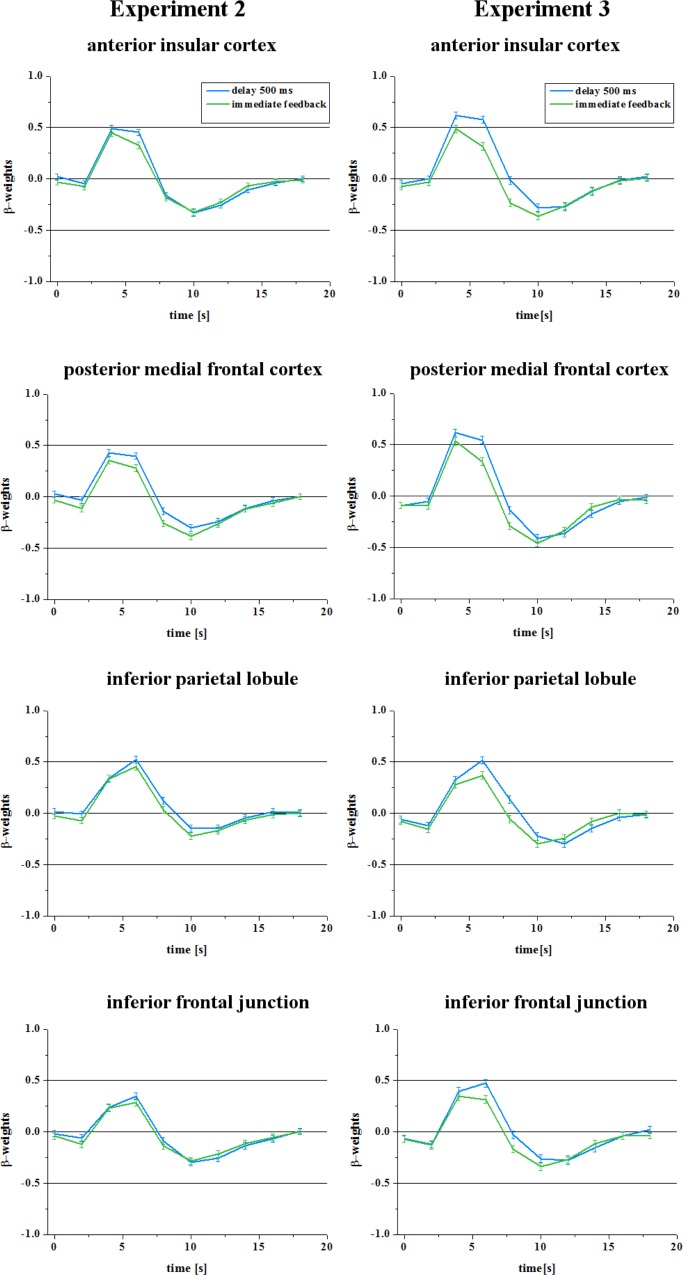
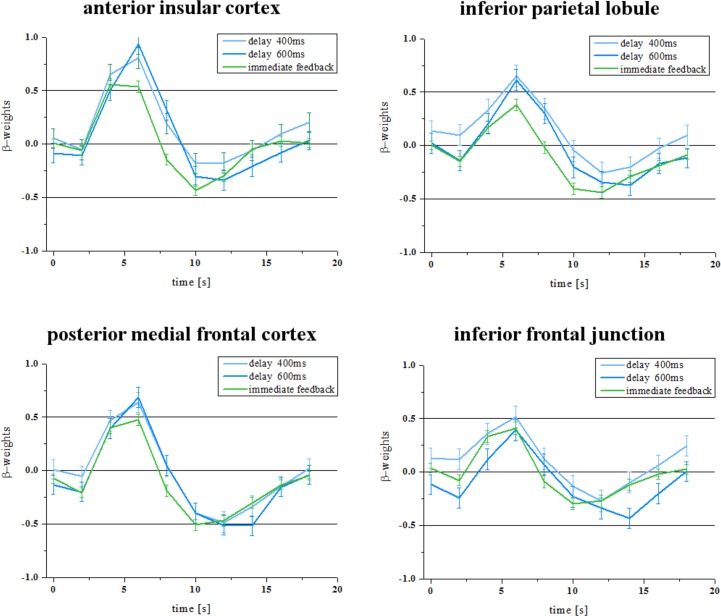
The temporal contingency of feedback is an essential requirement of successful human-computer interactions. The timing of feedback not only affects the behavior of a user but is also accompanied by changes in psychophysiology and neural activity. In three fMRI experiments we systematically studied the impact of delayed feedback on brain activity while subjects performed an auditory categorization task. In the first fMRI experiment, we analyzed the effects of rare and thus unexpected delays of different delay duration on brain activity. In the second experiment, we investigated if users can adapt to frequent delays. Therefore, delays were presented as often as immediate feedback. In a third experiment, the influence of interaction outage was analyzed by measuring the effect of infrequent omissions of feedback on brain activity. The results show that unexpected delays in feedback presentation compared to immediate feedback stronger activate inter alia bilateral the anterior insular cortex, the posterior medial frontal cortex, the left inferior parietal lobule and the right inferior frontal junction. The strength of this activation increases with the duration of the delay. Thus, delays interrupt the course of an interaction and trigger an orienting response that in turn activates brain regions of action control. If delays occur frequently, users can adapt, delays become expectable, and the brain activity in the observed network diminishes over the course of the interaction. However, introducing rare omissions of expected feedback reduces the system's trustworthiness which leads to an increase in brain activity not only in response to such omissions but also following frequently occurring and thus expected delays.
反馈的时间偶然性是成功的人机交互的一项基本要求。反馈的时机不仅会影响用户的行为,还会伴随着心理生理学和神经活动的变化。在三项功能磁共振成像(fMRI)实验中,我们系统地研究了延迟反馈对大脑活动的影响,实验中受试者执行一项听觉分类任务。在第一个fMRI实验中,我们分析了不同延迟时长的罕见且意外的延迟对大脑活动的影响。在第二个实验中,我们研究了用户是否能够适应频繁的延迟。因此,延迟反馈与即时反馈出现的频率相同。在第三个实验中,通过测量不频繁的反馈缺失对大脑活动的影响,分析了交互中断的影响。结果表明,与即时反馈相比,反馈呈现中的意外延迟尤其会更强地激活双侧前脑岛皮质、后内侧额叶皮质、左侧顶下小叶和右侧额下交界区。这种激活的强度会随着延迟时长的增加而增强。因此,延迟会中断交互过程并引发定向反应,进而激活动作控制的脑区。如果延迟频繁发生,用户能够适应,延迟变得可预期,并且在交互过程中观察到的网络中的大脑活动会减弱。然而,引入预期反馈的罕见缺失会降低系统的可信度,这不仅会导致在出现此类缺失时大脑活动增加,还会在频繁出现且因此可预期的延迟之后导致大脑活动增加。