Kivi Gaily, Teesalu Kaupo, Parik Jüri, Kontkar Elen, Ustav Mart, Noodla Liis, Ustav Mart, Männik Andres
Icosagen Cell Factory OÜ, Eerika tee 1, Õssu village, Ülenurme parish, Tartumaa, 61713, Estonia.
University of Tartu, Institute of Technology, Nooruse1, Tartu, 50411, Estonia.
BMC Biotechnol. 2016 Jan 8;16:2. doi: 10.1186/s12896-016-0232-6.
The production of recombinant monoclonal antibodies in mammalian cell culture is of high priority in research and medical fields. A critical step in this process is the isolation of the antigen-binding domain sequences of antibodies possessing the desired properties. Many different techniques have been described to achieve this goal, but all have shortcomings; most techniques have problems with robustness, are time-consuming and costly, or have complications in the transfer from isolation to production phase. Here, we report a novel HybriFree technology for the development of monoclonal antibodies from different species that is robust, rapid, inexpensive and flexible and can be used for the subsequent production of antibodies in mammalian cell factories.
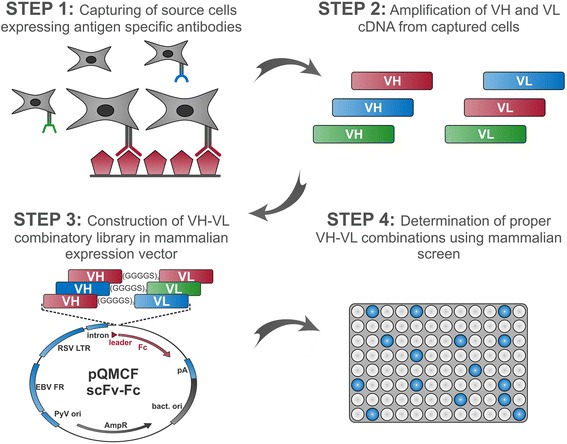
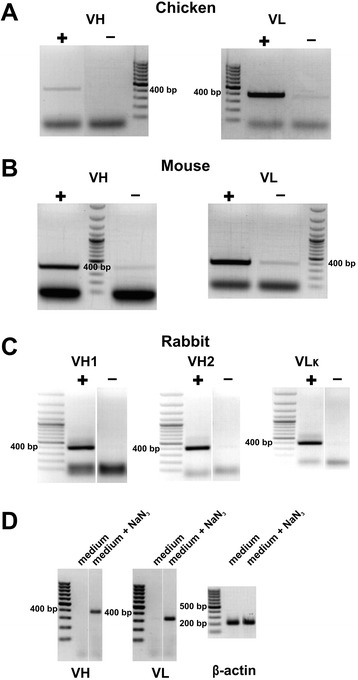
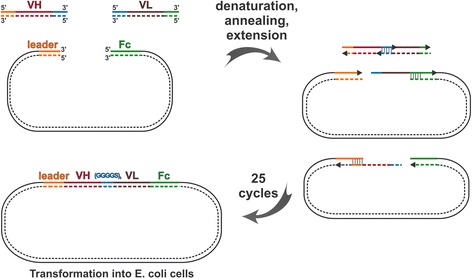
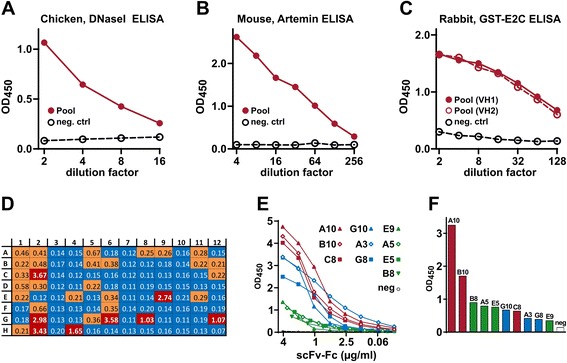
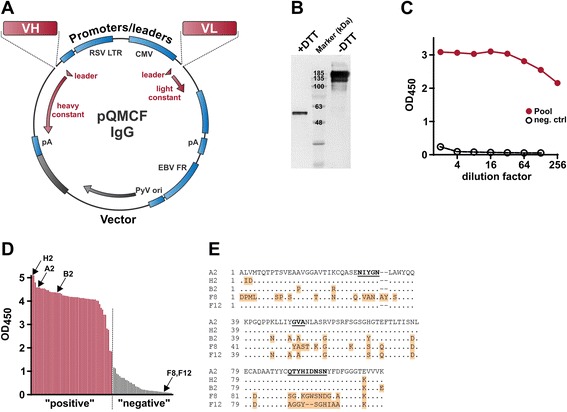
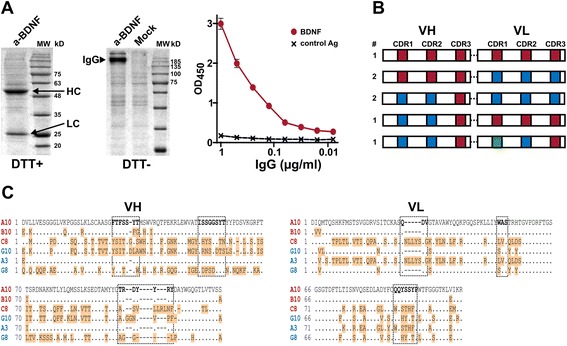
HybriFree technology is illustrated herein via detailed examples of isolating mouse, rabbit and chicken monoclonal antibody sequences from immunized animals. Starting from crude spleen samples, antigen capturing of specific B-cells is performed initially. cDNA of antibody variable domains is amplified from the captured cells and used a source material for simple and rapid restriction/ligation free cloning of expression vector library in order to produce scFv-Fc or intact IgG antibodies. The vectors can be directly used for screening purposes as well as for the subsequent production of the developed monoclonal antibodies in mammalian cell culture. The antibodies isolated by the method have been shown to be functional in different immunoassays, including ELISA, immunofluorescence and Western blot. In addition, we demonstrate that by using a modified method including a negative selection step, we can isolate specific antibodies targeting the desired epitope and eliminate antibodies directed to undesired off-targets.
HybriFree can be used for the reliable development of monoclonal antibodies and their subsequent production in mammalian cells. This simple protocol requires neither the culturing of B-cells nor single-cell manipulations, and only standard molecular biology laboratory equipment is needed. In principle, the method is applicable to any species for which antibody cDNA sequence information is available.
在研究和医学领域,利用哺乳动物细胞培养生产重组单克隆抗体具有高度的优先性。这一过程中的关键步骤是分离具有所需特性的抗体的抗原结合域序列。为实现这一目标,已描述了许多不同的技术,但都存在缺点;大多数技术在稳健性方面存在问题,耗时且成本高,或者在从分离阶段转移到生产阶段时存在并发症。在此,我们报告了一种新型的HybriFree技术,用于从不同物种开发单克隆抗体,该技术稳健、快速、廉价且灵活,可用于随后在哺乳动物细胞工厂中生产抗体。
本文通过从免疫动物中分离小鼠、兔和鸡单克隆抗体序列的详细实例说明了HybriFree技术。从粗脾样本开始,首先进行特异性B细胞的抗原捕获。从捕获的细胞中扩增抗体可变域的cDNA,并将其用作表达载体文库简单快速的无限制/连接克隆的原材料,以生产单链抗体片段-免疫球蛋白(scFv-Fc)或完整的IgG抗体。这些载体可直接用于筛选目的,以及随后在哺乳动物细胞培养中生产所开发的单克隆抗体。通过该方法分离的抗体已在包括酶联免疫吸附测定(ELISA)、免疫荧光和蛋白质免疫印迹(Western blot)等不同免疫测定中显示出功能。此外,我们证明通过使用包括阴性选择步骤的改良方法,我们可以分离靶向所需表位的特异性抗体,并消除针对不需要的脱靶的抗体。
HybriFree可用于可靠地开发单克隆抗体及其随后在哺乳动物细胞中的生产。这个简单的方案既不需要培养B细胞,也不需要单细胞操作,只需要标准的分子生物学实验室设备。原则上,该方法适用于任何有抗体cDNA序列信息的物种。