Reichelt Robert, Gindner Antonia, Thomm Michael, Hausner Winfried
Lehrstuhl für Mikrobiologie und Archaeenzentrum, Universität Regensburg, Universitätsstrasse 31, Regensburg, D-93053, Germany.
BMC Genomics. 2016 Jan 8;17:40. doi: 10.1186/s12864-015-2360-0.
Several in vitro studies document the function of the transcriptional regulator TrmBL1 of Pyrococcus furiosus. These data indicate that the protein can act as repressor or activator and is mainly involved in transcriptional control of sugar uptake and in the switch between glycolysis and gluconeogenesis. The aim of this study was to complement the in vitro data with an in vivo analysis using ChIP-seq to explore the genome-wide binding profile of TrmBL1 under glycolytic and gluconeogenic growth conditions.
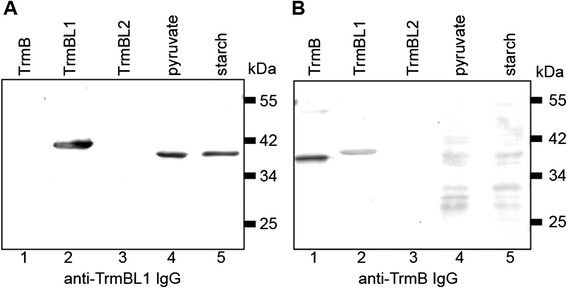
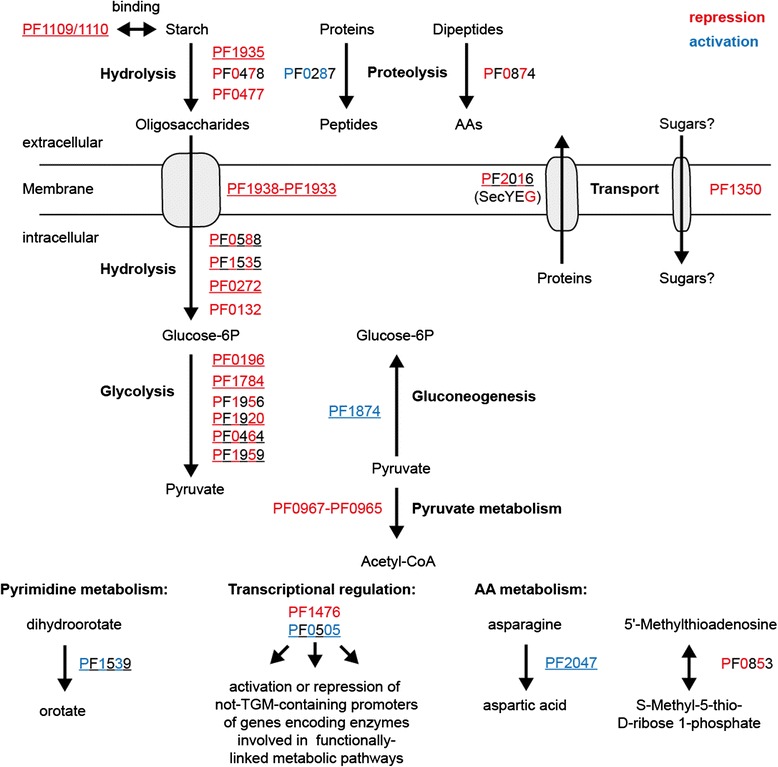
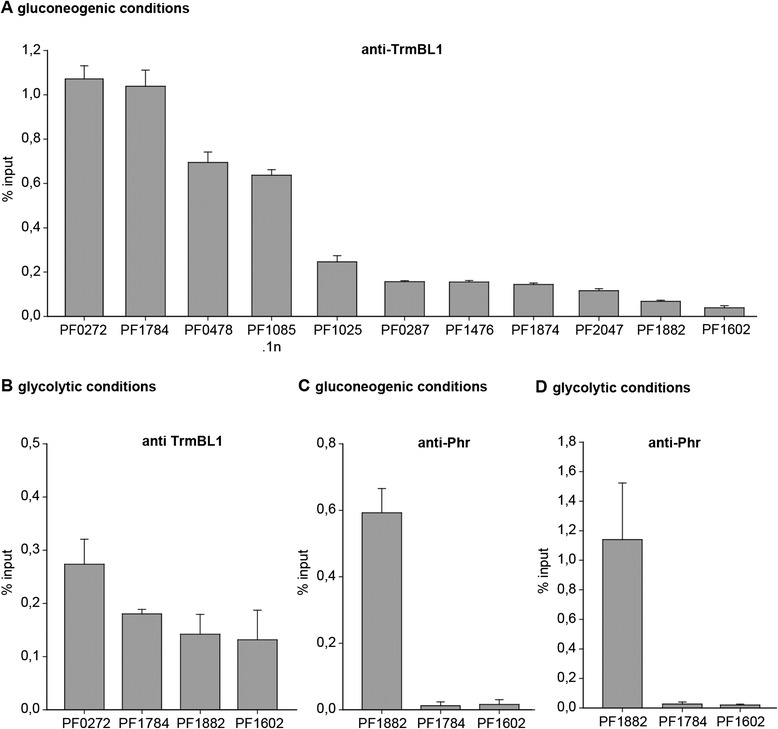
The ChIP-seq analysis revealed under gluconeogenic growth conditions 28 TrmBL1 binding sites where the TGM is located upstream of coding regions and no binding sites under glycolytic conditions. The experimental confirmation of the binding sites using qPCR, EMSA, DNase I footprinting and in vitro transcription experiments validated the in vivo identified TrmBL1 binding sites. Furthermore, this study provides evidence that TrmBL1 is also involved in transcriptional regulation of additional cellular processes e.g. amino acid metabolism, transcriptional control or metabolic pathways. In the initial setup we were interested to include the binding analysis of TrmB, an additional member of the TrmB family, but western blot experiments and the ChIP-seq data indicated that the corresponding gene is deleted in our Pyrococcus strain. A detailed analysis of a new type strain demonstrated that a 16 kb fragment containing the trmb gene is almost completely deleted after the first re-cultivation.
The identified binding sites in the P. furiosus genome classified TrmBL1 as a more global regulator as hitherto known. Furthermore, the high resolution of the mapped binding positions enabled reliable predictions, if TrmBL1 activates (binding site upstream of the promoter) or represses transcription (binding site downstream) of the corresponding genes.
多项体外研究记录了嗜热栖热菌转录调节因子TrmBL1的功能。这些数据表明,该蛋白可作为阻遏物或激活物,主要参与糖摄取的转录控制以及糖酵解和糖异生之间的转换。本研究的目的是通过染色质免疫沉淀测序(ChIP-seq)进行体内分析,以补充体外数据,从而探索TrmBL1在糖酵解和糖异生生长条件下的全基因组结合图谱。
ChIP-seq分析显示,在糖异生生长条件下有28个TrmBL1结合位点,其中TGM位于编码区上游,而在糖酵解条件下没有结合位点。使用定量聚合酶链反应(qPCR)、电泳迁移率变动分析(EMSA)、脱氧核糖核酸酶I足迹实验和体外转录实验对结合位点进行的实验验证,证实了体内鉴定的TrmBL1结合位点。此外,本研究提供了证据表明TrmBL1还参与其他细胞过程的转录调控,例如氨基酸代谢、转录控制或代谢途径。在最初的设置中,我们有意纳入TrmB家族的另一个成员TrmB的结合分析,但蛋白质免疫印迹实验和ChIP-seq数据表明,我们的嗜热栖热菌菌株中相应基因已缺失。对一种新型菌株的详细分析表明,含有trmb基因的16 kb片段在首次传代培养后几乎完全缺失。
在嗜热栖热菌基因组中鉴定出的结合位点表明,TrmBL1是一种比迄今所知更为全面的调节因子。此外,所绘制结合位置的高分辨率使得能够可靠地预测TrmBL1是激活(启动子上游的结合位点)还是抑制(下游的结合位点)相应基因的转录。