Larmuth Kate M, Masuyer Geoffrey, Douglas Ross G, Schwager Sylva L, Acharya K Ravi, Sturrock Edward D
Department of Integrative Biomedical Sciences, Institute of Infectious Disease and Molecular Medicine, University of Cape Town, South Africa.
Department of Biology and Biochemistry, University of Bath, UK.
FEBS J. 2016 Mar;283(6):1060-76. doi: 10.1111/febs.13647. Epub 2016 Feb 9.
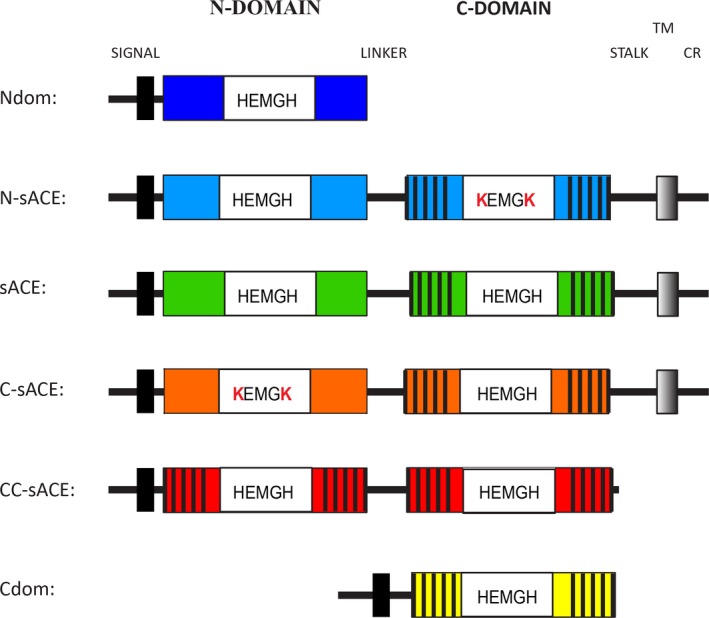
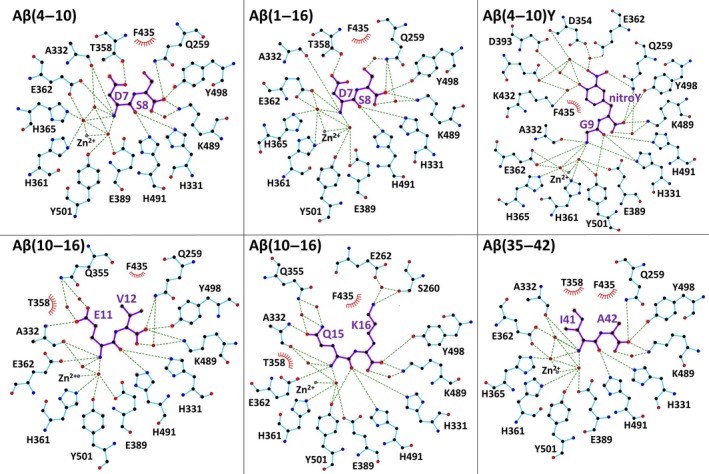
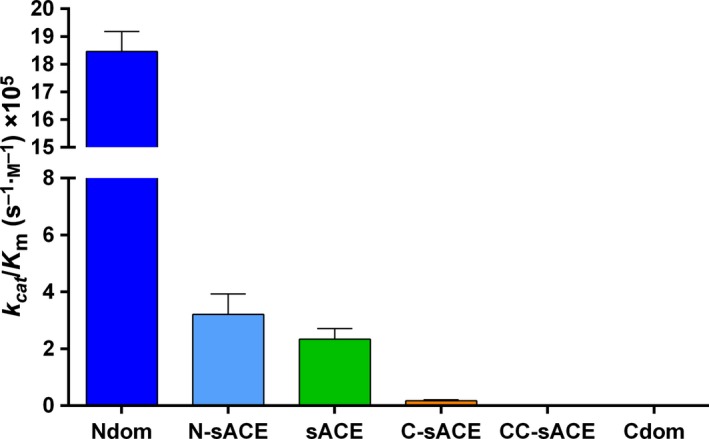
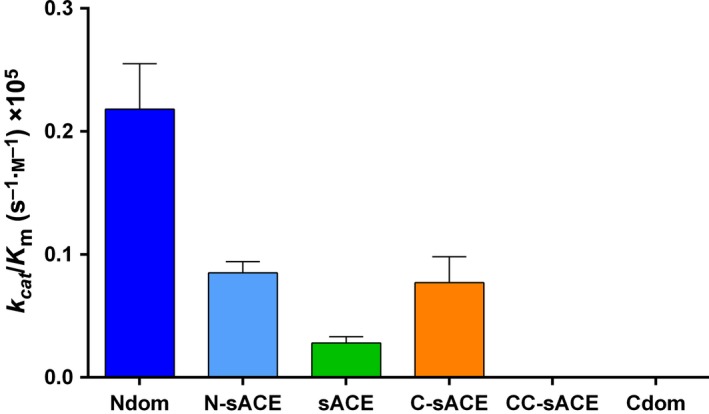
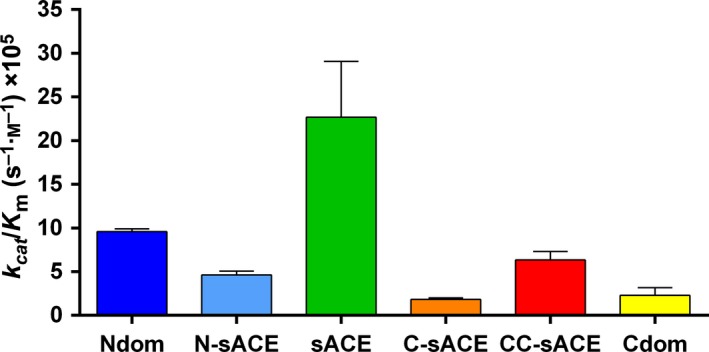
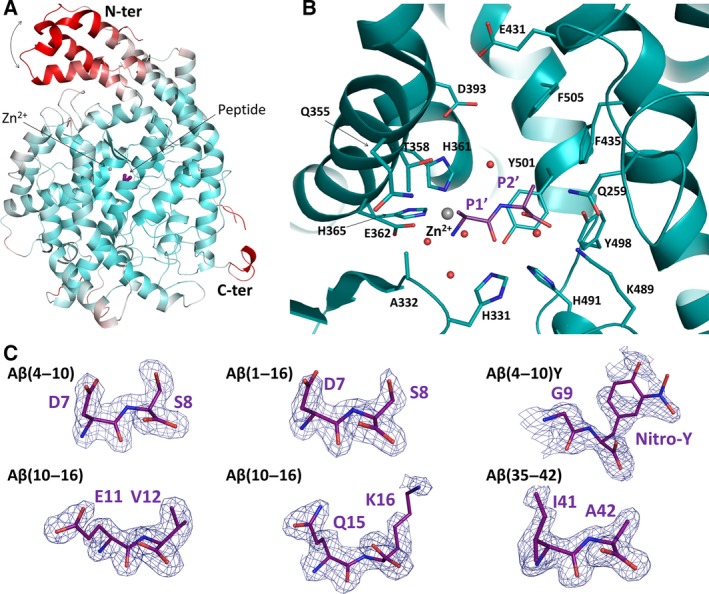
Angiotensin-1-converting enzyme (ACE), a zinc metallopeptidase, consists of two homologous catalytic domains (N and C) with different substrate specificities. Here we report kinetic parameters of five different forms of human ACE with various amyloid beta (Aβ) substrates together with high resolution crystal structures of the N-domain in complex with Aβ fragments. For the physiological Aβ(1-16) peptide, a novel ACE cleavage site was found at His14-Gln15. Furthermore, Aβ(1-16) was preferentially cleaved by the individual N-domain; however, the presence of an inactive C-domain in full-length somatic ACE (sACE) greatly reduced enzyme activity and affected apparent selectivity. Two fluorogenic substrates, Aβ(4-10)Q and Aβ(4-10)Y, underwent endoproteolytic cleavage at the Asp7-Ser8 bond with all ACE constructs showing greater catalytic efficiency for Aβ(4-10)Y. Surprisingly, in contrast to Aβ(1-16) and Aβ(4-10)Q, sACE showed positive domain cooperativity and the double C-domain (CC-sACE) construct no cooperativity towards Aβ(4-10)Y. The structures of the Aβ peptide-ACE complexes revealed a common mode of peptide binding for both domains which principally targets the C-terminal P2' position to the S2' pocket and recognizes the main chain of the P1' peptide. It is likely that N-domain selectivity for the amyloid peptide is conferred through the N-domain specific S2' residue Thr358. Additionally, the N-domain can accommodate larger substrates through movement of the N-terminal helices, as suggested by the disorder of the hinge region in the crystal structures. Our findings are important for the design of domain selective inhibitors as the differences in domain selectivity are more pronounced with the truncated domains compared to the more physiological full-length forms.
The atomic coordinates and structure factors for N-domain ACE with Aβ peptides 4-10 (5AM8), 10-16 (5AM9), 1-16 (5AMA), 35-42 (5AMB) and (4-10)Y (5AMC) complexes have been deposited in the Protein Data Bank, Research Collaboratory for Structural Bioinformatics, Rutgers University, New Brunswick, NJ, USA (http://www.rcsb.org/).
血管紧张素转换酶(ACE)是一种锌金属肽酶,由两个具有不同底物特异性的同源催化结构域(N和C)组成。在此,我们报告了五种不同形式的人ACE与各种淀粉样β(Aβ)底物的动力学参数,以及N结构域与Aβ片段复合物的高分辨率晶体结构。对于生理性Aβ(1-16)肽,在His14-Gln15处发现了一个新的ACE切割位点。此外,Aβ(1-16)优先被单个N结构域切割;然而,全长体细胞ACE(sACE)中无活性的C结构域的存在大大降低了酶活性并影响了表观选择性。两种荧光底物Aβ(4-10)Q和Aβ(4-10)Y在Asp7-Ser8键处进行内切蛋白水解切割,所有ACE构建体对Aβ(4-10)Y均表现出更高的催化效率。令人惊讶的是,与Aβ(1-16)和Aβ(4-10)Q相反,sACE表现出正结构域协同性,而双C结构域(CC-sACE)构建体对Aβ(4-10)Y没有协同性。Aβ肽-ACE复合物的结构揭示了两个结构域共同的肽结合模式,该模式主要将C末端P2'位置靶向S2'口袋并识别P1'肽的主链。淀粉样肽的N结构域选择性可能是通过N结构域特异性的S2'残基Thr358赋予的。此外,如晶体结构中铰链区的无序所示,N结构域可以通过N末端螺旋的移动容纳更大的底物。我们的发现对于结构域选择性抑制剂的设计很重要,因为与更接近生理状态的全长形式相比,截短结构域的结构域选择性差异更为明显。
N结构域ACE与Aβ肽4-10(5AM8)、10-16(5AM9)、1-16(5AMA)、35-42(5AMB)和(4-10)Y(5AMC)复合物的原子坐标和结构因子已存入美国新泽西州新不伦瑞克市罗格斯大学结构生物信息学研究合作实验室的蛋白质数据库(http://www.rcsb.org/)。