Hemsley A, Arnheim N, Toney M D, Cortopassi G, Galas D J
Department of Molecular Biology, University of Southern California, Los Angeles 90089-1340.
Nucleic Acids Res. 1989 Aug 25;17(16):6545-51. doi: 10.1093/nar/17.16.6545.
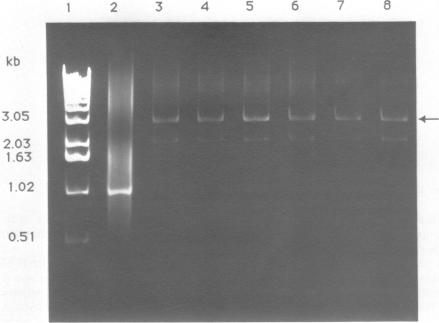
We have developed a general and simple method for directing specific sequence changes in a plasmid using primed amplification by the polymerase chain reaction (PCR). The method is based on the amplification of the entire plasmid using primers that include the desired changes. The method is rapid, simple in its execution, and requires only minute amounts of plasmid template DNA. It is significant that there are no special requirements for appropriately placed restriction sites in the sequence to be manipulated. In our system the yield of transformants was high and the fraction of them harboring plasmids with only the desired change was consistently about 80%. The generality of the method should make it useful for the direct alteration of most cloned genes. The only limitation may be the total length of the plasmid to be manipulated. During the study we found that the Taq DNA polymerase used for PCR adds on a single extra base (usually an A) at the end of a large fraction of the newly synthesized chains. These had to be removed by the Klenow fragment of DNA polymerase to insure restoration of the gene sequence.
我们开发了一种通用且简单的方法,利用聚合酶链反应(PCR)引发的扩增来指导质粒中的特定序列变化。该方法基于使用包含所需变化的引物对整个质粒进行扩增。此方法快速、操作简单,仅需微量的质粒模板DNA。值得注意的是,对于待操作序列中适当位置的限制性酶切位点没有特殊要求。在我们的系统中,转化子的产量很高,其中仅含有所需变化质粒的比例始终约为80%。该方法的通用性使其可用于大多数克隆基因的直接改造。唯一的限制可能是待操作质粒的总长度。在研究过程中我们发现,用于PCR的Taq DNA聚合酶会在很大一部分新合成链的末端额外添加一个碱基(通常是A)。必须通过DNA聚合酶的Klenow片段将这些碱基去除,以确保基因序列的恢复。