Moon Jae-Su, Lee Seung-Hoon, Kim Eun-Jung, Cho Hee, Lee Wooseong, Kim Geon-Woo, Park Hyun-Ji, Cho Seung-Woo, Lee Choongho, Oh Jong-Won
Department of Biotechnology, Yonsei University, 50 Yonsei-ro, Seodaemun-gu, Seoul 120-749, Korea.
College of Pharmacy, Dongguk University, Goyang 410-820, Korea.
PLoS One. 2016 Jan 11;11(1):e0146710. doi: 10.1371/journal.pone.0146710. eCollection 2016.
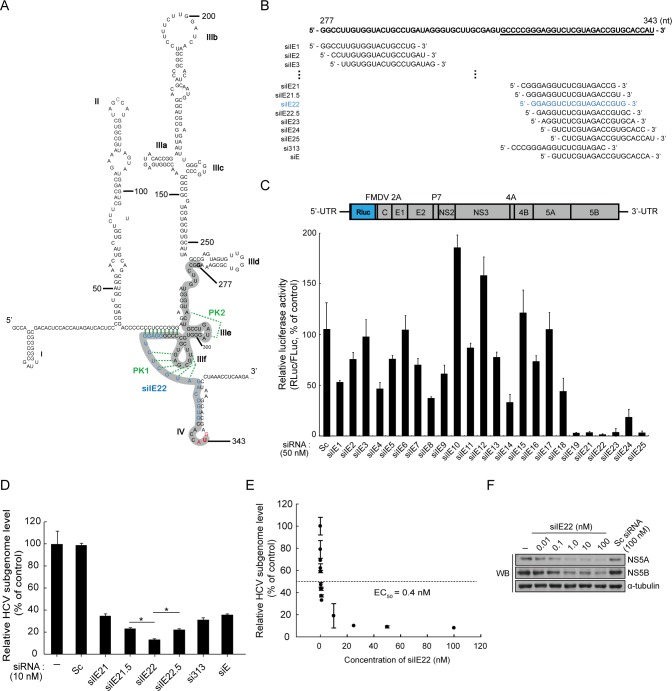
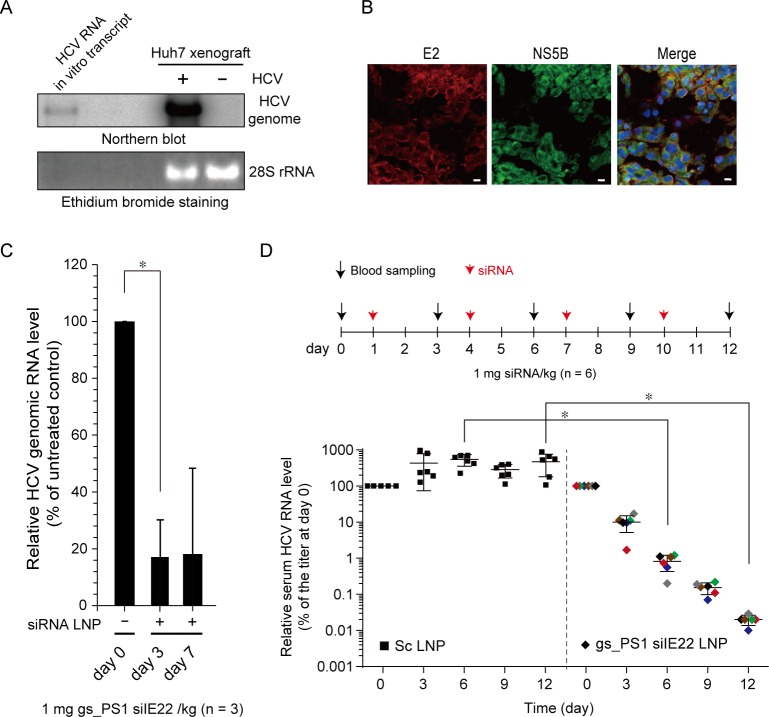
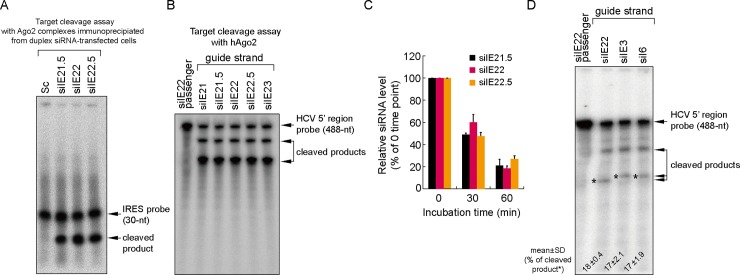
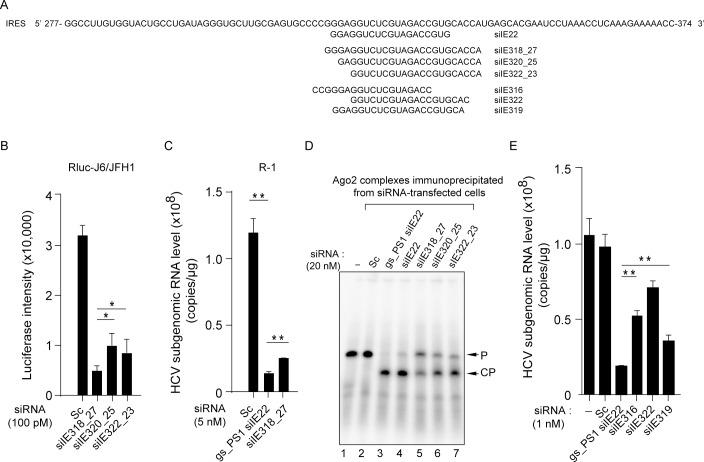
The hepatitis C virus (HCV) internal ribosome entry site (IRES) that directs cap-independent viral translation is a primary target for small interfering RNA (siRNA)-based HCV antiviral therapy. However, identification of potent siRNAs against HCV IRES by bioinformatics-based siRNA design is a challenging task given the complexity of HCV IRES secondary and tertiary structures and association with multiple proteins, which can also dynamically change the structure of this cis-acting RNA element. In this work, we utilized siRNA tiling approach whereby siRNAs were tiled with overlapping sequences that were shifted by one or two nucleotides over the HCV IRES stem-loop structures III and IV spanning nucleotides (nts) 277-343. Based on their antiviral activity, we mapped a druggable region (nts 313-343) where the targets of potent siRNAs were enriched. siIE22, which showed the greatest anti-HCV potency, targeted a highly conserved sequence across diverse HCV genotypes, locating within the IRES subdomain IIIf involved in pseudoknot formation. Stepwise target shifting toward the 5' or 3' direction by 1 or 2 nucleotides reduced the antiviral potency of siIE22, demonstrating the importance of siRNA accessibility to this highly structured and sequence-conserved region of HCV IRES for RNA interference. Nanoparticle-mediated systemic delivery of the stability-improved siIE22 derivative gs_PS1 siIE22, which contains a single phosphorothioate linkage on the guide strand, reduced the serum HCV genome titer by more than 4 log10 in a xenograft mouse model for HCV replication without generation of resistant variants. Our results provide a strategy for identifying potent siRNA species against a highly structured RNA target and offer a potential pan-HCV genotypic siRNA therapy that might be beneficial for patients resistant to current treatment regimens.
丙型肝炎病毒(HCV)的内部核糖体进入位点(IRES)可指导不依赖帽结构的病毒翻译,是基于小干扰RNA(siRNA)的HCV抗病毒治疗的主要靶点。然而,鉴于HCV IRES二级和三级结构的复杂性以及与多种蛋白质的关联,通过基于生物信息学的siRNA设计来鉴定针对HCV IRES的有效siRNA是一项具有挑战性的任务,这些蛋白质也会动态改变这种顺式作用RNA元件的结构。在这项研究中,我们采用了siRNA平铺方法,即通过重叠序列将siRNA平铺在跨越核苷酸(nt)277 - 343的HCV IRES茎环结构III和IV上,重叠序列每次移动一个或两个核苷酸。基于它们的抗病毒活性,我们绘制了一个可成药区域(nt 313 - 343),有效siRNA的靶点在该区域富集。siIE22表现出最大的抗HCV效力,它靶向不同HCV基因型间高度保守的序列,位于参与假结形成的IRES亚结构域IIIf内。将靶点向5'或3'方向逐步移动1个或2个核苷酸会降低siIE22的抗病毒效力,这表明siRNA进入HCV IRES这个高度结构化且序列保守区域对于RNA干扰的重要性。纳米颗粒介导的稳定性增强的siIE22衍生物gs_PS1 siIE22(其引导链上含有一个硫代磷酸酯键)的全身递送,在HCV复制的异种移植小鼠模型中使血清HCV基因组滴度降低了超过4个对数10,且未产生抗性变体。我们的结果提供了一种针对高度结构化RNA靶点鉴定有效siRNA种类的策略,并提供了一种潜在的泛HCV基因型siRNA疗法,这可能对当前治疗方案耐药的患者有益。