Amitsur M, Morad I, Kaufmann G
Biochemistry Department, Tel Aviv University, Israel.
EMBO J. 1989 Aug;8(8):2411-5. doi: 10.1002/j.1460-2075.1989.tb08371.x.
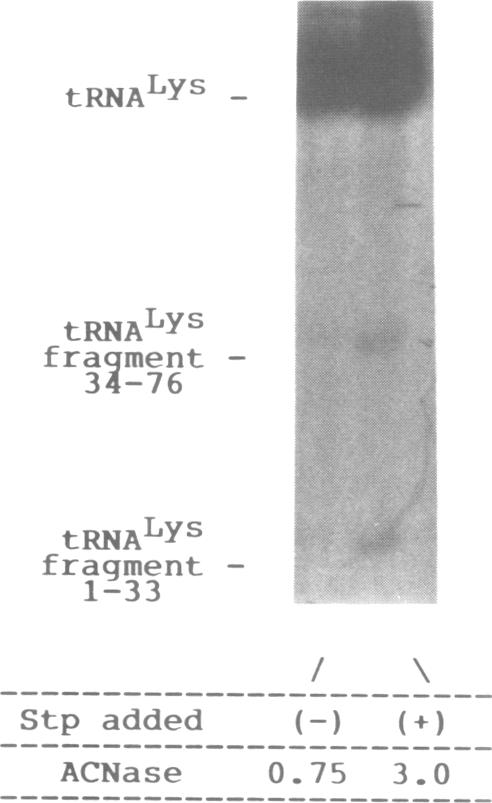
During phage T4 infection of Escherichia coli strains containing the prr locus the host tRNALys undergoes cleavage-ligation in reactions catalyzed by anticodon nuclease, polynucleotide kinase and RNA ligase. Known genetic determinants of anticodon nuclease are prr, which restricts T4 mutants lacking polynucleotide kinase or RNA ligase, and stp, the T4 suppressor of prr encoded restriction. The present communication describes an in vitro anticodon nuclease assay in which the specific cleavage of tRNALys is driven by an extract from E. coli prrr (restrictive) cells infected by phage T4. The in vitro anticodon nuclease reaction requires factor(s) encoded by prr, is stimulated by a synthetic Stp polypeptide and appears to require additional T4 induced factor(s) distinct from Stp.
在噬菌体T4感染含有prr基因座的大肠杆菌菌株时,宿主tRNALys在反密码子核酸酶、多核苷酸激酶和RNA连接酶催化的反应中发生切割-连接。反密码子核酸酶已知的遗传决定因素是prr,它限制缺乏多核苷酸激酶或RNA连接酶的T4突变体,以及stp,即prr编码限制的T4抑制子。本通讯描述了一种体外反密码子核酸酶测定法,其中tRNALys的特异性切割由受噬菌体T4感染的大肠杆菌prrr(限制性)细胞提取物驱动。体外反密码子核酸酶反应需要prr编码的因子,受合成Stp多肽刺激,并且似乎需要不同于Stp的其他T4诱导因子。