Gao Zhengyu, Feng Yue
Beijing Advanced Innovation Center for Soft Matter Science and Engineering, Beijing Key Laboratory of Bioprocess, State Key Laboratory of Chemical Resource Engineering, College of Life Science and Technology, Beijing University of Chemical Technology, Beijing, China.
Front Microbiol. 2023 Jun 8;14:1211793. doi: 10.3389/fmicb.2023.1211793. eCollection 2023.
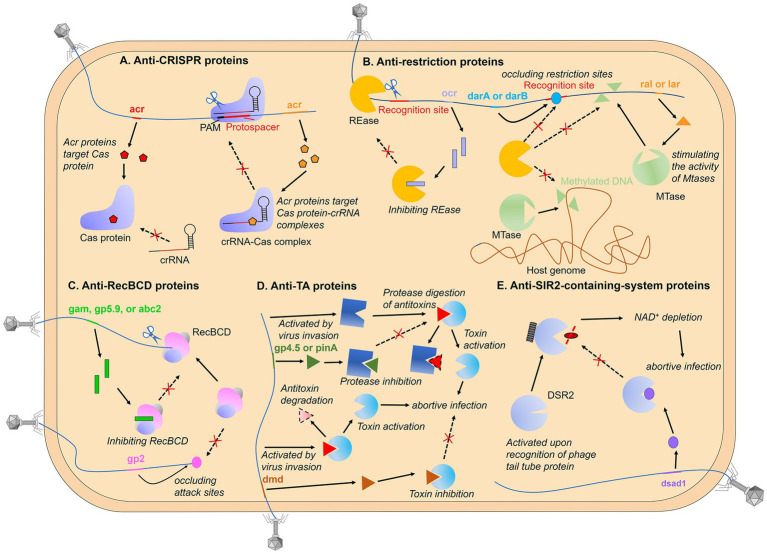
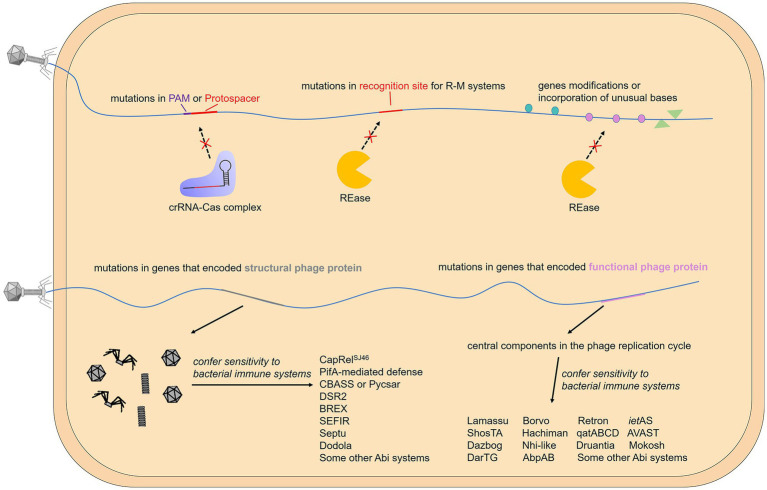
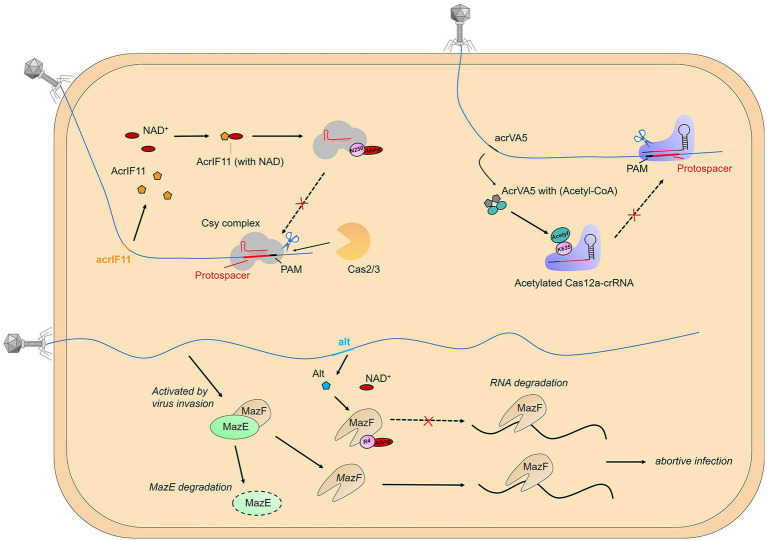
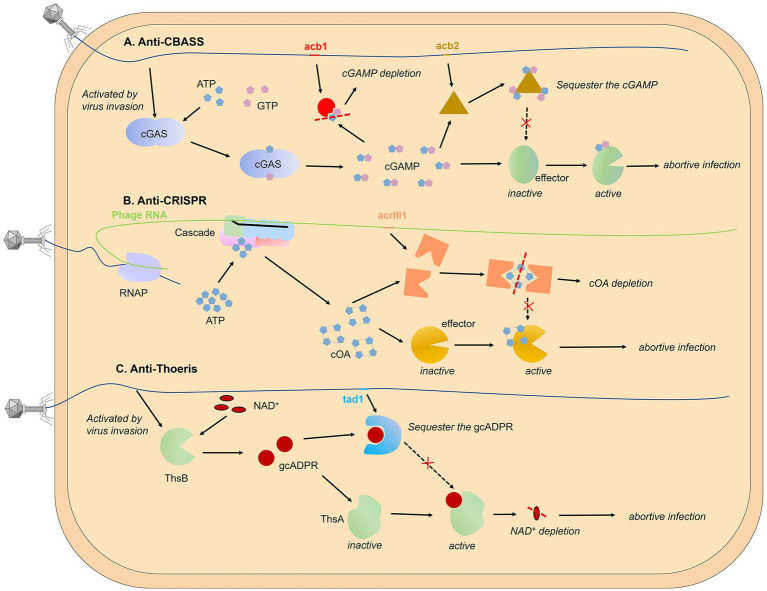
Phages and their bacterial hosts together constitute a vast and diverse ecosystem. Facing the infection of phages, prokaryotes have evolved a wide range of antiviral mechanisms, and phages in turn have adopted multiple tactics to circumvent or subvert these mechanisms to survive. An in-depth investigation into the interaction between phages and bacteria not only provides new insight into the ancient coevolutionary conflict between them but also produces precision biotechnological tools based on anti-phage systems. Moreover, a more complete understanding of their interaction is also critical for the phage-based antibacterial measures. Compared to the bacterial antiviral mechanisms, studies into counter-defense strategies adopted by phages have been a little slow, but have also achieved important advances in recent years. In this review, we highlight the numerous intracellular immune systems of bacteria as well as the countermeasures employed by phages, with an emphasis on the bacteriophage strategies in response to host antiviral immunity.
噬菌体及其细菌宿主共同构成了一个庞大而多样的生态系统。面对噬菌体的感染,原核生物进化出了广泛的抗病毒机制,而噬菌体则相应地采取了多种策略来规避或颠覆这些机制以存活下来。深入研究噬菌体与细菌之间的相互作用,不仅能为它们之间古老的共同进化冲突提供新的见解,还能基于抗噬菌体系统开发出精准的生物技术工具。此外,更全面地了解它们之间的相互作用对于基于噬菌体的抗菌措施也至关重要。与细菌的抗病毒机制相比,对噬菌体所采用的反击策略的研究进展较为缓慢,但近年来也取得了重要进展。在这篇综述中,我们重点介绍了细菌众多的细胞内免疫系统以及噬菌体所采用的应对措施,尤其着重于噬菌体应对宿主抗病毒免疫的策略。