Kharbanda Elyse Olshen, Vazquez-Benitez Gabriela, Lipkind Heather S, Klein Nicola P, Cheetham T Craig, Naleway Allison L, Lee Grace M, Hambidge Simon, Jackson Michael L, Omer Saad B, McCarthy Natalie, Nordin James D
HealthPartners Institute for Education and Research, Minneapolis, MN, United States.
HealthPartners Institute for Education and Research, Minneapolis, MN, United States.
Vaccine. 2016 Feb 10;34(7):968-73. doi: 10.1016/j.vaccine.2015.12.046. Epub 2016 Jan 4.
Since October 2012, the combined tetanus toxoid, reduced diphtheria toxoid, acellular pertussis vaccine (Tdap) has been recommended in the United States during every pregnancy.
In this observational study from the Vaccine Safety Datalink, we describe receipt of Tdap during pregnancy among insured women with live births across seven health systems. Using a retrospective matched cohort, we evaluated risks for selected medically attended adverse events in pregnant women, occurring within 42 days of vaccination. Using a generalized estimating equation, we calculated adjusted incident rate ratios (AIRR).
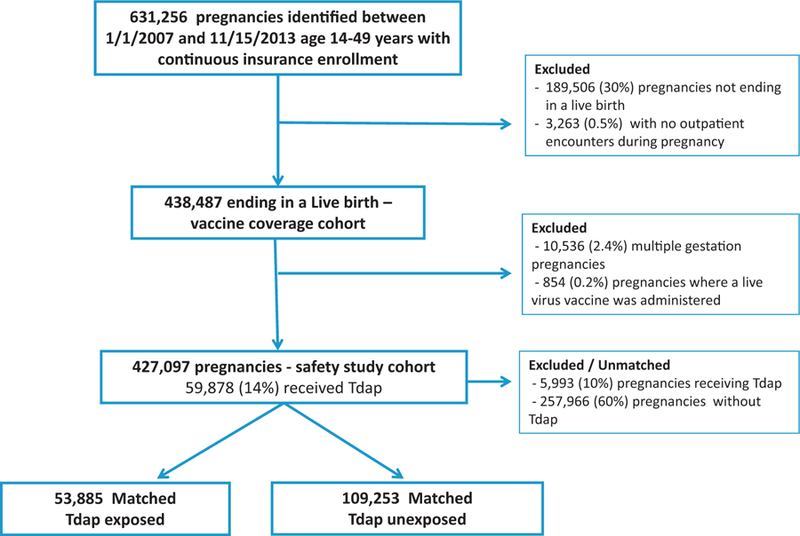
Our vaccine coverage cohort included 438,487 live births between January 1, 2007 and November 15, 2013. Across the coverage cohort, 14% received Tdap during pregnancy. By 2013, Tdap was administered during pregnancy in 41.7% of live births, primarily in the 3rd trimester. Our vaccine safety cohort included 53,885 vaccinated and 109,253 matched unvaccinated pregnant women. There was no increased risk for a composite outcome of medically attended acute adverse events within 3 days of vaccination. Similarly, across the safety cohort, over a 42 day window, incident neurologic events, thrombotic events, and new onset proteinuria did not differ by maternal receipt of Tdap. Among women receiving Tdap at 20 weeks gestation or later, as compared to their matched controls, there was no increased risk for gestational diabetes or cardiac events while venous thromboembolic events and thrombocytopenia were diagnosed within 42 days of vaccination at slightly decreased rates.
Tdap coverage during pregnancy increased from 2007 through 2013, but was still below 50%. No acute maternal safety signals were detected in this large cohort.
自2012年10月起,美国建议在每次孕期接种破伤风类毒素、低剂量白喉类毒素、无细胞百日咳联合疫苗(Tdap)。
在这项来自疫苗安全数据链的观察性研究中,我们描述了七个医疗系统中生育活产婴儿的参保女性孕期接种Tdap的情况。我们采用回顾性匹配队列,评估了孕妇在接种疫苗后42天内发生的部分需就医治疗的不良事件风险。我们使用广义估计方程计算调整后的发病率比(AIRR)。
我们的疫苗接种覆盖队列包括2007年1月1日至2013年11月15日期间的438,487例活产。在整个覆盖队列中,14%的孕妇在孕期接种了Tdap。到2013年,41.7%的活产孕妇在孕期接种了Tdap,主要是在孕晚期。我们的疫苗安全队列包括53,885名接种疫苗的孕妇和109,253名匹配的未接种疫苗的孕妇。接种疫苗后3天内,需就医治疗的急性不良事件综合结局风险没有增加。同样,在整个安全队列中,在42天的观察期内,孕妇接种Tdap与否,神经系统事件、血栓形成事件和新发蛋白尿的发生率并无差异。在妊娠20周及以后接种Tdap的女性中,与匹配的对照组相比,妊娠期糖尿病或心脏事件风险没有增加,而静脉血栓栓塞事件和血小板减少症在接种疫苗后42天内的诊断率略有下降。
2007年至2013年期间,孕期Tdap接种率有所上升,但仍低于50%。在这个大型队列中未检测到急性孕产妇安全信号。