Sharma Manuj, Nazareth Irwin, Petersen Irene
Department of Primary Care and Population Health, University College London, London, UK.
Department of Primary Care and Population Health, University College London, London, UK Department of Clinical Epidemiology, Aarhus University, Aarhus, Denmark.
BMJ Open. 2016 Jan 13;6(1):e010210. doi: 10.1136/bmjopen-2015-010210.
To investigate trends in incident and prevalent diagnoses of type 2 diabetes mellitus (T2DM) and its pharmacological treatment between 2000 and 2013.
Analysis of longitudinal electronic health records in The Health Improvement Network (THIN) primary care database.
UK primary care.
In total, we examined 8,838,031 individuals aged 0-99 years.
The incidence and prevalence of T2DM between 2000 and 2013, and the effect of age, sex and social deprivation on these measures were examined. Changes in prescribing patterns of antidiabetic therapy between 2000 and 2013 were also investigated.
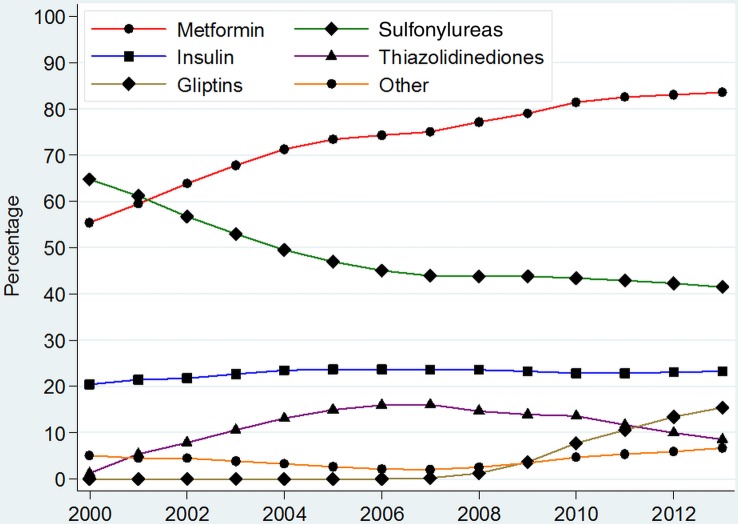
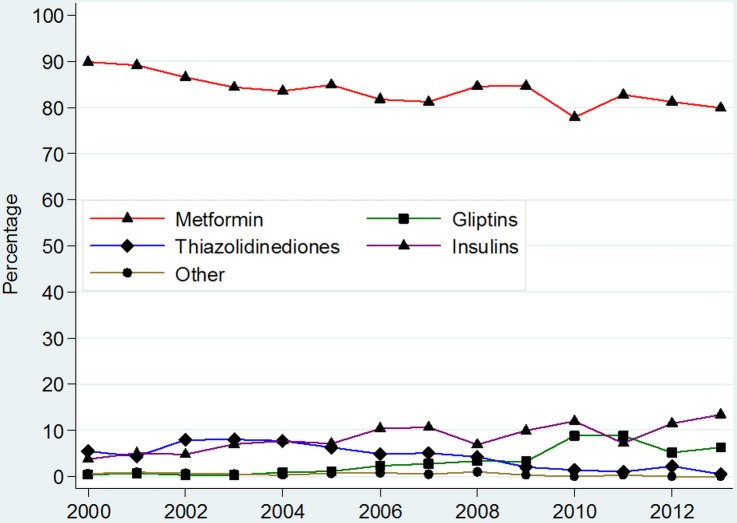
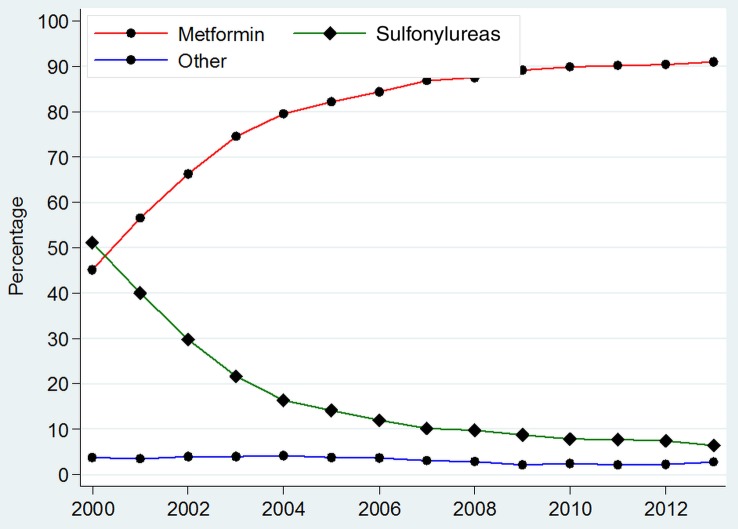
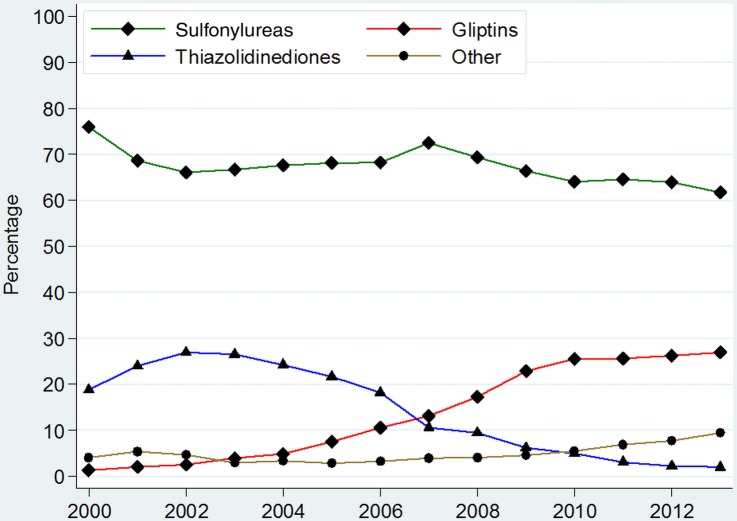
Overall, 406,344 individuals had a diagnosis of T2DM, of which 203,639 were newly diagnosed between 2000 and 2013. The incidence of T2DM rose from 3.69 per 1000 person-years at risk (PYAR) (95% CI 3.58 to 3.81) in 2000 to 3.99 per 1000 PYAR (95% CI 3.90 to 4.08) in 2013 among men; and from 3.06 per 1000 PYAR (95% CI 2.95 to 3.17) to 3.73 per 1000 PYAR (95% CI 3.65 to 3.82) among women. Prevalence of T2DM more than doubled from 2.39% (95% CI 2.37 to 2.41) in 2000 to 5.32% (95% CI 5.30 to 5.34) in 2013. Being male, older, and from a more socially deprived area was strongly associated with having T2DM, (p<0.001). Prescribing changes over time reflected emerging clinical guidance and novel treatments. In 2013, metformin prescribing peaked at 83.6% (95% CI 83.4% to 83.8%), while sulfonylureas prescribing reached a low of 41.4% (95% CI 41.1% to 41.7%). Both remained, however, the most commonly used pharmacological treatments as first-line agents and add-on therapy. Thiazolidinediones and incretin based therapies (gliptins and GLP-1 analogues) were also prescribed as alternate add-on therapy options, however were rarely used for first-line treatment in T2DM.
Prevalent cases of T2DM more than doubled between 2000 and 2013, while the number of incident cases increased more steadily. Changes in prescribing patterns observed may reflect the impact of national policies and prescribing guidelines on UK primary care.
调查2000年至2013年间2型糖尿病(T2DM)的发病率、现患率及其药物治疗趋势。
对健康改善网络(THIN)初级保健数据库中的纵向电子健康记录进行分析。
英国初级保健机构。
共检查了8838031名年龄在0至99岁之间的个体。
研究2000年至2013年间T2DM的发病率和现患率,以及年龄、性别和社会剥夺对这些指标的影响。同时调查2000年至2013年间抗糖尿病治疗的处方模式变化。
总体而言,有406344人被诊断为T2DM,其中203639人是在2000年至2013年间新诊断出的。2000年男性T2DM发病率为每1000人年危险人群(PYAR)3.69例(95%CI 3.58至3.81),到2013年升至每1000 PYAR 3.99例(95%CI 3.90至4.08);女性发病率从每1000 PYAR 3.06例(95%CI 2.95至3.17)升至每1000 PYAR 3.73例(95%CI 3.65至3.82)。T2DM现患率从2000年的2.39%(95%CI 2.37至2.41)增加了一倍多,到2013年达到5.32%(95%CI 5.30至5.34)。男性、年龄较大以及来自社会剥夺程度较高地区的人群与患T2DM密切相关(p<0.001)。随着时间推移,处方变化反映了新出现的临床指南和新型治疗方法。2013年,二甲双胍处方率达到峰值83.6%(95%CI 83.4%至83.8%),而磺脲类药物处方率降至41.4%(95%CI 41.1%至41.7%)的低点。然而,两者仍是最常用的一线药物治疗和附加治疗药物。噻唑烷二酮类药物和基于肠促胰岛素的疗法(格列汀类药物和GLP-1类似物)也作为替代附加治疗药物被处方,但在T2DM的一线治疗中很少使用。
2000年至2013年间,T2DM现患病例增加了一倍多,而新发病例数量增长较为稳定。观察到的处方模式变化可能反映了国家政策和处方指南对英国初级保健的影响。