Zang Jiajie, Shen Meihua, Du Sufa, Chen Tianwen, Zou Shurong
Department of Nutrition Hygiene, Shanghai Municipal Center for Disease Control and Prevention, Shanghai, China.
Department of Emergency, Shanghai Armed Policed General Troops Hospital, Shanghai, China.
J Breast Cancer. 2015 Dec;18(4):313-22. doi: 10.4048/jbc.2015.18.4.313. Epub 2015 Dec 23.
To date, studies investigating the association between dairy consumption and breast cancer in women have produced conflicting results. As diet is an important, modifiable factor affecting cancer development, the aim of this study was to examine the association between dairy consumption and breast cancer risk.
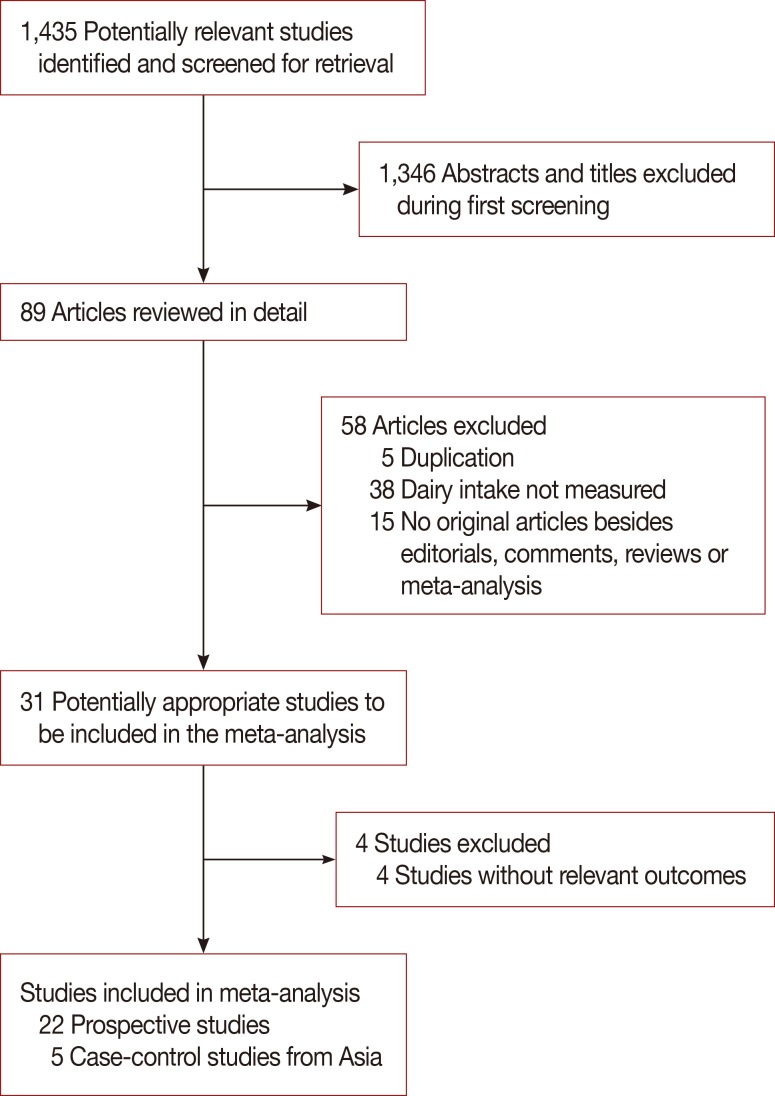
PubMed, Embase, and Cochrane Library databases were searched with a priority for prospective cohort studies. Case-control studies were also considered in case of the absence of a cohort study.
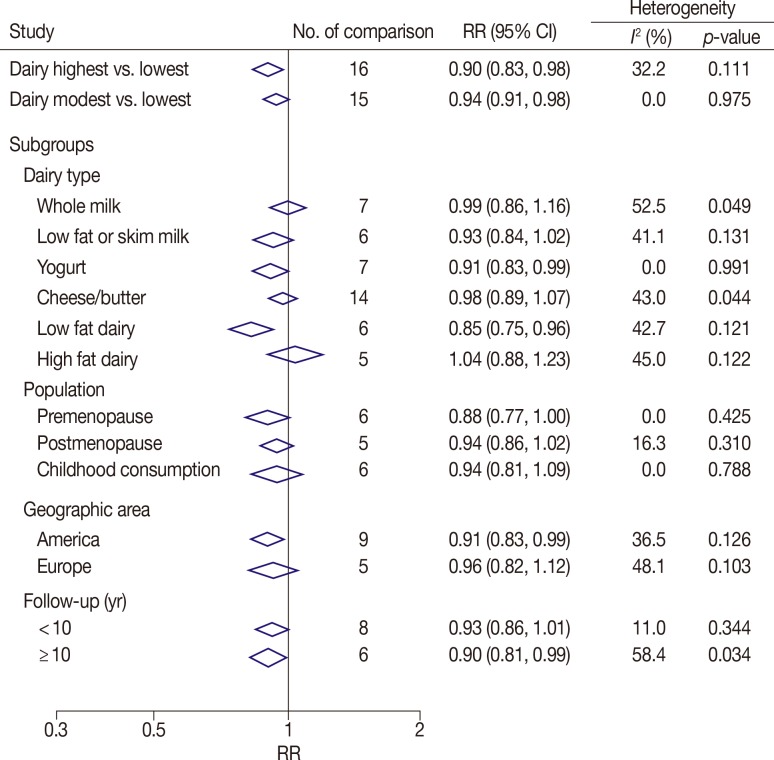
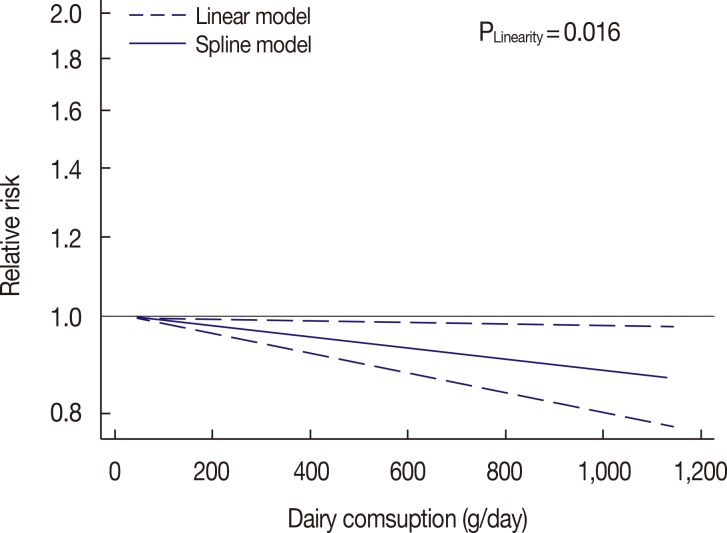
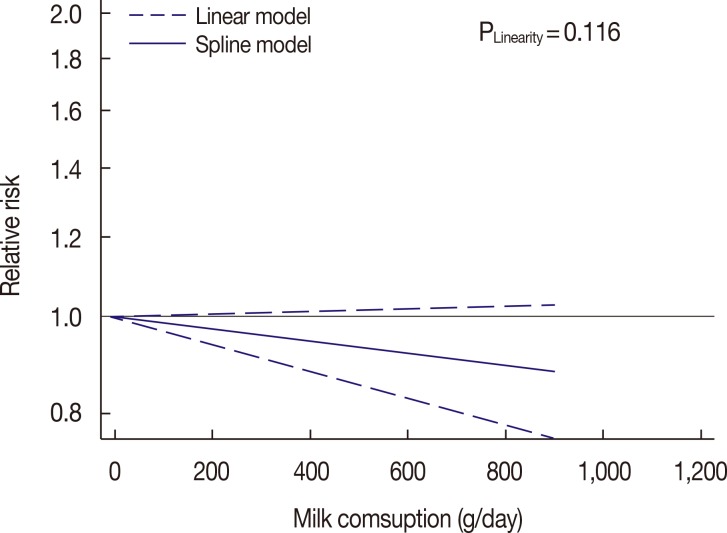
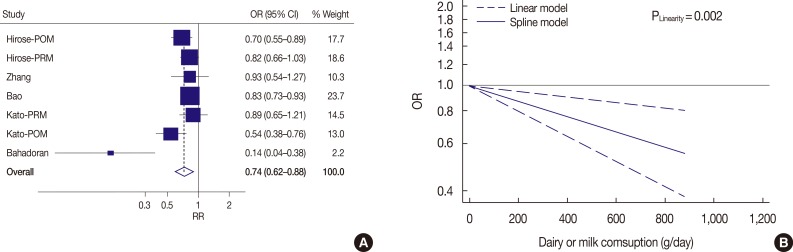
We analyzed 22 prospective cohort studies (1,566,940 participants) and five case-control studies (33,372 participants). High and modest dairy consumption (>600 and 400-600 g/day, respectively) significantly reduced the risk of breast cancer compared with low dairy consumption (<400 g/day; risk ratio [RR], 0.90, 95% confidence interval [CI], 0.83-0.98, and RR, 0.94, 95% CI, 0.91-0.98, respectively). A significant linear relationship between dairy consumption and breast cancer risk was found on dose-response analysis. Subgroup analysis found that yogurt (RR, 0.91; 95% CI, 0.83-0.99) and low-fat dairy (RR, 0.85; 95% CI, 0.75-0.96) reduced the risk of breast cancer, while other dairy product types did not. A reduced risk was observed for people in the United States (RR, 0.91; 95% CI, 0.83-0.99) and in those followed for ≥10 years (RR, 0.90; 95% CI, 0.81-0.99). Additionally, the highest level of dairy consumption among Asians was associated with a reduced risk of breast cancer (odds ratio, 0.74; 95% CI, 0.62-0.88).
Dairy consumption was inversely associated with the risk of developing breast cancer and this effect was dependent on the dose, dairy-type, and time.
迄今为止,关于女性乳制品消费与乳腺癌之间关联的研究结果相互矛盾。由于饮食是影响癌症发展的一个重要且可改变的因素,本研究旨在探讨乳制品消费与乳腺癌风险之间的关联。
对PubMed、Embase和Cochrane图书馆数据库进行检索,优先检索前瞻性队列研究。若缺乏队列研究,则也考虑病例对照研究。
我们分析了22项前瞻性队列研究(1566940名参与者)和5项病例对照研究(33372名参与者)。与低乳制品消费量(<400克/天)相比,高和适度的乳制品消费量(分别>600克/天和400 - 600克/天)显著降低了患乳腺癌的风险(风险比[RR]分别为0.90,95%置信区间[CI]为0.83 - 0.98;RR为0.94,95% CI为0.91 - 0.98)。剂量反应分析发现乳制品消费与乳腺癌风险之间存在显著的线性关系。亚组分析发现,酸奶(RR为0.91;95% CI为0.83 - 0.99)和低脂乳制品(RR为0.85;95% CI为0.75 - 0.96)降低了患乳腺癌的风险,而其他类型的乳制品则没有。在美国人群(RR为0.91;95% CI为0.83 - 0.99)以及随访时间≥10年的人群(RR为0.90;95% CI为0.81 - 0.99)中观察到风险降低。此外,亚洲人最高水平的乳制品消费与患乳腺癌风险降低相关(优势比为0.74;95% CI为0.62 - 0.88)。
乳制品消费与患乳腺癌的风险呈负相关,且这种影响取决于剂量、乳制品类型和时间。