Kassem Neemat M, Abdelmegid Yassmin A, El-Sayed Mahmoud K, Sayed Rana S, Abdel-Aalla Mahmoud H, Kassem Hebatallah A
Clinical and Chemical Pathology Department, Kasr Al Ainy Centre of Clinical Oncology & Nuclear Medicine, School of Medicine, Cairo University, Cairo, Egypt.
OBG Department, Kasr Al-Ainy School of Medicine, Cairo University, Cairo, Egypt.
J Genet Eng Biotechnol. 2023 Nov 22;21(1):134. doi: 10.1186/s43141-023-00599-2.
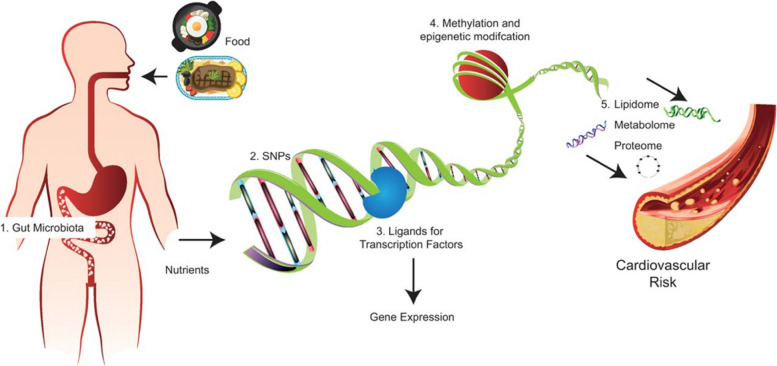
The relationship between nutrition and genes has long been hinted at and sometimes plainly associated with certain diseases. Now, after many years of research and coincidental findings, it is believed that this relationship, termed "Nutrigenomics," is certainly a factor of major importance in various conditions. In this review article, we discuss nutrigenomics, starting with basics definitions and enzymatic functions and ending with its palpable association with cancer. Now, diet is basically what we eat on a daily basis. Everything that enters through our alimentary tract ends up broken down to minute molecules and amino acids. These molecules interact with our microbiome and genome in discreet ways. For instance, we demonstrate how proper intake of probiotics enhances beneficial bacteria and may alleviate IBS and prevent colorectal cancer on the long term. We also show how a diet rich in folic acid is essential for methylenetetrahydrofolate reductase (MTHFR) function, which lowers risk of colorectal cancer. Also, we discuss how certain diets were associated with development of certain cancers. For example, red and processed meat are highly associated with colorectal and prostate cancer, salty diets with stomach cancer, and obesity with breast cancer. The modification of these diets significantly lowered the risk and improved prognosis of these cancers among many others. We also examined how micronutrients had a role in cancer prevention, as vitamin A and C exert anti-carcinogenic effects through their function as antioxidants. In addition, we show how folic acid prevent DNA mutations by enhancing protein methylation processes. Finally, after a systematic review of myriad articles on the etiology and prevention of cancer, we think that diet should be a crucial feature in cancer prevention and treatment programs. In the future, healthy diets and micronutrients may even be able to successively alter the liability to genetic mutations that result in cancer. It also will play a role in boosting treatment and improving prognosis of diagnosed cancers.
营养与基因之间的关系长期以来一直有所暗示,有时还与某些疾病明显相关。如今,经过多年研究和一些巧合的发现,人们认为这种被称为“营养基因组学”的关系在各种情况下无疑是一个至关重要的因素。在这篇综述文章中,我们将讨论营养基因组学,从基本定义和酶的功能入手,最后阐述其与癌症的明显关联。如今,饮食基本上就是我们日常所吃的东西。所有通过我们消化道进入的物质最终都会被分解成微小的分子和氨基酸。这些分子以独特的方式与我们的微生物群和基因组相互作用。例如,我们展示了适当摄入益生菌如何增强有益细菌,并可能缓解肠易激综合征以及长期预防结直肠癌。我们还表明富含叶酸的饮食对于亚甲基四氢叶酸还原酶(MTHFR)的功能至关重要,而这会降低患结直肠癌的风险。此外,我们讨论了某些饮食如何与特定癌症的发生有关。例如,红肉和加工肉类与结直肠癌和前列腺癌高度相关,高盐饮食与胃癌相关,肥胖与乳腺癌相关。对这些饮食进行调整可显著降低这些癌症以及许多其他癌症的风险并改善预后。我们还研究了微量营养素在癌症预防中的作用,因为维生素A和C通过其抗氧化剂功能发挥抗癌作用。此外,我们展示了叶酸如何通过增强蛋白质甲基化过程来预防DNA突变。最后,在对大量关于癌症病因和预防的文章进行系统综述后,我们认为饮食应成为癌症预防和治疗方案的关键要素。未来,健康饮食和微量营养素甚至可能能够相继改变导致癌症的基因突变易感性。它还将在促进治疗和改善已确诊癌症的预后方面发挥作用。