Medical School, University of Cyprus, P.O. Box 20537, Nicosia, 1678, Cyprus.
Department of Epidemiology and Biostatistics, School of Public Health, Imperial College London, London, SW7 2AZ, UK.
BMC Cancer. 2024 Jul 26;24(1):903. doi: 10.1186/s12885-024-12641-8.
Previous research has found associations between various non-genetic factors and breast cancer (BrCa) risk. This study summarises and appraises the credibility of the available evidence on the association between non-genetic factors and BrCa risk.
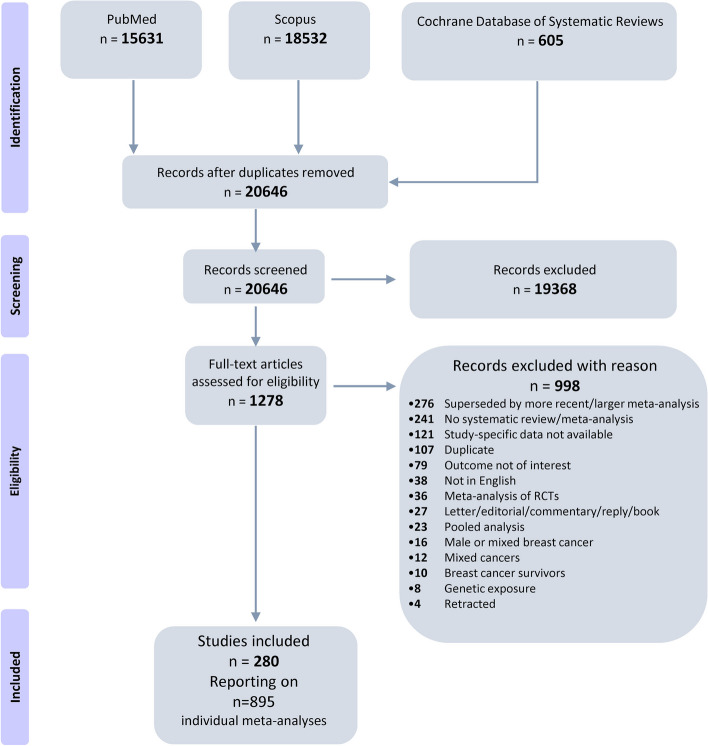
We conducted an umbrella review of meta-analyses. Medline, Scopus, and the Cochrane databases were systematically searched for meta-analyses examining non-genetic factors and BrCa incidence or mortality. The strength of the evidence was graded in four categories (i.e., weak, suggestive, highly suggestive, convincing).
A total of 781 meta-analyses from 280 publications were evaluated and graded. We included exposures related to anthropometric measurements, biomarkers, breast characteristics and diseases, diet and supplements, environment, exogenous hormones, lifestyle and social factors, medical history, medication, reproductive history, and pregnancy. The largest number of examined associations was found for the category of diet and supplements and for exposures such as aspirin use and active smoking. The statistically significant (P-value < 0.05) meta-analyses were 382 (49%), of which 204 (53.4%) reported factors associated with increased BrCa risk. Most of the statistically significant evidence (n = 224, 58.6%) was graded as weak. Convincing harmful associations with heightened BrCa risk were found for increased body mass index (BMI), BMI and weight gain in postmenopausal women, oral contraceptive use in premenopausal women, increased androstenedione, estradiol, estrone, and testosterone concentrations, high Breast Imaging Reporting and Data System (BIRADS) classification, and increased breast density. Convincing protective factors associated with lower BrCa risk included high fiber intake and high sex hormone binding globulin (SHBG) levels while highly suggestive protective factors included high 25 hydroxy vitamin D [25(OH)D] levels, adherence to healthy lifestyle, and moderate-vigorous physical activity.
Our findings suggest some highly modifiable factors that protect from BrCa. Interestingly, while diet was the most studied exposure category, the related associations failed to reach higher levels of evidence, indicating the methodological limitations in the field. To improve the validity of these associations, future research should utilise more robust study designs and better exposure assessment techniques. Overall, our study provides knowledge that supports the development of evidence-based BrCa prevention recommendations and guidance, both at an individual level and for public health initiatives.
PROSPERO CRD42022370675.
先前的研究发现了各种非遗传因素与乳腺癌(BrCa)风险之间的关联。本研究总结和评估了非遗传因素与 BrCa 风险之间关联的现有证据的可信度。
我们进行了荟萃分析的伞式审查。系统地检索了 Medline、Scopus 和 Cochrane 数据库中检查非遗传因素与 BrCa 发生率或死亡率之间关系的荟萃分析。证据强度分为四个等级(即弱、提示、高度提示、有说服力)。
共评估和分级了 280 篇出版物中的 781 项荟萃分析。我们纳入了与人体测量、生物标志物、乳房特征和疾病、饮食和补充剂、环境、外源性激素、生活方式和社会因素、病史、药物、生殖史和妊娠相关的暴露。检查最多的关联是饮食和补充剂类别,以及阿司匹林使用和主动吸烟等暴露。有统计学意义(P 值<0.05)的荟萃分析有 382 项(49%),其中 204 项(53.4%)报告了与增加 BrCa 风险相关的因素。大多数具有统计学意义的证据(n=224,58.6%)被评为弱。有说服力的有害关联与增加的 BrCa 风险有关的是增加的体重指数(BMI)、绝经后妇女的 BMI 和体重增加、绝经前妇女的口服避孕药使用、增加的雄烯二酮、雌二醇、雌酮和睾酮浓度、高乳腺成像报告和数据系统(BIRADS)分类,以及增加的乳房密度。与降低 BrCa 风险相关的有说服力的保护因素包括高纤维摄入量和高性激素结合球蛋白(SHBG)水平,而高度提示的保护因素包括高 25 羟维生素 D[25(OH)D]水平、坚持健康的生活方式和适度剧烈的身体活动。
我们的研究结果表明了一些具有高度可操作性的因素可以预防 BrCa。有趣的是,尽管饮食是研究最多的暴露类别,但相关关联未能达到更高水平的证据,表明该领域存在方法学限制。为了提高这些关联的有效性,未来的研究应利用更强大的研究设计和更好的暴露评估技术。总的来说,我们的研究提供了支持制定基于证据的 BrCa 预防建议和指导的知识,无论是在个人层面还是公共卫生倡议方面。
PROSPERO CRD42022370675。