Majeed Sahar A, Hadi Najah R, Al Mudhafar Ahmed M, Al-Janabi Hussein A
Department of Pharmacology & Therapeutics, College of Medicine, University of Kufa, Najaf, Iraq.
SAGE Open Med. 2013 Sep 10;1:2050312113499912. doi: 10.1177/2050312113499912. eCollection 2013.
Atherosclerosis is the major cause of death. The most common risk factors are hyperlipidemia, diabetes, and other factors like chronic infection and inflammation.
This study was undertaken to assess the effect of sitagliptin on atherosclerosis via interfering with inflammatory and oxidative pathways.
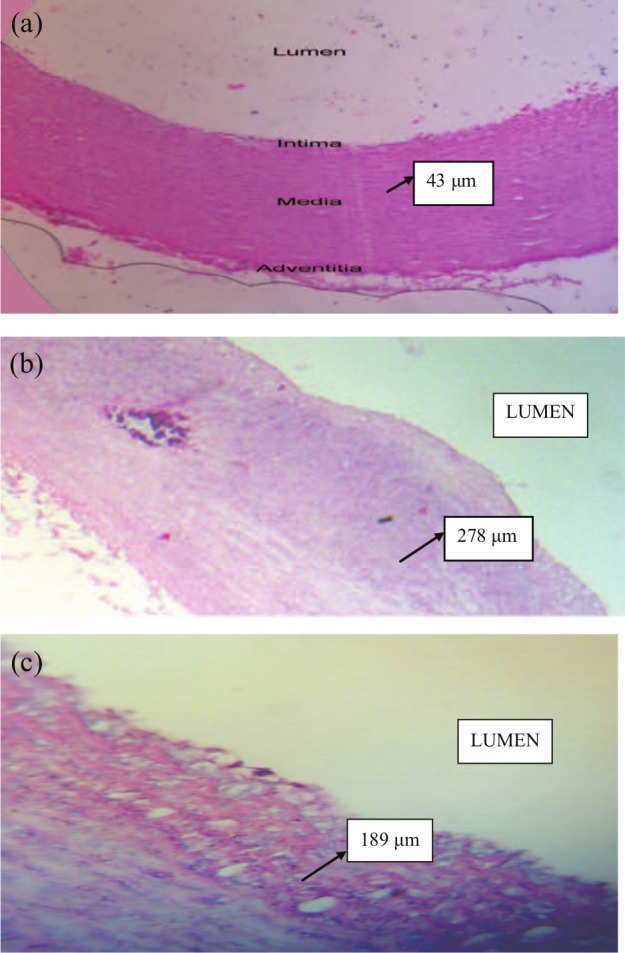
A total of 18 local domestic male rabbits were included in this study. The animals were randomly divided into three groups (6 rabbits in each group): Group I normal were fed with chow (oxiod) diet for 12 weeks. Group II were fed with 1% cholesterol enriched diet for 12 weeks. Group III rabbits fed with cholesterol enriched diet for 6 weeks, and then continued on cholesterol enriched diet and treated with sitagliptin 125 mg/kg/day orally for the next 6 weeks. Blood samples were collected at the start of the study, at 6 weeks of the study and then at the end of treatment to measure serum lipids profile, hsCRP and TNFα. At end of the study, the aorta was removed for measurement of MDA, glutathione and, aortic intima-media thickness.
Sitagliptin results in a significant reduction (p < 0.05) in serum level of total cholesterol (TC), triglycerides (TG), high sensitive C-reactive protein (hsCRP) and TNFα with a significant increase (p < 0.05) in serum HDL level. There was a significant reduction (p < 0.05) in aortic MDA, in comparison to the untreated control group. Furthermore, sitagliptin causes significant increment (p < 0.05) in aortic GSH in comparison to induced untreated group. Regarding histopathological results, sitagliptin results in a significant reduction (p < 0.05) in atherosclerotic lesions in comparison to the induced untreated group and significant reduction in aortic intima-media thickness (p < 0.05).
Sitagliptin reduced atherosclerosis progression in hyperlipidemic rabbit via its effect on lipid parameters and interfering with inflammatory and oxidative stress.
动脉粥样硬化是主要的死亡原因。最常见的危险因素是高脂血症、糖尿病以及慢性感染和炎症等其他因素。
本研究旨在通过干扰炎症和氧化途径来评估西他列汀对动脉粥样硬化的影响。
本研究共纳入18只本地雄性家兔。将动物随机分为三组(每组6只兔子):第一组正常组喂食普通(oxiod)饲料12周。第二组喂食含1%胆固醇的饲料12周。第三组兔子先喂食含胆固醇的饲料6周,然后继续喂食含胆固醇的饲料,并在接下来的6周内每天口服125 mg/kg西他列汀。在研究开始时、研究6周时以及治疗结束时采集血样,以测量血脂谱、高敏C反应蛋白(hsCRP)和肿瘤坏死因子α(TNFα)。在研究结束时,取出主动脉测量丙二醛(MDA)、谷胱甘肽以及主动脉内膜中层厚度。
西他列汀可使血清总胆固醇(TC)、甘油三酯(TG)、高敏C反应蛋白(hsCRP)和TNFα水平显著降低(p < 0.05),血清高密度脂蛋白(HDL)水平显著升高(p < 0.05)。与未治疗的对照组相比,主动脉MDA显著降低(p < 0.05)。此外,与未治疗的诱导组相比,西他列汀可使主动脉谷胱甘肽(GSH)显著增加(p < 0.05)。关于组织病理学结果,与未治疗的诱导组相比,西他列汀可使动脉粥样硬化病变显著减少(p < 0.05),主动脉内膜中层厚度显著降低(p < 0.05)。
西他列汀通过对脂质参数的影响以及干扰炎症和氧化应激,降低了高脂血症家兔动脉粥样硬化的进展。