Truong Julie T, Backes Andrea C
Keck Graduate Institute School of Pharmacy, Claremont, CA, USA.
Frederick Memorial Hospital, Frederick, MD, USA.
SAGE Open Med. 2015 Mar 30;3:2050312115577986. doi: 10.1177/2050312115577986. eCollection 2015.
To examine the impact of a Continuum of Care Resident Pharmacist on (1) heart failure 30-day hospital readmissions and (2) compliance with Joint Commission Heart Failure core measure 1 at a community hospital.
The Continuum of Care Network led by a Continuum of Care Resident Pharmacist was established in August 2011. The Continuum of Care Resident Pharmacist followed Continuum of Care Network patients and retrospectively collected data from August 2011 to December 2012. Thirty-day readmission rates for Continuum of Care Network heart failure patients versus non-Continuum of Care Network heart failure patients were compared and analyzed. Joint Commission Heart Failure core measure 1 compliance rates were retrospectively collected from January 2011 and compared to data after establishment of the Continuum of Care Network.
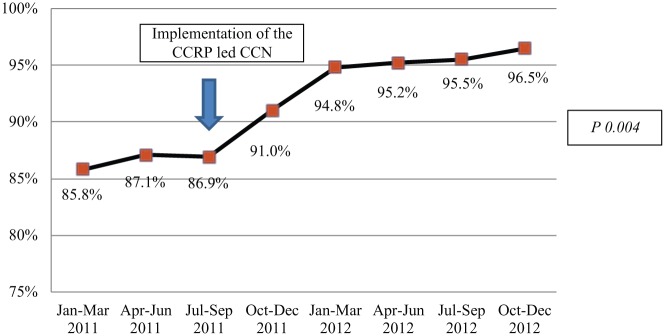
In all, 162 Continuum of Care Network patients and 470 non-Continuum of Care Network patients were discharged with a diagnosis of heart failure from August 2011 to December 2012. Continuum of Care Network heart failure patients had a lower 30-day all-cause readmission rate compared to non-Continuum of Care Network heart failure patients (12% versus 24%, respectively; p = 0.005). In addition, Heart Failure core measure 1 compliance rates improved from the 80th percentile to the 90th percentile after implementation of the Continuum of Care Network (p = 0.004). The top three interventions performed by the Continuum of Care Resident Pharmacist were discharge counseling (74.1%), providing a MedActionPlan(™) (68.5%), and resolving medication reconciliation discrepancies (64.8%).
The study findings suggest that a Continuum of Care Resident Pharmacist contributed to lowered heart failure readmission rates and improved Heart Failure core measure 1 compliance rates. Future randomized, controlled trials are needed to confirm these findings.
研究连续护理住院药师对(1)心力衰竭30天内再入院率以及(2)社区医院联合委员会心力衰竭核心指标1的依从性的影响。
由连续护理住院药师领导的连续护理网络于2011年8月建立。连续护理住院药师跟踪连续护理网络患者,并回顾性收集2011年8月至2012年12月的数据。比较并分析连续护理网络心力衰竭患者与非连续护理网络心力衰竭患者的30天再入院率。回顾性收集2011年1月起联合委员会心力衰竭核心指标1的依从率,并与连续护理网络建立后的数据进行比较。
2011年8月至2012年12月,共有162名连续护理网络患者和470名非连续护理网络患者因心力衰竭诊断出院。与非连续护理网络心力衰竭患者相比,连续护理网络心力衰竭患者的30天全因再入院率较低(分别为12%和24%;p = 0.005)。此外,实施连续护理网络后,心力衰竭核心指标1的依从率从第80百分位数提高到第90百分位数(p = 0.004)。连续护理住院药师实施的前三项干预措施为出院指导(74.1%)、提供药物治疗行动计划(™)(68.5%)和解决用药核对差异(64.8%)。
研究结果表明,连续护理住院药师有助于降低心力衰竭再入院率,并提高心力衰竭核心指标1的依从率。未来需要进行随机对照试验来证实这些发现。