Cresi Francesco, Liguori Stefania Alfonsina, Maggiora Elena, Locatelli Emanuela, Indrio Flavia, Bertino Enrico, Coscia Alessandra
Neonatal Intensive Care Unit, S.Anna-Regina Margherita Children's Hospital, Torino, Italy.; Department of Pediatrics, University of Torino, Torino, Italy.
Neonatal Intensive Care Unit, Maria Vittoria Hospital, Torino, Italy.
Pediatr Gastroenterol Hepatol Nutr. 2015 Dec;18(4):238-45. doi: 10.5223/pghn.2015.18.4.238. Epub 2015 Dec 23.
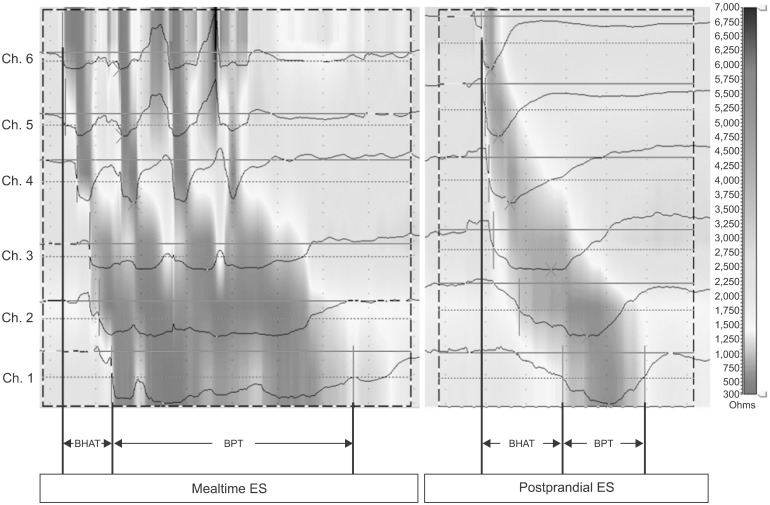
The aim of this study was to evaluate bolus transit during esophageal swallow (ES) and gastroesophageal reflux (GER) events and to investigate the relationship between the characteristics of ES and GER events in a population of term and preterm newborns with symptoms of gastroesophageal reflux disease (GERD).
The study population consisted of term and preterm newborns referred to combined multichannel intraluminal impedance (MII) and pH monitoring for GERD symptoms. The frequency and characteristics of ES and GER events were assessed by two independent investigators. Statistical significance was set at p<0.05.
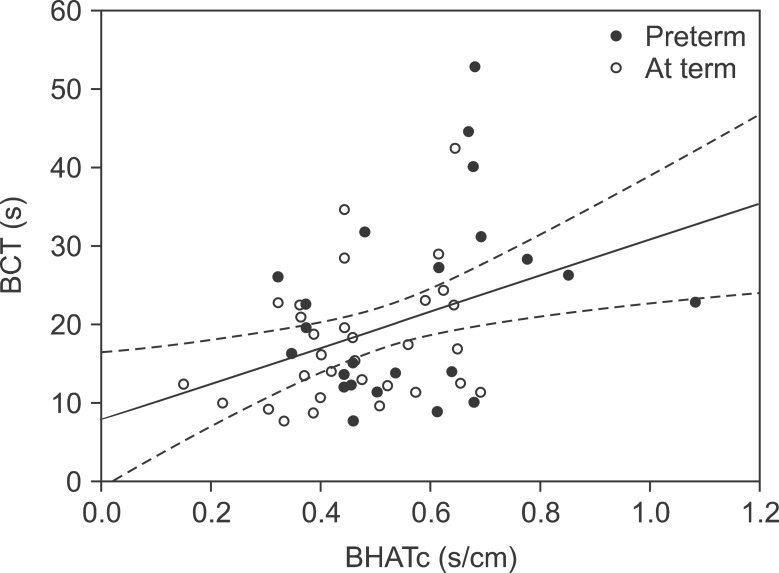
Fifty-four newborns (23 preterm) were included in the analyses. Median bolus head advancing time corrected for esophageal length (BHATc) was shorter during mealtime than during the postprandial period (median, interquartile range): 0.20 (0.15-0.29) s/cm vs. 0.47 (0.39-0.64) s/cm, p<0.001. Median bolus presence time (BPT) was prolonged during mealtime: 4.71(3.49-6.27) s vs. 2.66 (1.82-3.73) s, p<0.001. Higher BHATc (p=0.03) and prolonged BPT (p<0.001) were observed in preterm newborns during the postprandial period. A significant positive correlation between BHATc and bolus clearance time was also observed (ρ=0.33, p=0.016).
The analysis of ES and GER events at the same time by MII provides useful information to better understand the physiopathology of GERD. In particular, the analysis of BHATc during the postprandial period could help clinicians identify newborns with prolonged esophageal clearance time due to impaired esophageal motility, which could allow for more accurate recommendations regarding further tests and treatment.
本研究旨在评估食管吞咽(ES)和胃食管反流(GER)事件期间食团的通过情况,并调查有胃食管反流病(GERD)症状的足月儿和早产儿群体中ES和GER事件特征之间的关系。
研究人群包括因GERD症状而接受多通道腔内阻抗(MII)和pH联合监测的足月儿和早产儿。ES和GER事件的频率及特征由两名独立研究人员评估。统计学显著性设定为p<0.05。
54名新生儿(23名早产儿)纳入分析。经食管长度校正后的食团头部推进时间中位数(BHATc)在进餐时比餐后短(中位数,四分位间距):0.20(0.15 - 0.29)秒/厘米对0.47(0.39 - 0.64)秒/厘米,p<0.001。进餐时食团存在时间中位数(BPT)延长:4.71(3.49 - 6.27)秒对2.66(1.82 - 3.73)秒,p<0.001。餐后早产儿的BHATc更高(p = 0.03)且BPT延长(p<0.001)。BHATc与食团清除时间之间也观察到显著正相关(ρ = 0.33,p = 0.016)。
通过MII同时分析ES和GER事件为更好地理解GERD的病理生理学提供了有用信息。特别是,餐后BHATc的分析可帮助临床医生识别因食管动力受损导致食管清除时间延长的新生儿,这有助于就进一步检查和治疗提出更准确的建议。