Roche Julien, Shen Yang, Lee Jung Ho, Ying Jinfa, Bax Ad
Laboratory of Chemical Physics, National Institute of Diabetes and Digestive and Kidney Diseases, National Institutes of Health , Bethesda, Maryland 20892-0510, United States.
Biochemistry. 2016 Feb 9;55(5):762-75. doi: 10.1021/acs.biochem.5b01259. Epub 2016 Jan 27.
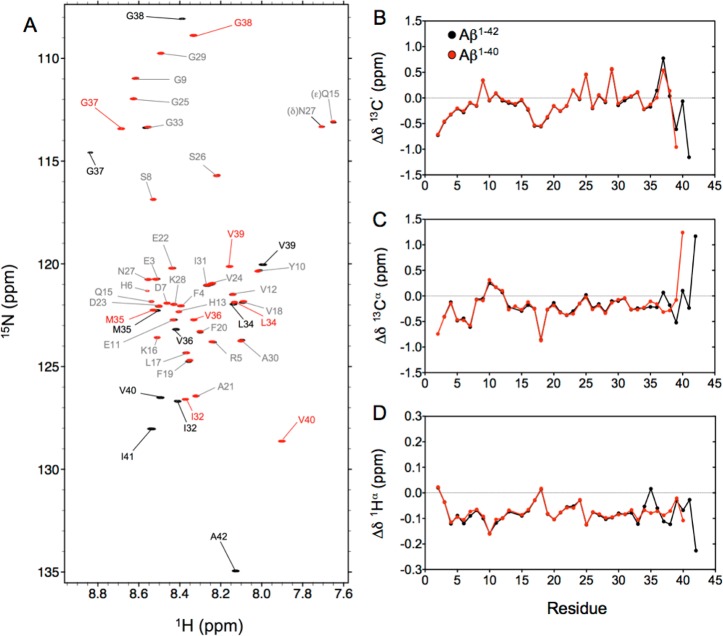
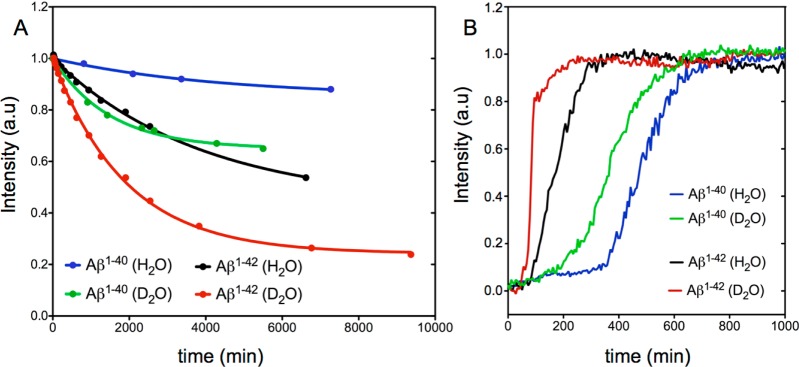
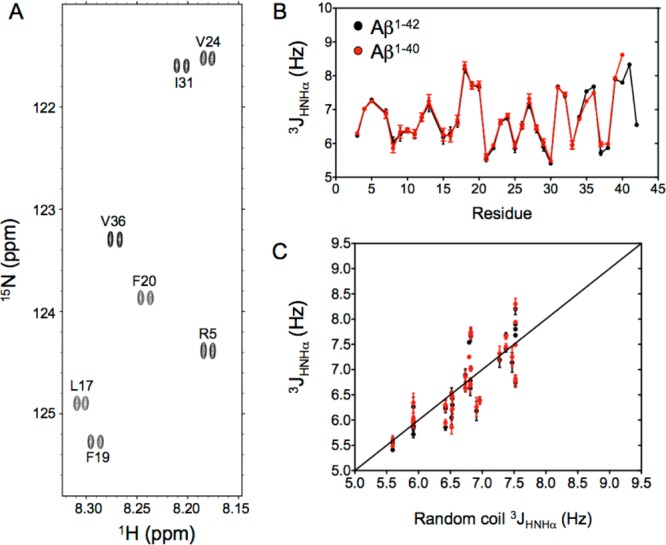
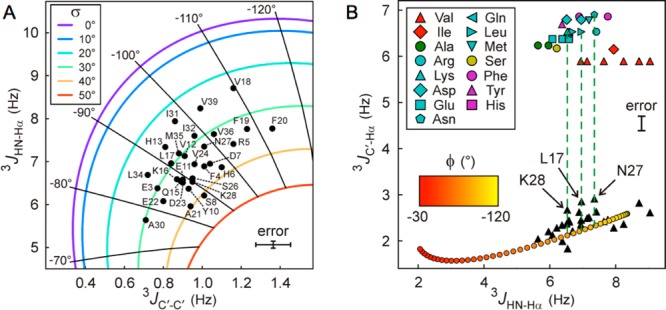
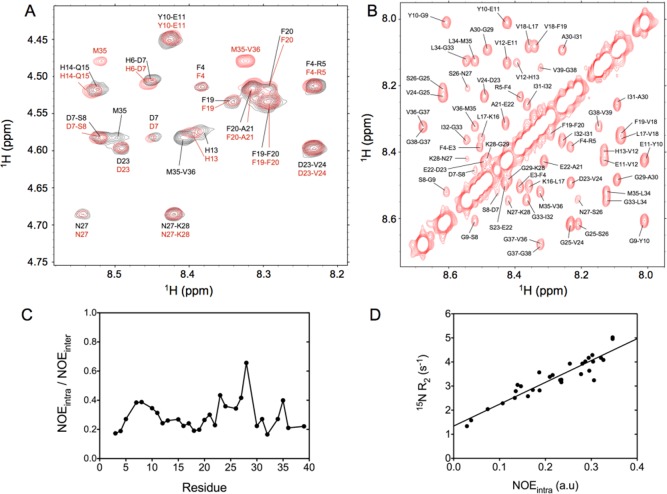
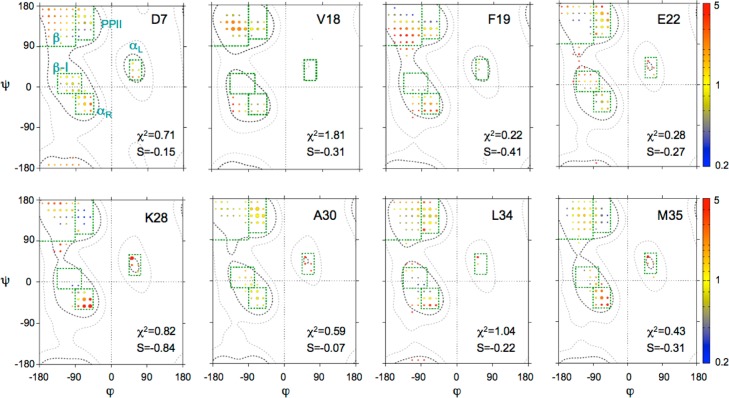
The pathogenesis of Alzheimer's disease is characterized by the aggregation and fibrillation of amyloid peptides Aβ(1-40) and Aβ(1-42) into amyloid plaques. Despite strong potential therapeutic interest, the structural pathways associated with the conversion of monomeric Aβ peptides into oligomeric species remain largely unknown. In particular, the higher aggregation propensity and associated toxicity of Aβ(1-42) compared to that of Aβ(1-40) are poorly understood. To explore in detail the structural propensity of the monomeric Aβ(1-40) and Aβ(1-42) peptides in solution, we recorded a large set of nuclear magnetic resonance (NMR) parameters, including chemical shifts, nuclear Overhauser effects (NOEs), and J couplings. Systematic comparisons show that at neutral pH the Aβ(1-40) and Aβ(1-42) peptides populate almost indistinguishable coil-like conformations. Nuclear Overhauser effect spectra collected at very high resolution remove assignment ambiguities and show no long-range NOE contacts. Six sets of backbone J couplings ((3)JHNHα, (3)JC'C', (3)JC'Hα, (1)JHαCα, (2)JNCα, and (1)JNCα) recorded for Aβ(1-40) were used as input for the recently developed MERA Ramachandran map analysis, yielding residue-specific backbone ϕ/ψ torsion angle distributions that closely resemble random coil distributions, the absence of a significantly elevated propensity for β-conformations in the C-terminal region of the peptide, and a small but distinct propensity for αL at K28. Our results suggest that the self-association of Aβ peptides into toxic oligomers is not driven by elevated propensities of the monomeric species to adopt β-strand-like conformations. Instead, the accelerated disappearance of Aβ NMR signals in D2O over H2O, particularly pronounced for Aβ(1-42), suggests that intermolecular interactions between the hydrophobic regions of the peptide dominate the aggregation process.
阿尔茨海默病的发病机制以淀粉样肽Aβ(1 - 40)和Aβ(1 - 42)聚集并形成淀粉样斑块为特征。尽管具有强烈的潜在治疗研究兴趣,但与单体Aβ肽转化为寡聚体相关的结构途径仍 largely未知。特别是,与Aβ(1 - 40)相比,Aβ(1 - 42)更高的聚集倾向和相关毒性了解甚少。为了详细探索溶液中单体Aβ(1 - 40)和Aβ(1 - 42)肽的结构倾向,我们记录了大量核磁共振(NMR)参数,包括化学位移、核Overhauser效应(NOE)和J耦合。系统比较表明,在中性pH值下,Aβ(1 - 40)和Aβ(1 - 42)肽呈现几乎难以区分的卷曲状构象。在非常高分辨率下收集的核Overhauser效应光谱消除了归属歧义,并且未显示出长程NOE接触。为Aβ(1 - 40)记录的六组主链J耦合((3)JHNHα、(3)JC'C'、(3)JC'Hα、(1)JHαCα、(2)JNCα和(1)JNCα)用作最近开发的MERA拉马钱德兰图分析的输入,产生与随机卷曲分布非常相似的残基特异性主链ϕ/ψ扭转角分布,肽的C末端区域不存在显著升高的β构象倾向,以及在K28处有一个小但明显的αL倾向。我们的结果表明,Aβ肽自组装成有毒寡聚体不是由单体物种采用β链样构象的升高倾向驱动的。相反,Aβ NMR信号在D2O中比在H2O中加速消失,这在Aβ(1 - 42)中尤为明显,表明肽的疏水区域之间的分子间相互作用主导了聚集过程。