Henning Rebecca L Warner, Bobholz Kate
School of Communication Sciences and Disorders, University of Wisconsin-Stevens Point, Wisconsin, USA.
Noise Health. 2016 Jan-Feb;18(80):10-20. doi: 10.4103/1463-1741.174372.
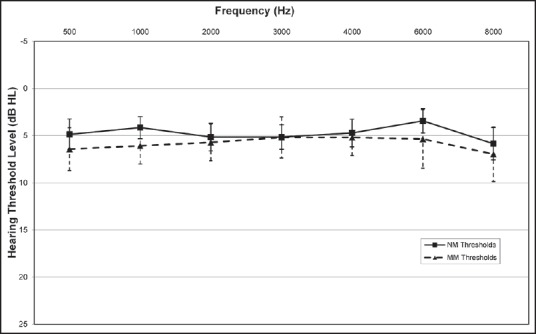
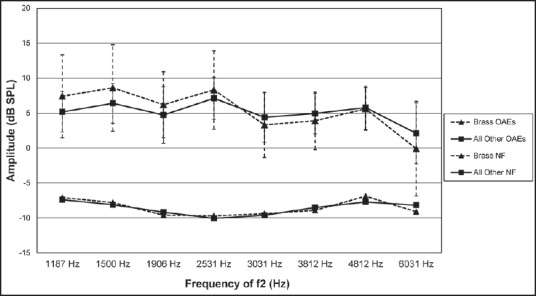
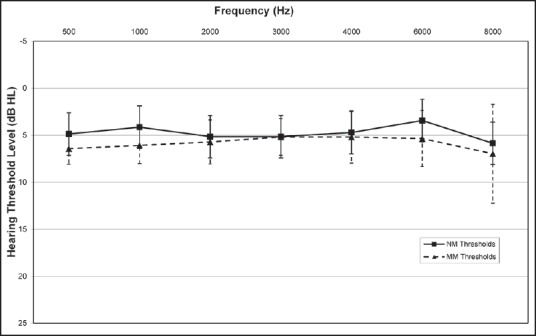
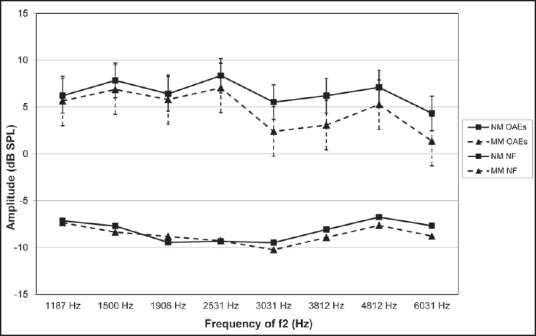
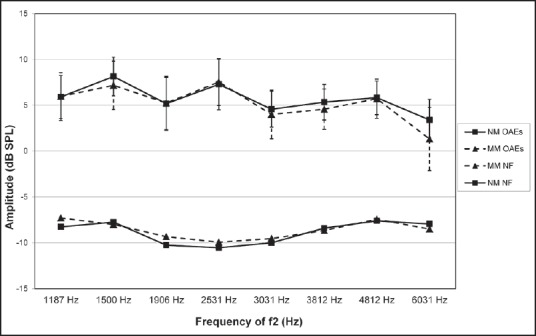
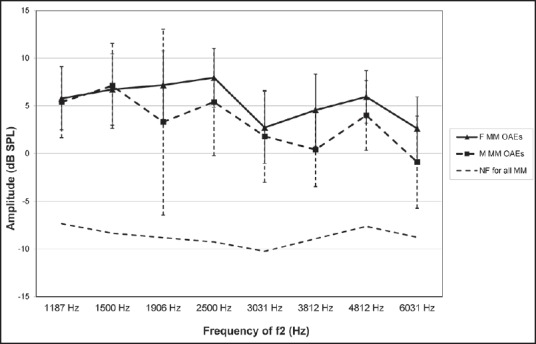
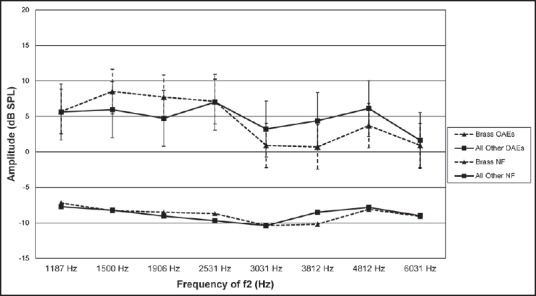
The presence and absence of distortion product otoacoustic emissions (DPOAEs) as well as DPOAE amplitudes were compared between college music majors and a control group of nonmusic majors. Participants included 28 music majors and 35 nonmusic majors enrolled at a university with ages ranging from 18-25 years. DPOAEs and hearing thresholds were measured bilaterally on all the participants. DPOAE amplitudes were analyzed at the following f2 frequencies: 1,187 Hz, 1,500 Hz, 1,906 Hz, 2,531 Hz, 3,031 Hz, 3812 Hz, 4,812 Hz, and 6,031 Hz. Significantly more music majors (7/28) than nonmusic majors (0/35) exhibited absent DPOAEs for at least one frequency in at least one ear. Both groups of students reported similar histories of recreational and occupational noise exposures that were unrelated to studying music, and none of the students reported high levels of noise exposure within the previous 48 h. There were no differences in audiometric thresholds between the groups at any frequency. At DPOAE f2 frequencies from 3,031 Hz to 6,031 Hz, nonsignificantly lower amplitudes of 2-4 dB were seen in the right ears of music majors versus nonmajors, and in the right ears of music majors playing brass instruments compared to music majors playing nonbrass instruments. Given the greater prevalence of absent DPOAEs in university music majors compared to nonmusic majors, it appears that early stages of cochlear damage may be occurring in this population. Additional research, preferably longitudinal and across multiple colleges/universities, would be beneficial to more definitively determine when the music students begin to show signs of cochlear damage, and to identify whether any particular subgroups of music majors are at a greater risk of cochlear damage.
比较了大学音乐专业学生和非音乐专业对照组的畸变产物耳声发射(DPOAE)的有无以及DPOAE幅值。参与者包括28名音乐专业学生和35名非音乐专业学生,他们就读于一所大学,年龄在18至25岁之间。对所有参与者双侧测量DPOAE和听力阈值。在以下f2频率分析DPOAE幅值:1187Hz、1500Hz、1906Hz、2531Hz、3031Hz、3812Hz、4812Hz和6031Hz。至少有一只耳朵至少在一个频率上DPOAE缺失的音乐专业学生(7/28)明显多于非音乐专业学生(0/35)。两组学生报告的娱乐和职业噪声暴露史相似,且与学习音乐无关,并且没有学生报告在过去48小时内有高水平的噪声暴露。两组在任何频率下的听力阈值均无差异。在3031Hz至6031Hz的DPOAE f2频率下,音乐专业学生右耳的幅值比非音乐专业学生低2 - 4dB,但差异不显著,并且与演奏非铜管乐器的音乐专业学生相比,演奏铜管乐器的音乐专业学生右耳的幅值也有非显著降低。鉴于与非音乐专业学生相比,大学音乐专业学生中DPOAE缺失的发生率更高,似乎该人群可能正在发生耳蜗损伤的早期阶段。进行更多的研究,最好是纵向研究且涉及多所学院/大学,将有助于更明确地确定音乐专业学生何时开始出现耳蜗损伤迹象,并确定音乐专业的任何特定亚组是否有更高的耳蜗损伤风险。