Department of Psychiatry and Neuropsychology, School for Mental Health and Neuroscience, Maastricht University, Maastricht, Netherlands.
Department of Neurosurgery, School for Mental Health and Neuroscience, Maastricht University, Maastricht, Netherlands.
Hum Brain Mapp. 2022 Oct 15;43(15):4699-4709. doi: 10.1002/hbm.25984. Epub 2022 Jun 23.
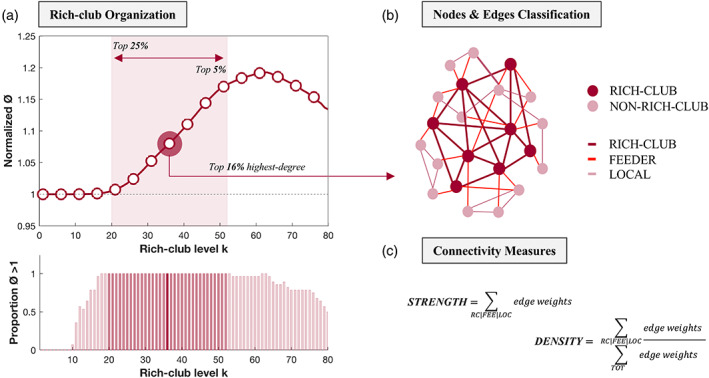
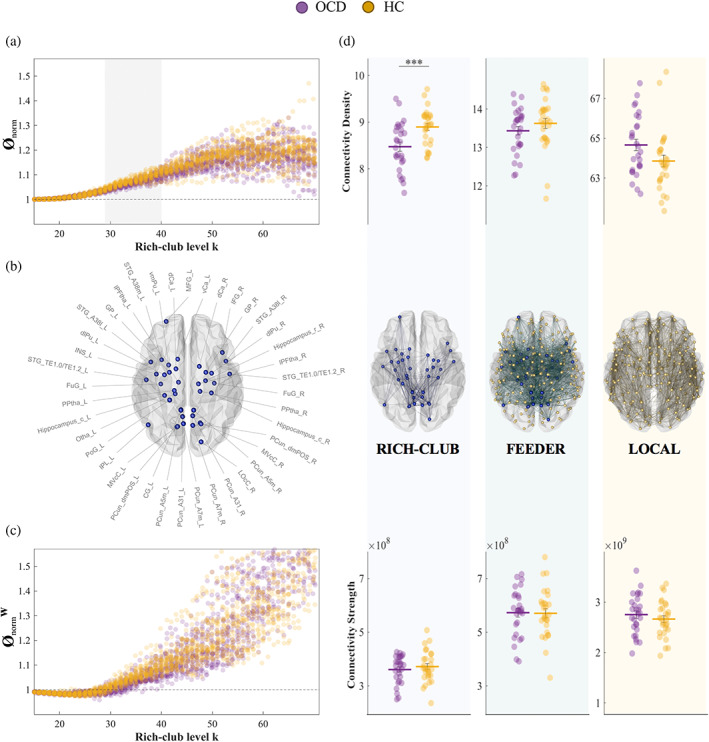
Rich-club organization is key to efficient global neuronal signaling and integration of information. Alterations interfere with higher-order cognitive processes, and are common to several psychiatric and neurological conditions. A few studies examining the structural connectome in obsessive-compulsive disorder (OCD) suggest lower efficiency of information transfer across the brain. However, it remains unclear whether this is due to alterations in rich-club organization. In the current study, the structural connectome of 28 unmedicated OCD patients, 8 of their unaffected siblings and 28 healthy controls was reconstructed by means of diffusion-weighted imaging and probabilistic tractography. Topological and weighted measures of rich-club organization and connectivity were computed, alongside global and nodal measures of network integration and segregation. The relationship between clinical scores and network properties was explored. Compared to healthy controls, OCD patients displayed significantly lower topological and weighted rich-club organization, allocating a smaller fraction of all connection weights to the rich-club core. Global clustering coefficient, local efficiency, and clustering of nonrich club nodes were significantly higher in OCD patients. Significant three-group differences emerged, with siblings displaying highest and lowest values in different measures. No significant correlation with any clinical score was found. Our results suggest weaker structural connectivity between rich-club nodes in OCD patients, possibly resulting in lower network integration in favor of higher network segregation. We highlight the need of looking at network-based alterations in brain organization and function when investigating the neurobiological basis of this disorder, and stimulate further research into potential familial protective factors against the development of OCD.
富连接组织是高效全球神经元信号传递和信息整合的关键。这种组织的改变会干扰高级认知过程,并且在几种精神和神经疾病中都很常见。一些研究观察到强迫症(OCD)患者大脑中的结构连接体存在信息传递效率降低的现象。然而,目前尚不清楚这种现象是否是由于富连接组织的改变所导致。在本研究中,通过弥散张量成像和概率追踪技术,重建了 28 名未用药的 OCD 患者、8 名未受影响的患者兄弟姐妹和 28 名健康对照者的结构连接组。计算了富连接组织和连接的拓扑和加权度量,以及网络整合和分离的全局和节点度量。还探讨了临床评分与网络属性之间的关系。与健康对照组相比,OCD 患者的拓扑和加权富连接组织明显降低,将连接权重的较小部分分配给富连接核心。OCD 患者的全局聚类系数、局部效率和非富连接节点的聚类显著升高。在不同的测量指标中,患者的兄弟姐妹表现出最高和最低的数值,出现了三组间的显著差异。但没有发现任何临床评分与网络属性之间存在显著相关性。我们的研究结果表明,OCD 患者的富连接节点之间的结构连接较弱,可能导致网络整合降低,而网络分离升高。我们强调,在研究这种疾病的神经生物学基础时,需要关注大脑组织和功能的基于网络的改变,并刺激对 OCD 发展的潜在家族保护因素的进一步研究。