Song Hun Min, Park Gwang Hun, Eo Hyun Ji, Jeong Jin Boo
Department of Bioresource Sciences, Andong National University, Andong 760749, Republic of Korea.
Biomol Ther (Seoul). 2016 Mar 1;24(2):140-6. doi: 10.4062/biomolther.2015.109.
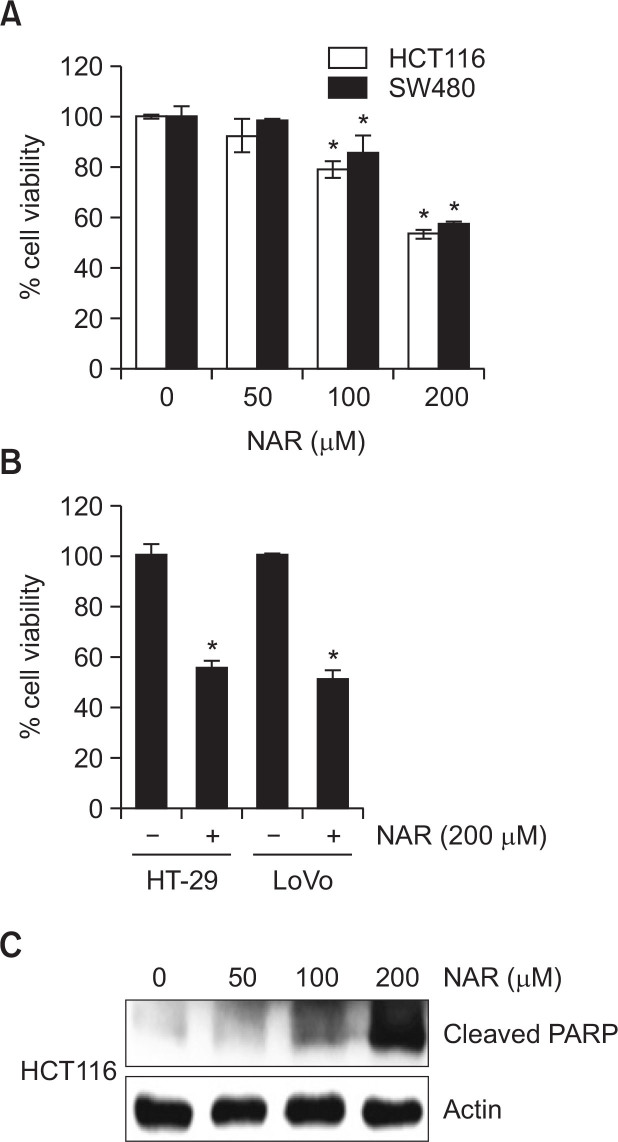
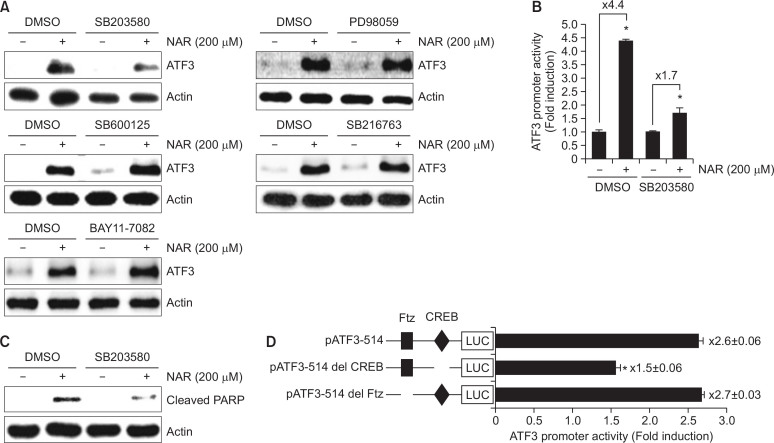
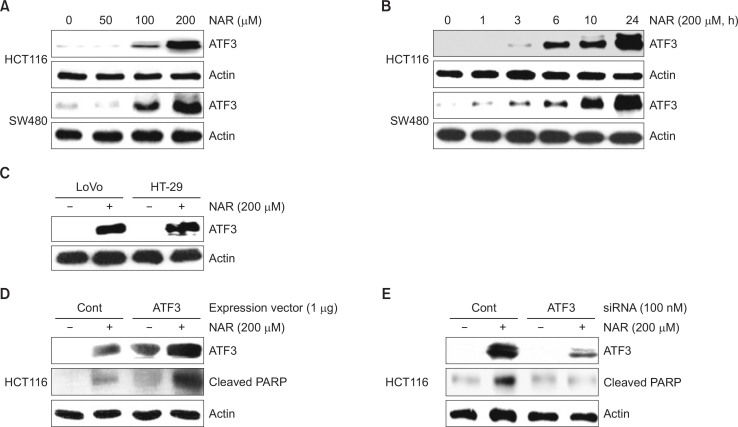
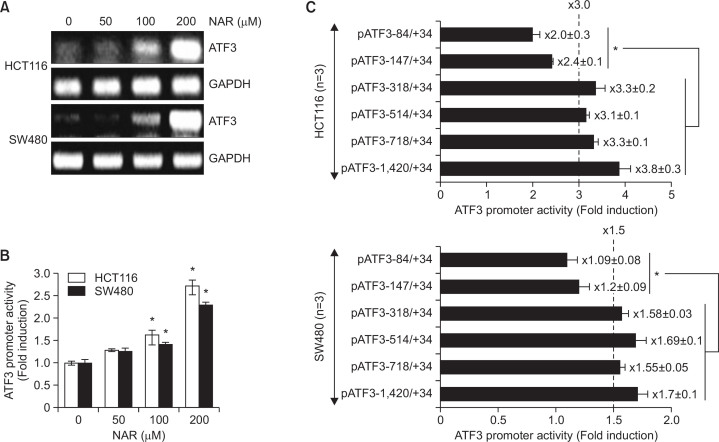
Naringenin (NAR) as one of the flavonoidsobserved in grapefruit has been reported to exhibit an anti-cancer activity. Activating transcription factor 3 (ATF3) is associated with apoptosis in human colon cancer cells. This study was performed to investigate the molecular mechanism by which NAR stimulates ATF3 expression and apoptosis in human colon cancer cells. NAR reduced the cell viability and induced an apoptosis in human colon cancer cells. ATF3 overexpression increased NAR-mediated cleaved PARP, while ATF3 knockdown attenuated the cleavage of PARP by NAR. NAR increased ATF3 expression in both protein and mRNA level, and increased the luciferase activity of ATF3 promoter in a dose-dependent manner. The responsible region for ATF3 transcriptional activation by NAR is located between -317 and -148 of ATF3 promoter. p38 inhibition blocked NAR-mediated ATF3 expression, its promoter activation and apoptosis. The results suggest that NAR induces apoptosis through p38-dependent ATF3 activation in human colon cancer cells.
柚皮素(NAR)作为葡萄柚中发现的类黄酮之一,已被报道具有抗癌活性。激活转录因子3(ATF3)与人类结肠癌细胞的凋亡有关。本研究旨在探讨NAR刺激人类结肠癌细胞中ATF3表达和凋亡的分子机制。NAR降低了人类结肠癌细胞的活力并诱导其凋亡。ATF3过表达增加了NAR介导的PARP裂解,而ATF3敲低则减弱了NAR对PARP的裂解作用。NAR在蛋白质和mRNA水平上均增加了ATF3的表达,并以剂量依赖的方式增加了ATF3启动子的荧光素酶活性。NAR激活ATF3转录的责任区域位于ATF3启动子的-317至-148之间。p38抑制可阻断NAR介导的ATF3表达、其启动子激活及凋亡。结果表明,NAR通过p38依赖的ATF3激活在人类结肠癌细胞中诱导凋亡。