
白细胞黏附和趋化功能缺陷导致常染色体隐性 MST1 缺陷患者出现联合免疫缺陷。
Defective Leukocyte Adhesion and Chemotaxis Contributes to Combined Immunodeficiency in Humans with Autosomal Recessive MST1 Deficiency.
作者信息
Dang Tarana Singh, Willet Joseph D P, Griffin Helen R, Morgan Neil V, O'Boyle Graeme, Arkwright Peter D, Hughes Stephen M, Abinun Mario, Tee Louise J, Barge Dawn, Engelhardt Karin R, Jackson Michael, Cant Andrew J, Maher Eamonn R, Koref Mauro Santibanez, Reynard Louise N, Ali Simi, Hambleton Sophie
机构信息
Institute for Cellular Medicine, Newcastle University, Newcastle upon Tyne, NE2 4HH, UK.
Institute of Genetic Medicine, Newcastle University, Newcastle upon Tyne, UK.
出版信息
J Clin Immunol. 2016 Feb;36(2):117-22. doi: 10.1007/s10875-016-0232-2. Epub 2016 Jan 22.
PURPOSE
To investigate the clinical and functional aspects of MST1 (STK4) deficiency in a profoundly CD4-lymphopenic kindred with a novel homozygous nonsense mutation in STK4. Although recent studies have described the cellular effects of murine Mst1 deficiency, the phenotype of MST1-deficient human lymphocytes has yet to be fully explored. Patient lymphocytes were therefore investigated in the context of current knowledge of murine Mst1 deficiency.
METHODS
Genetic etiology was identified by whole exome sequencing of genomic DNA from two siblings, combined with linkage analysis in the wider family. MST1 protein expression was assessed by immunoblotting. The ability of patient lymphocytes to adhere to ICAM-1 under flow conditions was measured, and transwell assays were used to assess chemotaxis. Chemokine receptor expression was examined by flow cytometry and receptor signalling by immunoblotting.
RESULTS
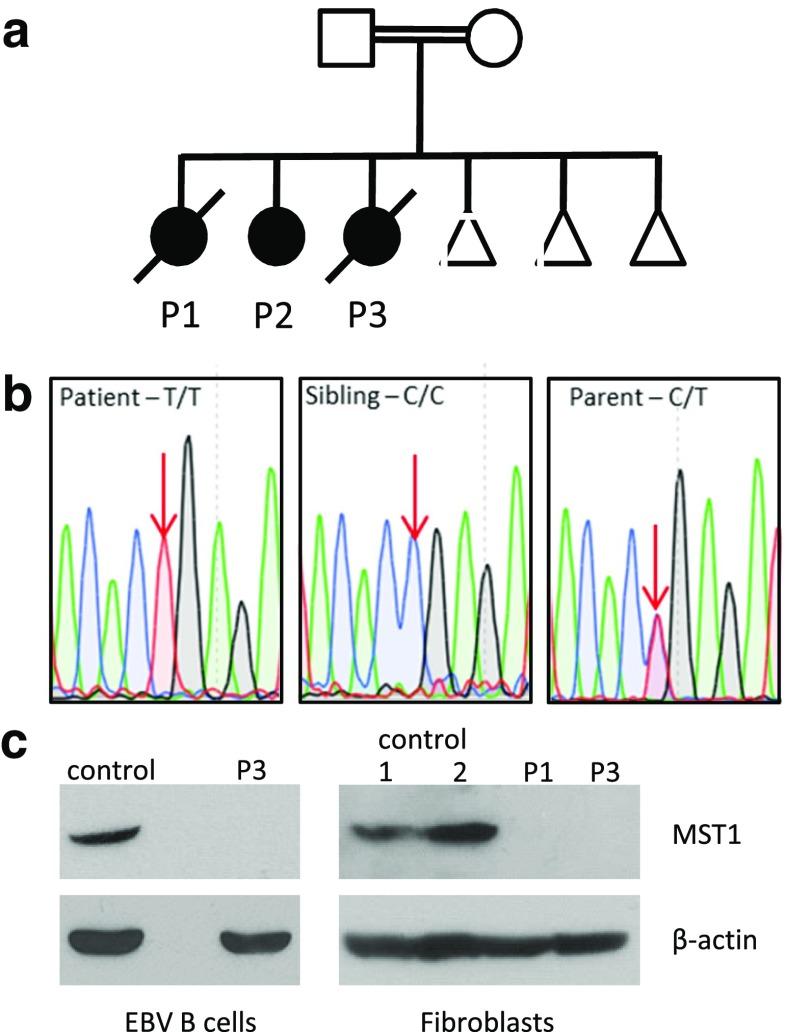
A homozygous nonsense mutation in STK4 (c.442C > T, p.Arg148Stop) was found in the patients, leading to a lack of MST1 protein expression. Patient leukocytes exhibited deficient chemotaxis after stimulation with CXCL11, despite preserved expression of CXCR3. Patient lymphocytes were also unable to bind effectively to immobilised ICAM-1 under flow conditions, in keeping with a failure to develop high affinity binding.
CONCLUSION
The observed abnormalities of adhesion and migration imply a profound trafficking defect among human MST1-deficient lymphocytes. By analogy with murine Mst1 deficiency and other defects of leucocyte trafficking, this is likely to contribute to immunodeficiency by impairing key aspects of T-cell development and function such as positive selection in the thymus, thymic egress and immune synapse formation in the periphery.
目的
在一个患有严重CD4淋巴细胞减少症的家族中,该家族的STK4基因存在一种新的纯合无义突变,研究MST1(STK4)缺乏的临床和功能方面。尽管最近的研究描述了小鼠Mst1缺乏的细胞效应,但MST1缺乏的人类淋巴细胞的表型尚未得到充分探索。因此,在当前对小鼠Mst1缺乏的认识背景下,对患者的淋巴细胞进行了研究。
方法
通过对两名同胞的基因组DNA进行全外显子测序,并结合更广泛家族中的连锁分析,确定遗传病因。通过免疫印迹法评估MST1蛋白表达。测量患者淋巴细胞在流动条件下与细胞间黏附分子-1(ICAM-1)结合的能力,并使用Transwell试验评估趋化性。通过流式细胞术检测趋化因子受体表达,并通过免疫印迹法检测受体信号传导。
结果
在患者中发现STK4基因的纯合无义突变(c.442C>T,p.Arg148Stop),导致MST1蛋白表达缺失。尽管CXCR3表达保留,但患者白细胞在受到CXCL11刺激后趋化性不足。患者淋巴细胞在流动条件下也无法有效地与固定化的ICAM-1结合,这与无法形成高亲和力结合一致。
结论
观察到的黏附和迁移异常表明人类MST1缺乏的淋巴细胞存在严重的运输缺陷。与小鼠Mst1缺乏和其他白细胞运输缺陷类似,这可能通过损害T细胞发育和功能的关键方面,如胸腺中的阳性选择、胸腺输出和外周免疫突触形成,导致免疫缺陷。

 Zotero 插件