de Oliveira Manoel Airton Leonardo, Goffi Alberto, Marotta Tom R, Schweizer Tom A, Abrahamson Simon, Macdonald R Loch
St. Michael's Hospital, 30 Bond Street, Toronto, ON, M5B 1 W8, Canada.
Keenan Research Centre for Biomedical Science of St. Michael's Hospital, 30 Bond Street, Toronto, ON, M5B 1 W8, Canada.
Crit Care. 2016 Jan 23;20:21. doi: 10.1186/s13054-016-1193-9.
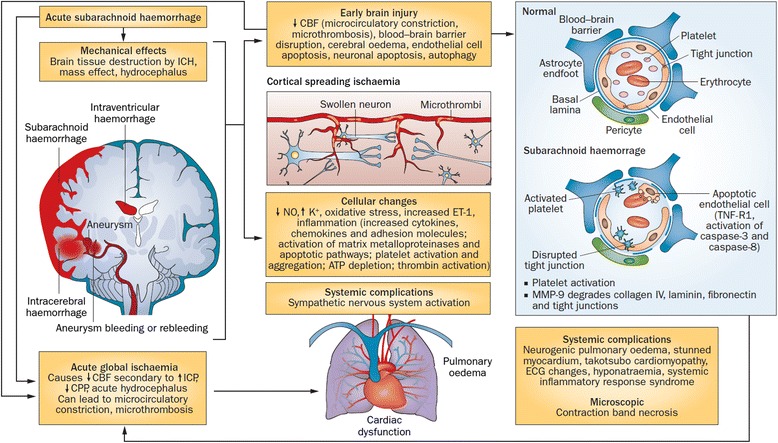
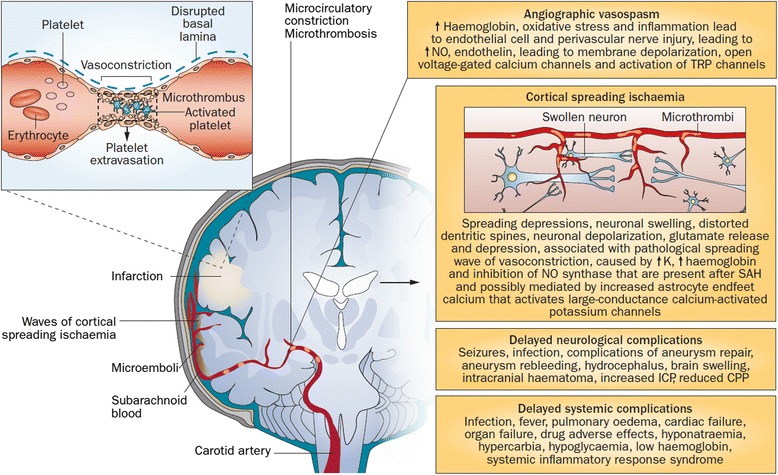
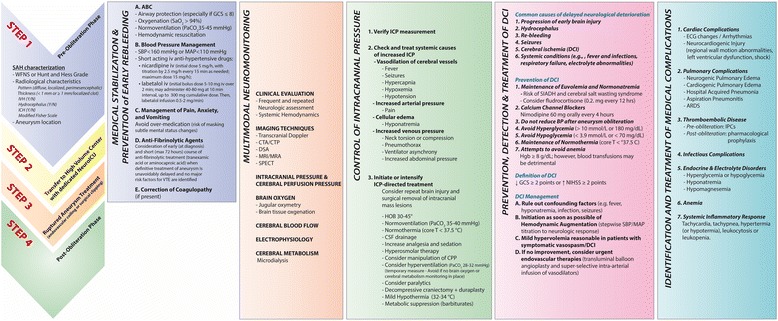
Aneurysmal subarachnoid haemorrhage is a neurological syndrome with complex systemic complications. The rupture of an intracranial aneurysm leads to the acute extravasation of arterial blood under high pressure into the subarachnoid space and often into the brain parenchyma and ventricles. The haemorrhage triggers a cascade of complex events, which ultimately can result in early brain injury, delayed cerebral ischaemia, and systemic complications. Although patients with poor-grade subarachnoid haemorrhage (World Federation of Neurosurgical Societies 4 and 5) are at higher risk of early brain injury, delayed cerebral ischaemia, and systemic complications, the early and aggressive treatment of this patient population has decreased overall mortality from more than 50% to 35% in the last four decades. These management strategies include (1) transfer to a high-volume centre, (2) neurological and systemic support in a dedicated neurological intensive care unit, (3) early aneurysm repair, (4) use of multimodal neuromonitoring, (5) control of intracranial pressure and the optimisation of cerebral oxygen delivery, (6) prevention and treatment of medical complications, and (7) prevention, monitoring, and aggressive treatment of delayed cerebral ischaemia. The aim of this article is to provide a summary of critical care management strategies applied to the subarachnoid haemorrhage population, especially for patients in poor neurological condition, on the basis of the modern concepts of early brain injury and delayed cerebral ischaemia.
动脉瘤性蛛网膜下腔出血是一种伴有复杂全身并发症的神经综合征。颅内动脉瘤破裂导致动脉血在高压下急性外渗至蛛网膜下腔,且常进入脑实质和脑室。出血引发一系列复杂事件,最终可导致早期脑损伤、迟发性脑缺血和全身并发症。尽管低分级蛛网膜下腔出血患者(世界神经外科协会联盟分级4级和5级)发生早期脑损伤、迟发性脑缺血和全身并发症的风险较高,但在过去四十年中,对这一患者群体的早期积极治疗已使总体死亡率从超过50%降至35%。这些管理策略包括:(1)转至大容量中心;(2)在专门的神经重症监护病房进行神经和全身支持;(3)早期动脉瘤修复;(4)使用多模式神经监测;(5)控制颅内压并优化脑氧输送;(6)预防和治疗医疗并发症;(7)预防、监测和积极治疗迟发性脑缺血。本文旨在基于早期脑损伤和迟发性脑缺血的现代概念,总结应用于蛛网膜下腔出血患者群体,尤其是神经状况较差患者的重症监护管理策略。