Li Jia-Je, Chang Shun-Fu, Liau I-Iu, Chan Pei-Chia, Liu Ren-Shyan, Yen Sang-Hue, Wang Hsin-Ell, Chang Cheng Allen
Department of Biomedical Imaging and Radiological Sciences, National Yang-Ming University, No. 155, Sec. 2, Linong St., Beitou District, Taipei, 112, Taiwan, ROC.
Program in Molecular Medicine, National Yang-Ming University and Academia Sinica, Taipei, 112, Taiwan, ROC.
J Biomed Sci. 2016 Jan 22;23:15. doi: 10.1186/s12929-016-0227-6.
The enzyme-prodrug system is considered a promising tool for tumor treatment when conjugated with a targeting molecule. The asparagine-glycine-arginine (NGR) motif is a developing and interesting targeting peptide that could specifically bind to aminopeptidase N (APN), which is an NGR receptor expressed on the cell membrane of angiogenic endothelial cells and a number of tumor cells within the tumor tissues. The objective of this study was to develop a novel targeted enzyme-prodrug system using 5-fluorocytosine (5-FC) and an NGR-containing peptide fused with yeast cytosine deaminase (yCD), i.e. CNGRC-yCD fusion protein, to target APN-expressing cells within the tumor tissues and to convert 5-FC into 5-fluorouracil (5-FU) to kill tumors.
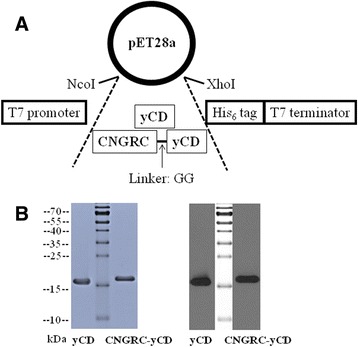
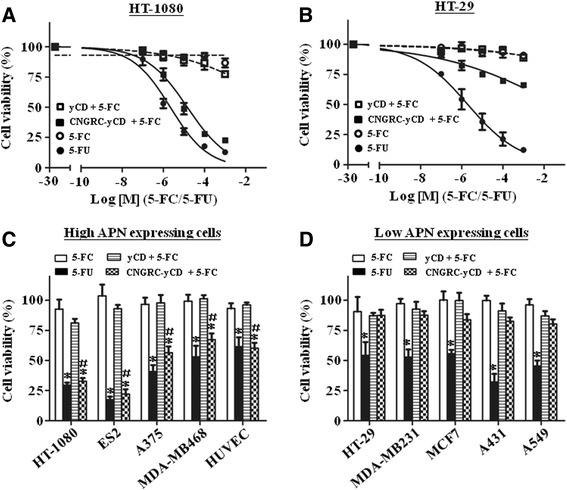
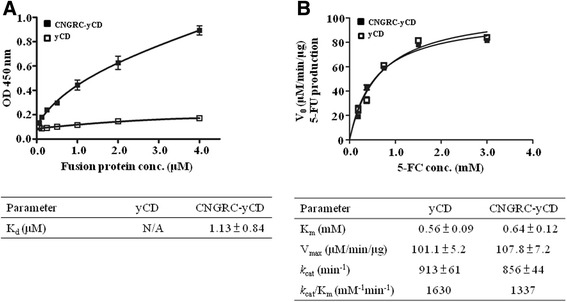
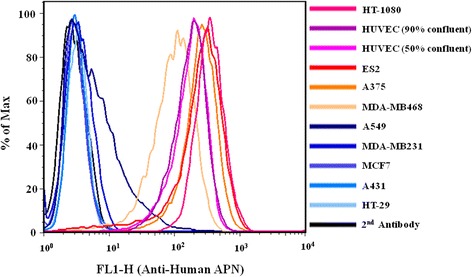
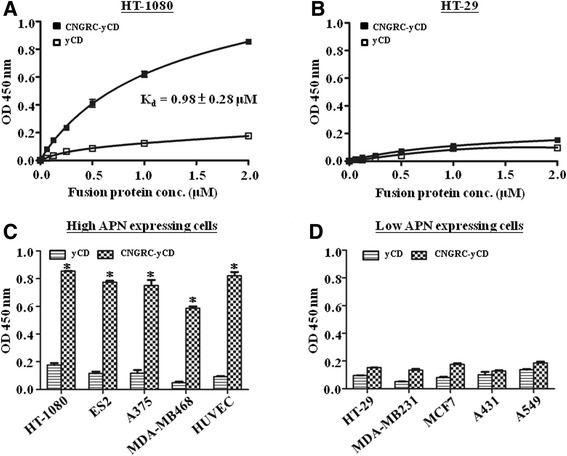
Both yCD and CNGRC-yCD proteins were cloned into the pET28a vector and expressed by an Escherichia coli host. Both yCD and CNGRC-yCD proteins were purified and the yields were approximately 20 mg/L with over 95 % purity. The binding assay demonstrated that the CNGRC-yCD fusion protein had specific binding affinity toward purified APN recombinant protein and high-APN-expressing cells, including human endothelial cells (HUVECs) and various types of human tumor cell lines, but not low-APN-expressing tumor cell lines. Moreover, the enzyme activity and cell viability assay showed that the CNGRC-yCD fusion protein could effectively convert 5-FC into 5-FU and resulted in significant cell death in both high-APN-expressing tumor cells and HUVECs.
This study successfully constructs a new targeting enzyme-prodrug system, CNGRC-yCD fusion protein/5-FC. Systematic experiments demonstrated that the CNGRC-yCD protein retained both the APN-binding affinity of NGR and the enzyme activity of yCD to convert 5-FC into 5-FU. The combined treatment of the CNGRC-yCD protein with 5-FC resulted in the significantly increased cell death of high-APN-expressing cells as compared to that of low-APN-expressing cells.
当与靶向分子偶联时,酶-前药系统被认为是一种有前景的肿瘤治疗工具。天冬酰胺-甘氨酸-精氨酸(NGR)基序是一种正在发展且有趣的靶向肽,它可以特异性结合氨肽酶N(APN),APN是一种在血管生成性内皮细胞膜以及肿瘤组织内的许多肿瘤细胞上表达的NGR受体。本研究的目的是开发一种新型靶向酶-前药系统,该系统使用5-氟胞嘧啶(5-FC)以及与酵母胞嘧啶脱氨酶(yCD)融合的含NGR肽,即CNGRC-yCD融合蛋白,以靶向肿瘤组织内表达APN的细胞,并将5-FC转化为5-氟尿嘧啶(5-FU)来杀死肿瘤。
yCD和CNGRC-yCD蛋白均被克隆到pET28a载体中,并由大肠杆菌宿主表达。yCD和CNGRC-yCD蛋白均被纯化,产量约为20 mg/L,纯度超过95%。结合试验表明,CNGRC-yCD融合蛋白对纯化的APN重组蛋白以及高表达APN的细胞具有特异性结合亲和力,这些细胞包括人内皮细胞(HUVECs)和各种类型的人肿瘤细胞系,但对低表达APN的肿瘤细胞系无此作用。此外,酶活性和细胞活力试验表明,CNGRC-yCD融合蛋白可有效将5-FC转化为5-FU,并导致高表达APN的肿瘤细胞和HUVECs中显著的细胞死亡。
本研究成功构建了一种新的靶向酶-前药系统,即CNGRC-yCD融合蛋白/5-FC。系统实验表明,CNGRC-yCD蛋白保留了NGR的APN结合亲和力以及yCD将5-FC转化为5-FU的酶活性。与低表达APN的细胞相比,CNGRC-yCD蛋白与5-FC联合治疗导致高表达APN的细胞死亡显著增加。