Eisendrath Stuart J, Gillung Erin, Delucchi Kevin L, Segal Zindel V, Nelson J Craig, McInnes L Alison, Mathalon Daniel H, Feldman Mitchell D
Department of Psychiatry, University of California, San Francisco, Calif., USA.
Psychother Psychosom. 2016;85(2):99-110. doi: 10.1159/000442260. Epub 2016 Jan 26.
Due to the clinical challenges of treatment-resistant depression (TRD), we evaluated the efficacy of mindfulness-based cognitive therapy (MBCT) relative to a structurally equivalent active comparison condition as adjuncts to treatment-as-usual (TAU) pharmacotherapy in TRD.
This single-site, randomized controlled trial compared 8-week courses of MBCT and the Health Enhancement Program (HEP), comprising physical fitness, music therapy and nutritional education, as adjuncts to TAU pharmacotherapy for outpatient adults with TRD. The primary outcome was change in depression severity, measured by percent reduction in the total score on the 17-item Hamilton Depression Rating Scale (HAM-D17), with secondary depression indicators of treatment response and remission.
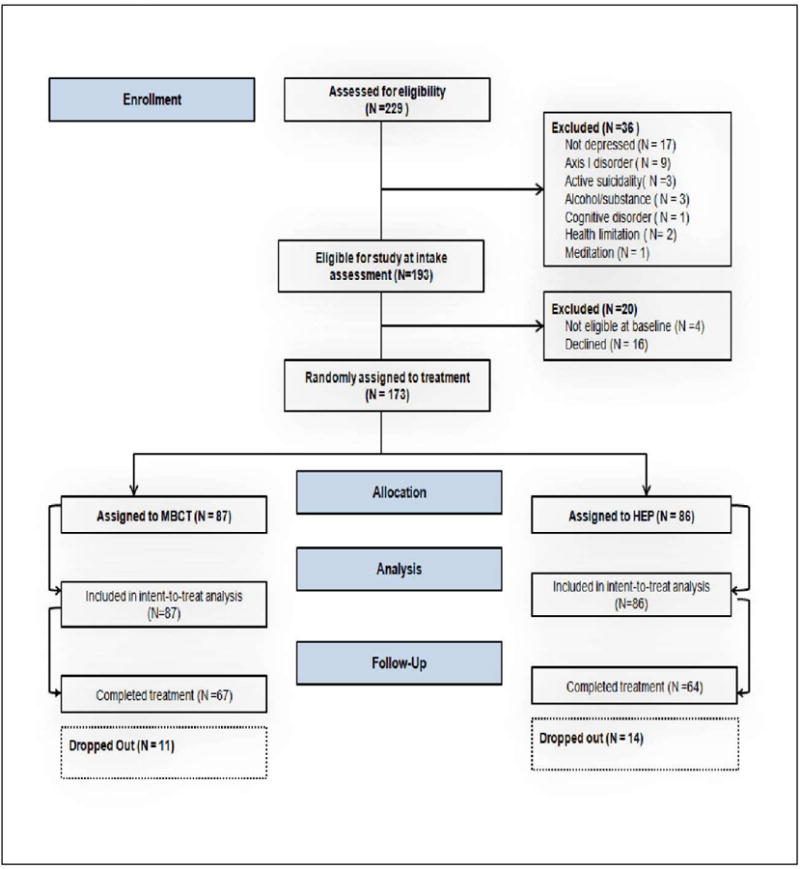
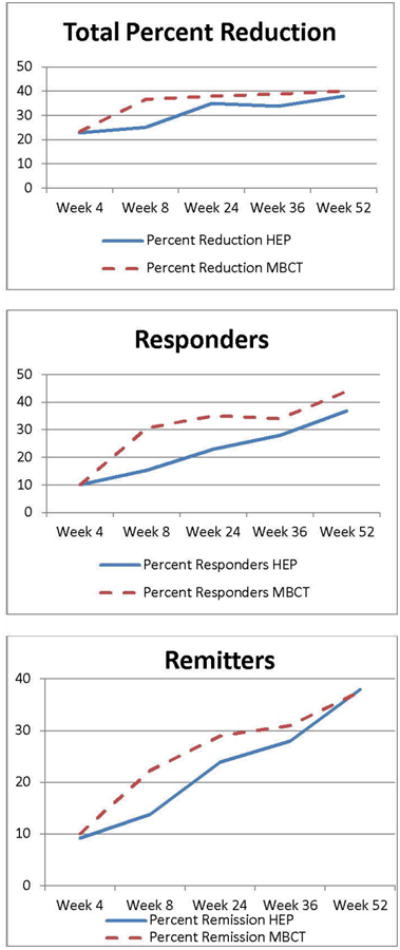
We enrolled 173 adults; mean length of a current depressive episode was 6.8 years (SD = 8.9). At the end of 8 weeks of treatment, a multivariate analysis showed that relative to the HEP condition, the MBCT condition was associated with a significantly greater mean percent reduction in the HAM-D17 (36.6 vs. 25.3%; p = 0.01) and a significantly higher rate of treatment responders (30.3 vs. 15.3%; p = 0.03). Although numerically superior for MBCT than for HEP, the rates of remission did not significantly differ between treatments (22.4 vs. 13.9%; p = 0.15). In these models, state anxiety, perceived stress and the presence of personality disorder had adverse effects on outcomes.
MBCT significantly decreased depression severity and improved treatment response rates at 8 weeks but not remission rates. MBCT appears to be a viable adjunct in the management of TRD.
鉴于难治性抑郁症(TRD)的临床治疗挑战,我们评估了正念认知疗法(MBCT)相对于结构等效的积极对照条件作为TRD常规治疗(TAU)药物治疗辅助手段的疗效。
这项单中心随机对照试验比较了MBCT和健康促进计划(HEP,包括体能训练、音乐疗法和营养教育)为期8周的课程,作为门诊成年TRD患者TAU药物治疗的辅助手段。主要结局是抑郁严重程度的变化,通过17项汉密尔顿抑郁量表(HAM-D17)总分降低的百分比来衡量,次要抑郁指标为治疗反应和缓解情况。
我们招募了173名成年人;当前抑郁发作的平均时长为6.8年(标准差=8.9)。在8周治疗结束时,多变量分析显示,相对于HEP组,MBCT组的HAM-D17平均降低百分比显著更高(36.6%对25.3%;p=0.01),治疗反应者的比例显著更高(30.3%对15.3%;p=0.03)。虽然MBCT组的缓解率在数值上高于HEP组,但两组治疗的缓解率差异不显著(22.4%对13.9%;p=0.15)。在这些模型中,状态焦虑、感知压力和人格障碍的存在对结局有不利影响。
MBCT在8周时显著降低了抑郁严重程度并提高了治疗反应率,但未提高缓解率。MBCT似乎是TRD管理中一种可行的辅助治疗方法。