Lu Dai-Yin, Yang Albert C, Cheng Hao-Min, Lu Tse-Min, Yu Wen-Chung, Chen Chen-Huan, Sung Shih-Hsien
Department of Medicine, Taipei Veterans General Hospital, Taipei, Taiwan.
Institute of Clinical Medicine, National Yang-Ming University, Taipei, Taiwan.
PLoS One. 2016 Jan 26;11(1):e0144935. doi: 10.1371/journal.pone.0144935. eCollection 2016.
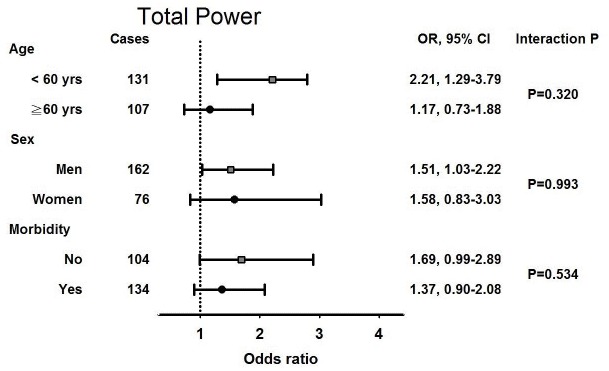
Heart rate variability (HRV) reflects the healthiness of autonomic nervous system, which is associated with exercise capacity. We therefore investigated whether HRV could predict the exercise capacity in the adults with cardiac syndrome X (CSX). A total of 238 subjects (57±12 years, 67.8% men), who were diagnosed as CSX by the positive exercise stress test and nearly normal coronary angiogram were enrolled. Power spectrum from the 24-hour recording of heart rate was analyzed in frequency domain using total power (TP) and spectral components of the very low frequency (VLF), low frequency (LF) and high frequency (HF) ranges. Among the study population, 129 subjects with impaired exercise capacity during the treadmill test had significantly lower HRV indices than those with preserved exercise capacity (≥90% of the age predicted maximal heart rate). After accounting for age, sex, and baseline SBP and heart rate, VLF (odds ratio per 1SD and 95% CI: 2.02, 1.19-3.42), LF (1.67, 1.10-2.55), and TP (1.82, 1.17-2.83) remained significantly associated with preserved exercise capacity. In addition, increased HRV indices were also associated with increased exercise duration, rate-pressure product, and heart rate recovery, independent of age, body mass index, and baseline SBP and heart rate. In subgroup analysis, HRV indices demonstrated similar predictive values related to exercise capacity across various subpopulations, especially in the young. In patients with CSX, HRV was independently associated with exercise capacity, especially in young subjects. The healthiness of autonomic nervous system may have a role in modulating the exercise capacity in patients with CSX.
心率变异性(HRV)反映自主神经系统的健康状况,而自主神经系统与运动能力相关。因此,我们研究了HRV是否能预测心脏X综合征(CSX)成人患者的运动能力。共有238名受试者(年龄57±12岁,男性占67.8%)入组,这些受试者经运动应激试验阳性及冠状动脉造影基本正常而被诊断为CSX。对24小时心率记录进行功率谱分析,在频域中使用总功率(TP)以及极低频(VLF)、低频(LF)和高频(HF)范围的频谱成分。在研究人群中,129名在跑步机试验中运动能力受损的受试者的HRV指标显著低于运动能力保留(≥年龄预测最大心率的90%)的受试者。在考虑年龄、性别、基线收缩压和心率后,VLF(每1标准差的比值比及95%可信区间:2.02,1.19 - 3.42)、LF(1.67,1.10 - 2.55)和TP(1.82,1.17 - 2.83)仍与运动能力保留显著相关。此外,HRV指标升高还与运动持续时间、心率 - 血压乘积和心率恢复增加相关,且独立于年龄、体重指数以及基线收缩压和心率。在亚组分析中,HRV指标在各个亚组中与运动能力相关的预测价值相似,尤其是在年轻人中。在CSX患者中,HRV与运动能力独立相关,尤其是在年轻受试者中。自主神经系统的健康状况可能在调节CSX患者的运动能力方面发挥作用。