Key Laboratory of Biorheological Science and Technology (Chongqing University), Ministry of Education, Chongqing Engineering Laboratory in Vascular Implants, Bioengineering College, Chongqing University, No. 174 Shazhengjie, Shapingba, Chongqing 400044, China, School of Biological Science and Medical Engineering, Beihang University, No. 37 XueYuan Road, HaiDian District, Beijing 100191, China and Department of Biotechnology, Chemistry, and Environmental Engineering, Aalborg University, Fredrik Bajers Vej 7, Building H, 9220, Aalborg, Denmark.
Regen Biomater. 2015 Jun;2(2):87-96. doi: 10.1093/rb/rbv007. Epub 2015 Jun 1.
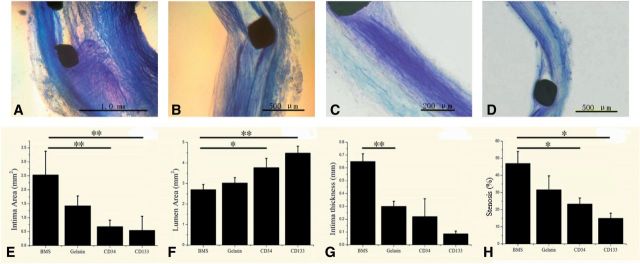
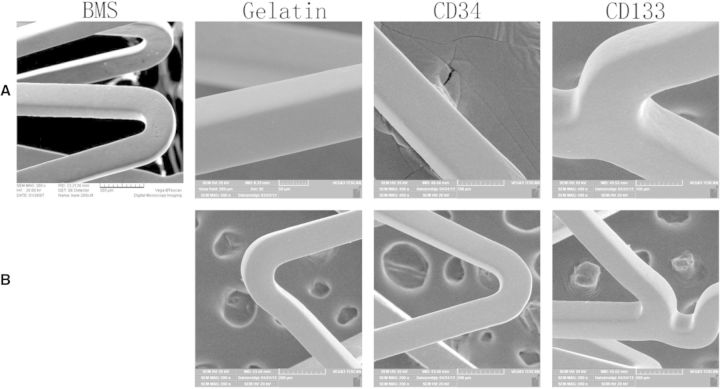
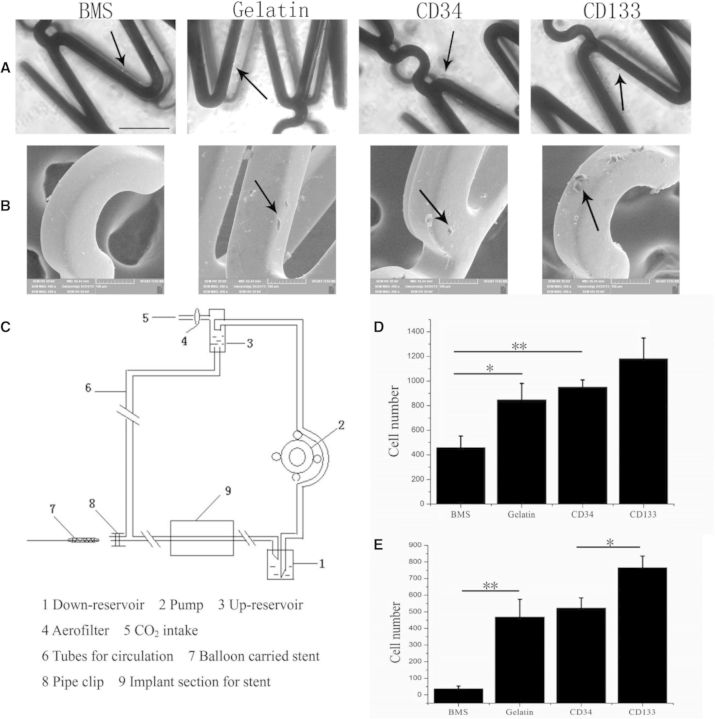
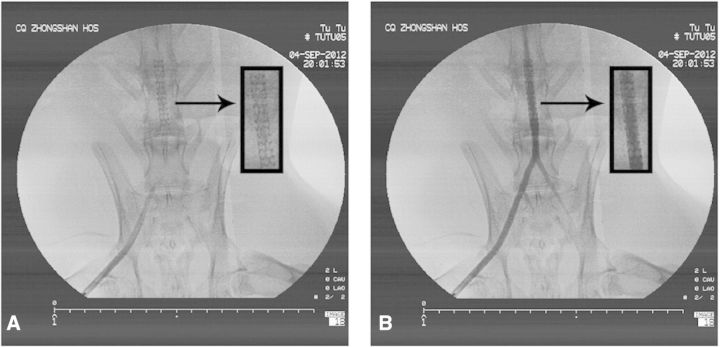
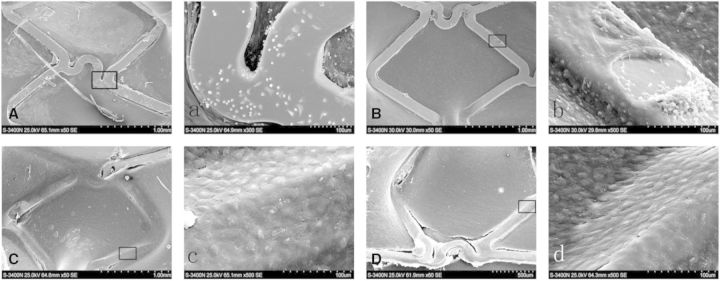
It is not clear what effects of CD34- and CD133-specific antibody-coated stents have on re-endothelialization and in-stent restenosis (ISR) at the early phase of vascular injury. This study aims at determining the capabilities of different coatings on stents (e.g. gelatin, anti-CD133 and anti-CD34 antibodies) to promote adhesion and proliferation of endothelial progenitor cells (EPCs). The in vitro study revealed that the adhesion force enabled the EPCs coated on glass slides to withstand flow-induced shear stress, so that allowing for the growth of the cells on the slides for 48 h. The in vivo experiment using a rabbit model in which the coated stents with different substrates were implanted showed that anti-CD34 and anti-CD133 antibody-coated stents markedly reduced the intima area and restenosis than bare mental stents (BMS) and gelatin-coated stents. Compared with the anti-CD34 antibody-coated stents, the time of cells adhesion was longer and earlier present in the anti-CD133 antibody-coated stents and anti-CD133 antibody-coated stents have superiority in re-endothelialization and inhibition of ISR. In conclusion, this study demonstrated that anti-CD133 antibody as a stent coating for capturing EPCs is better than anti-CD34 antibody in promoting endothelialization and reducing ISR.
目前尚不清楚 CD34 和 CD133 特异性抗体涂层支架对血管损伤早期再内皮化和支架内再狭窄(ISR)的影响。本研究旨在确定支架上不同涂层(如明胶、抗 CD133 和抗 CD34 抗体)促进内皮祖细胞(EPCs)黏附和增殖的能力。体外研究表明,涂覆在载玻片上的 EPCs 的黏附力使其能够承受流动诱导的剪切力,从而使细胞在载玻片上生长 48 小时。在植入不同基底涂层支架的兔模型体内实验中,抗 CD34 和抗 CD133 抗体涂层支架明显减少了内膜面积和再狭窄,与裸金属支架(BMS)和明胶涂层支架相比。与抗 CD34 抗体涂层支架相比,细胞黏附的时间更长,在抗 CD133 抗体涂层支架中更早出现,抗 CD133 抗体涂层支架在再内皮化和抑制 ISR 方面具有优势。总之,本研究表明,抗 CD133 抗体作为一种捕获 EPCs 的支架涂层,在促进内皮化和减少 ISR 方面优于抗 CD34 抗体。