
急诊科就诊时血液白细胞介素-6水平升高与钝性创伤患者重症监护病房住院时间延长之间的关联。
Association between increased blood interleukin-6 levels on emergency department arrival and prolonged length of intensive care unit stay for blunt trauma.
作者信息
Taniguchi Masashi, Nakada Taka-Aki, Shinozaki Koichiro, Mizushima Yasuaki, Matsuoka Tetsuya
机构信息
Senshu Trauma and Critical Care Center, 2-23 Rinku Orai Kita, Osaka, 598-8577 Japan.
Senshu Trauma and Critical Care Center, 2-23 Rinku Orai Kita, Osaka, 598-8577 Japan ; Chiba University Graduate School of Medicine, 1-8-1 Inohana, Chuo, Chiba, 260-8677 Japan.
出版信息
World J Emerg Surg. 2016 Jan 25;11:6. doi: 10.1186/s13017-016-0063-8. eCollection 2016.
BACKGROUND
Systemic immune response to injury plays a key role in the pathophysiological mechanism of blunt trauma. We tested the hypothesis that increased blood interleukin-6 (IL-6) levels of blunt trauma patients on emergency department (ED) arrival are associated with poor clinical outcomes, and investigated the utility of rapid measurement of the blood IL-6 level.
METHODS
We enrolled 208 consecutive trauma patients who were transferred from the scene of an accident to a level I trauma centre in Japan and admitted to the intensive care unit (ICU). Blood IL-6 levels on ED arrival were measured by using a rapid measurement assay. The primary outcome variable was prolonged ICU stay (length of ICU stay > 7 days). The secondary outcomes were 28-day mortality, probability of survival and Abbreviated Injury Scale (AIS) scores.
RESULTS
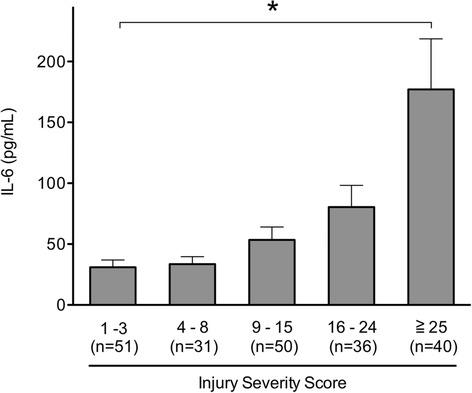
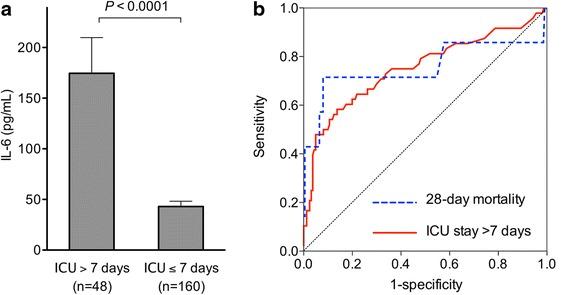
Patients with prolonged ICU stay had significantly higher blood IL-6 levels on ED arrival than the patients without prolonged ICU stay (P < 0.0001). The receiver-operating characteristic curves produced an area under the curve of 0.75 (95 % confidence interval [CI], 0.66-0.84; P < 0.0001) for prolonged ICU stay. The patients who had increased blood IL-6 levels on ED arrival had increased 28-day mortality (P = 0.021) and decreased probability of survival (P < 0.0001). The AIS scores for the thorax, abdomen, extremity, and external body regions independently correlated with blood IL-6 levels (unstandardized coefficients [95 % CI] for the thorax: 23.8 [12.6-35.1]; P < 0.0001; abdomen: 42.7 [23.8-61.7]; P < 0.0001; extremity: 19.0 [5.5-32.4]; P = 0.0060; external body regions: 62.9 [13.2-112.7]; P = 0.030); the standardized coefficients for the thorax (0.27) and abdomen (0.28) were larger than those for the extremity (0.18) and external body regions (0.15).
CONCLUSIONS
Increased blood IL-6 level on ED arrival was significantly associated with prolonged length of ICU stay. Blood IL-6 level on ED arrival independently correlated with the AIS scores for the abdomen and thorax, and, to a lesser extent, those for the extremity and external body regions. The rapid measurement of blood IL-6 level on ED arrival can be utilized as a fast screening tool to improve assessment of injury severity and prediction of clinical outcomes in the initial phase of trauma care.
背景
机体对损伤的全身免疫反应在钝性创伤的病理生理机制中起关键作用。我们检验了以下假设:钝性创伤患者在急诊科(ED)就诊时血白细胞介素-6(IL-6)水平升高与不良临床结局相关,并研究了快速检测血IL-6水平的实用性。
方法
我们纳入了208例连续的创伤患者,这些患者从事故现场转运至日本的一级创伤中心并入住重症监护病房(ICU)。采用快速检测法测定患者在ED就诊时的血IL-6水平。主要结局变量为ICU住院时间延长(ICU住院时间>7天)。次要结局包括28天死亡率、生存概率和简明损伤定级(AIS)评分。
结果
ICU住院时间延长的患者在ED就诊时的血IL-6水平显著高于未延长ICU住院时间的患者(P<0.0001)。对于ICU住院时间延长,受试者工作特征曲线下面积为0.75(95%置信区间[CI],0.66-0.84;P<0.0001)。在ED就诊时血IL-6水平升高的患者28天死亡率增加(P=0.021),生存概率降低(P<0.0001)。胸部、腹部、四肢和体表区域的AIS评分与血IL-6水平独立相关(胸部的非标准化系数[95%CI]:23.8[12.6-35.1];P<0.0001;腹部:42.7[23.8-61.7];P<0.0001;四肢:19.0[5.5-32.4];P=0.0060;体表区域:62.9[13.2-112.7];P=0.030);胸部(0.27)和腹部(0.28)的标准化系数大于四肢(0.18)和体表区域(0.15)。
结论
在ED就诊时血IL-6水平升高与ICU住院时间延长显著相关。在ED就诊时血IL-6水平与腹部和胸部的AIS评分独立相关,与四肢和体表区域的AIS评分相关性较小。在ED就诊时快速检测血IL-6水平可作为一种快速筛查工具,以改善创伤救治初始阶段对损伤严重程度的评估和临床结局的预测。

 Zotero 插件