Botting Carolyn, Lu Xu, Triezenberg Steven J
Van Andel Research Institute, 333 Bostwick Ave NE, Grand Rapids, MI, 49503, USA.
Department of Biology, University of Findlay, 1000 N Main St, Findlay, OH, 45840, USA.
Virol J. 2016 Jan 27;13:15. doi: 10.1186/s12985-016-0470-1.
Herpes simplex virus type 1 (HSV-1) can establish both lytic and latent infections in humans. The phosphorylation of histone H2AX, a common marker of DNA damage, during lytic infection by HSV-1 is well established. However, the role(s) of H2AX phosphorylation in lytic infection remain unclear.
Following infection of human foreskin fibroblasts by HSV-1 or HSV-2, we assayed the phosphorylation of H2AX in the presence of inhibitors of transcription, translation, or viral DNA replication, or in the presence of inhibitors of ATM and ATR kinases (KU-55933 and VE-821, respectively). We also assayed viral replication in fibroblasts in the presence of the kinase inhibitors or siRNAs specific for ATM and ATR, as well as in cell lines deficient for either ATR or ATM.
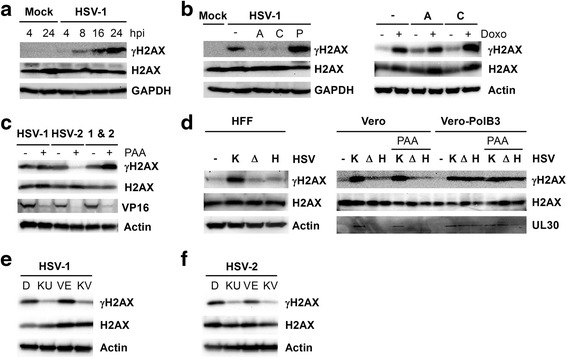
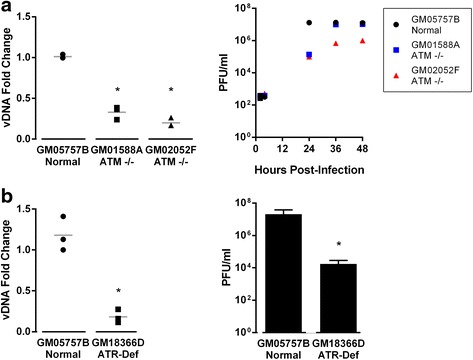
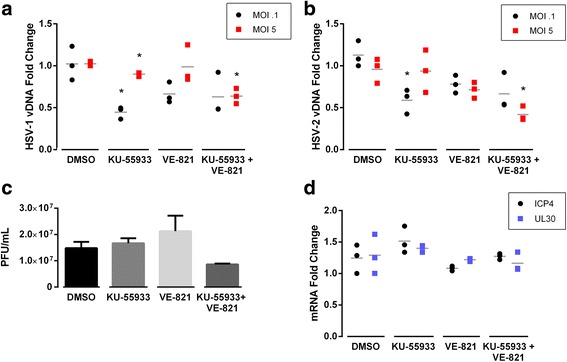
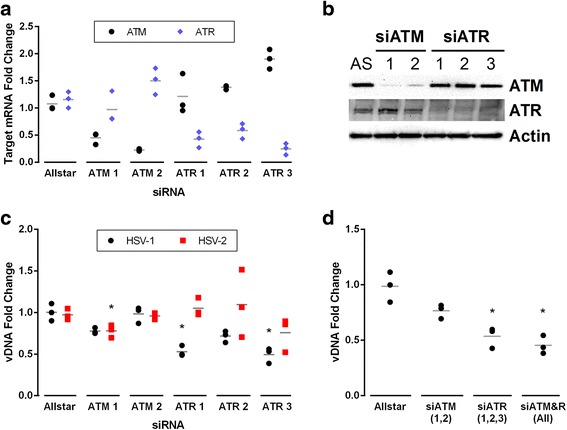
The expression of viral immediate-early and early proteins (including the viral DNA polymerase), but not viral DNA replication or late protein expression, were required for H2AX phosphorylation following HSV-1 infection. Inhibition of ATM kinase activity prevented HSV-stimulated H2AX phosphorylation but had only a minor effect on DNA replication and virus yield in HFF cells. These results differ from previous reports of a dramatic reduction in viral yield following chemical inhibition of ATM in oral keratinocytes or following infection of ATM(-/-) cells. Inhibition of the closely related kinase ATR (whether by chemical inhibitor or siRNA disruption) had no effect on H2AX phosphorylation and reduced viral DNA replication only moderately. During infection by HSV-2, H2AX phosphorylation was similarly dispensable but was dependent on both ATM activity and viral DNA replication.
H2AX phosphorylation represents a cell type-specific and virus type-specific host response to HSV infection with little impact on viral infection.
单纯疱疹病毒1型(HSV-1)可在人类中建立裂解性感染和潜伏性感染。HSV-1裂解性感染期间,组蛋白H2AX(一种常见的DNA损伤标志物)的磷酸化已得到充分证实。然而,H2AX磷酸化在裂解性感染中的作用仍不清楚。
用HSV-1或HSV-2感染人包皮成纤维细胞后,我们在存在转录抑制剂、翻译抑制剂或病毒DNA复制抑制剂的情况下,或在存在ATM和ATR激酶抑制剂(分别为KU-55933和VE-821)的情况下,检测了H2AX的磷酸化情况。我们还在存在激酶抑制剂或针对ATM和ATR的小干扰RNA(siRNA)的情况下,以及在ATR或ATM缺陷的细胞系中,检测了成纤维细胞中的病毒复制情况。
HSV-1感染后,H2AX磷酸化需要病毒即刻早期和早期蛋白(包括病毒DNA聚合酶)的表达,但不需要病毒DNA复制或晚期蛋白表达。抑制ATM激酶活性可阻止HSV刺激的H2AX磷酸化,但对人包皮成纤维细胞中的DNA复制和病毒产量只有轻微影响。这些结果与之前关于在口腔角质形成细胞中化学抑制ATM后或感染ATM(-/-)细胞后病毒产量显著降低的报道不同。抑制密切相关的激酶ATR(无论是通过化学抑制剂还是siRNA干扰)对H2AX磷酸化没有影响,仅适度降低病毒DNA复制。在HSV-2感染期间,H2AX磷酸化同样不是必需的,但依赖于ATM活性和病毒DNA复制。
H2AX磷酸化代表了细胞类型特异性和病毒类型特异性的宿主对HSV感染的反应,对病毒感染影响很小。