Liang Hong, Olsen Jørn, Yuan Wei, Cnattingus Sven, Vestergaard Mogens, Obel Carsten, Gissler Mika, Li Jiong
From the Department of Reproductive Epidemiology and Social Science (HL, WY), National Population and Family Planning Key Laboratory of Contraceptive Drugs and Devices, Shanghai Institute of Planned Parenthood Research, Shanghai, China; Department of Clinical Epidemiology (JO, JL), Aarhus University Hospital, Aarhus, Denmark; Department of Epidemiology (JO), School of Public Health, University of California, Los Angeles, California, USA; Reproduction and Development Institute (WY), Fudan University, Shanghai, China; Department of Medicine (SC), Clinical Epidemiology Unit, Karolinska Institutet, Sweden; Section for General Practice (MV, CO), Department of Public Health, Aarhus University, Denmark; Research Unit of General Practice (MV, CO), Department of Public Health, Aarhus University, Denmark; and National Institute for Health and Welfare (MG), Finland and Nordic School of Public Health, Sweden.
Medicine (Baltimore). 2016 Jan;95(3):e2434. doi: 10.1097/MD.0000000000002434.
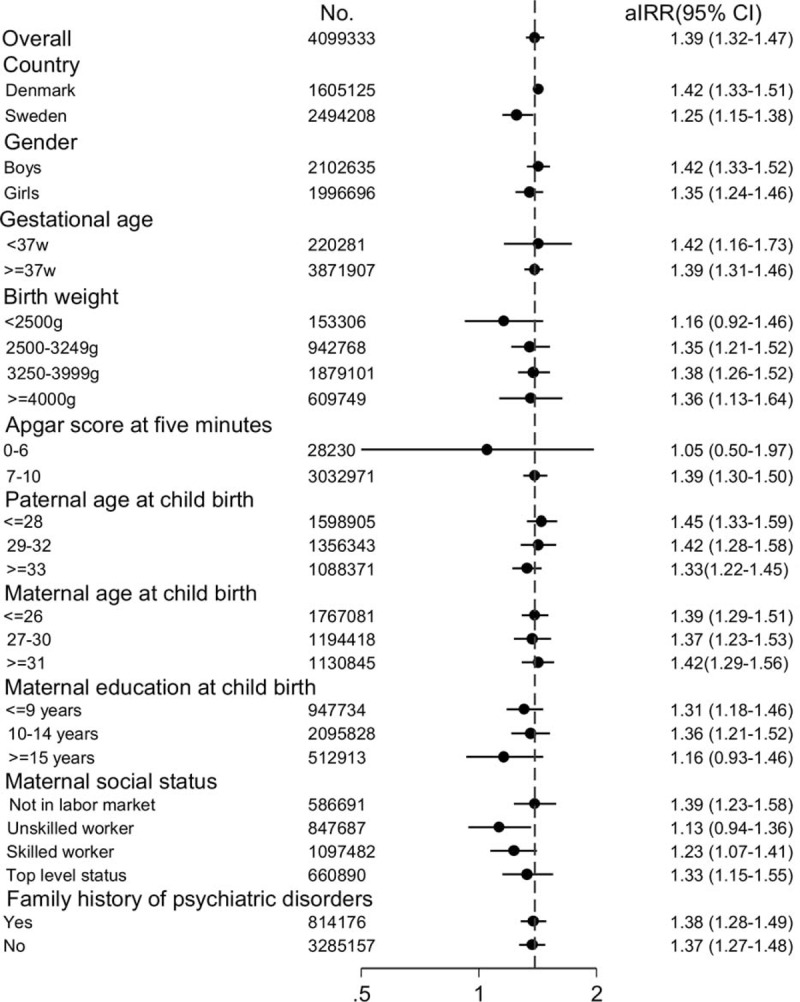
We aimed to examine whether early life bereavement, as indicator of severe stress, was associated with an increased risk of schizophrenia later in life.Based on population registers, we established a cohort of all children born in Denmark (N = 1 686 416) and Sweden (N = 2 563 659) from 1973 to 1997. Children were categorized as exposed if they lost a first-degree relative during the first 18 years of life. Outcome is the first diagnosis of schizophrenia as either inpatient or outpatient. Log-linear Poisson regression models were used to estimate incidence rate ratios (IRRs).A total of 188,850 children (4.6%) experienced death of a first-degree relative from birth to 18 years of age. Compared with unexposed children, those exposed had overall a 39% higher risk of schizophrenia (= 1.39, 95% CI [confidence interval]: 1.32-1.47). The IRR was particularly high if the family member committed suicide (aIRR = 2.11, 95% CI: 1.90-2.34) or died due to an injury or accident (aIRR = 1.44, 95% CI: 1.27-1.63). The IRR of schizophrenia decreased with increasing child's age at bereavement (P < 0.0001). Children who experienced >1 death during the first 18 years of life (aIRR = 1.79, 95% CI: 1.46-2.19) had a higher risk than those with a single death (aIRR = 1.37, 95% CI: 1.30-1.45).The study suggested that exposure to death of a first-degree relative before 18 years was associated with an increased risk of schizophrenia in later life. The complex mechanisms behind these associations remain to be elucidated.
我们旨在研究早年丧亲这一严重应激指标是否与日后患精神分裂症的风险增加有关。基于人口登记数据,我们建立了一个队列,纳入了1973年至1997年在丹麦出生的所有儿童(N = 1,686,416)以及在瑞典出生的所有儿童(N = 2,563,659)。如果儿童在18岁之前失去了一位一级亲属,则被归类为暴露组。结局指标是首次诊断为精神分裂症,无论是住院还是门诊诊断。使用对数线性泊松回归模型来估计发病率比(IRR)。
共有188,850名儿童(4.6%)在出生至18岁期间经历了一级亲属的死亡。与未暴露儿童相比,暴露组儿童患精神分裂症的总体风险高39%(IRR = 1.39,95%置信区间[CI]:1.32 - 1.47)。如果家庭成员自杀(校正发病率比[aIRR] = 2.11,95% CI:1.90 - 2.34)或因受伤或事故死亡(aIRR = 1.44,95% CI:1.27 - 1.63),则IRR特别高。精神分裂症的IRR随着丧亲时儿童年龄的增加而降低(P < 0.0001)。在18岁之前经历>1次死亡的儿童(aIRR = 1.79,95% CI:1.46 - 2.19)比经历单次死亡的儿童(aIRR = 1.37,95% CI:1.30 - 1.45)风险更高。
该研究表明,18岁之前暴露于一级亲属死亡与日后患精神分裂症的风险增加有关。这些关联背后的复杂机制仍有待阐明。