Division of Psychiatry, University College London, London, UK.
Department of Public Health Sciences, Karolinska Institutet, Stockholm, Sweden.
Schizophr Bull. 2019 Sep 11;45(5):1152-1160. doi: 10.1093/schbul/sby147.
There are limited data on the epidemiology of very late-onset schizophrenia-like psychosis (VLOSLP) and how this relates to potential risk factors including migration, sensory impairment, traumatic life events, and social isolation.
We followed up a cohort of 3 007 378 people living in Sweden, born 1920-1949, from their 60th birthday (earliest: January 15, 1980) until December 30 2011, emigration, death, or first recorded diagnosis of nonaffective psychosis. We examined VLOSLP incidence by age, sex, region of origin, income, partner or child death, birth period, and sensory impairments.
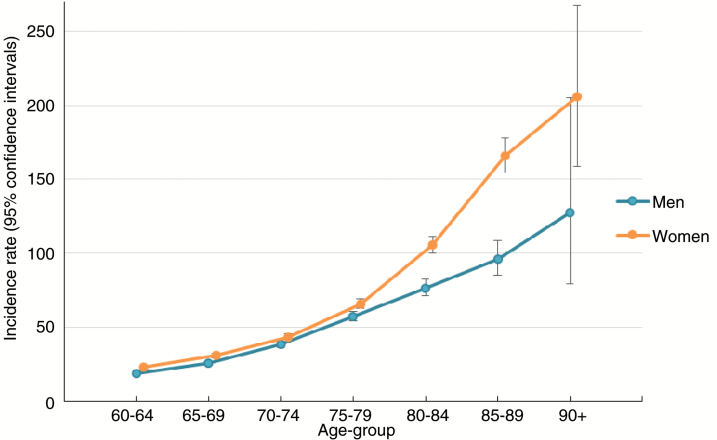
We identified 14 977 cases and an overall incidence of 37.7 per 100 000 person-years at-risk (95% CI = 37.1-38.3), with evidence that rates increased more sharply with age for women (likelihood ratio test: χ2(6) = 31.56, P < .001). After adjustment for confounders, rates of VLOSLP were higher among migrants from Africa (hazard ratio [HR] = 2.0, 95% CI = 1.4-2.7), North America (HR = 1.4, 95% CI = 1.0-1.9, P = .04), Europe (HR = 1.3, 95% CI = 1.2-1.4), Russian-Baltic regions (HR = 1.6, 95% CI = 1.4-1.9), and Finland (HR = 1.6, 95% CI = 1.5-1.7). VLOSLP risk was highest for those in the lowest income quartile (HR = 3.1, 95% CI = 2.9-3.3). Rates were raised in those whose partner died 2 years before cohort exit (HR = 1.1, 95% CI = 1.0-1.3, P = .02) or whose child died in infancy (HR = 1.2, 95% CI = 1.0-1.4, P = .05), those without a partner (HR = 1.9, 95% CI = 1.8-1.9) or children (HR = 2.4, 95% CI = 2.3-2.5), and those whose child had a psychotic disorder (HR = 2.4, 95% CI = 2.2-2.6).
We identified a substantial burden of psychosis incidence in old age, with a higher preponderance in women and most migrant groups. Life course exposure to environmental factors including markers of deprivation, isolation, and adversity were associated with VLOSLP risk.
关于极晚发性精神分裂样精神病(VLOSLP)的流行病学以及其与潜在风险因素(包括移民、感觉障碍、创伤性生活事件和社会隔离)之间的关系,数据有限。
我们对出生于 1920 年至 1949 年、60 岁生日(最早:1980 年 1 月 15 日)以后的瑞典 3007378 名人群进行了随访,随访至 2011 年 12 月 30 日,期间出现移民、死亡或首次记录的非情感性精神病。我们根据年龄、性别、原籍地区、收入、伴侣或子女死亡、出生时期和感觉障碍检查了 VLOSLP 的发病率。
我们发现了 14977 例病例,每 100000 人年发病风险为 37.7(95%CI=37.1-38.3),有证据表明女性的发病率随年龄增长而急剧上升(似然比检验:χ2(6)=31.56,P<.001)。在调整了混杂因素后,来自非洲(HR=2.0,95%CI=1.4-2.7)、北美(HR=1.4,95%CI=1.0-1.9,P=0.04)、欧洲(HR=1.3,95%CI=1.2-1.4)、俄罗斯-波罗的海地区(HR=1.6,95%CI=1.4-1.9)和芬兰(HR=1.6,95%CI=1.5-1.7)的移民的 VLOSLP 发病风险较高。收入最低四分位数的人风险最高(HR=3.1,95%CI=2.9-3.3)。在队列退出前 2 年伴侣死亡(HR=1.1,95%CI=1.0-1.3,P=0.02)或子女在婴儿期死亡(HR=1.2,95%CI=1.0-1.4,P=0.05)、没有伴侣(HR=1.9,95%CI=1.8-1.9)或子女(HR=2.4,95%CI=2.3-2.5)的人群以及子女患有精神病的人群(HR=2.4,95%CI=2.2-2.6)的 VLOSLP 发病风险增加。
我们发现了老年人群中精神病发病率的显著负担,女性和大多数移民群体的发病率更高。一生中接触环境因素,包括贫困、隔离和逆境的标志物,与 VLOSLP 风险相关。