Dincer D'Alessandro H, Sennaroğlu G, Yücel E, Belgin E, Mancini P
Department of Sensory Organs, Sapienza Università di Roma, Italy;
Department of Audiology and Speech Pathology, Hacettepe University, Ankara, Turkey;
Acta Otorhinolaryngol Ital. 2015 Oct;35(5):343-9. doi: 10.14639/0392-100X-497.
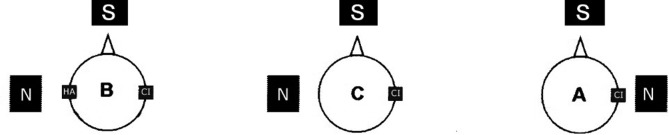
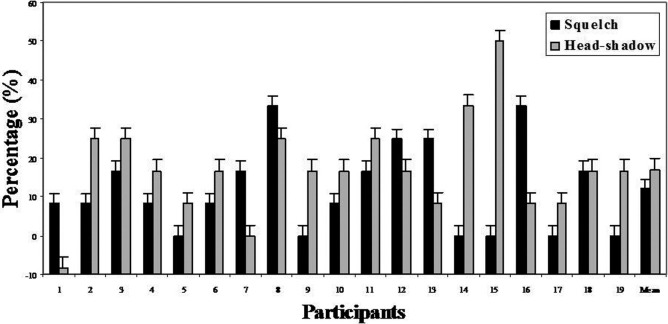
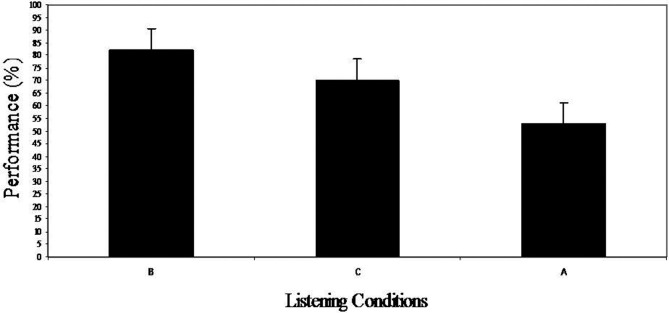
The aim of this study was to investigate the amount of binaural squelch effect (BSE) and head shadow effect (HSE) in children who use unilateral cochlear implants (CI) and contralateral hearing aids (HA). The study group consisted of 19 CI recipient children who consistently wore a contralateral HA. Speech sounds were used to evaluate speech perception performance in noise. Testing was performed in three listening conditions: (1) bimodal listening with noise source on HA side; (2) CI only with noise source contralaterally (HA off); (3) CI only with noise source on the CI side. Statistical analysis revealed a significant difference between the three listening conditions and post hoc tests indicated significant differences for all pairwise comparisons (p < 0.001). The average BSE and HSE were 11.8% and 17.1% respectively. The majority of bimodal CI users showed BSE and HSE with significant speech perception improvement in the presence of noise.
本研究的目的是调查使用单侧人工耳蜗(CI)和对侧助听器(HA)的儿童的双耳静噪效应(BSE)和头影效应(HSE)的程度。研究组由19名持续佩戴对侧HA的CI受者儿童组成。使用语音来评估噪声环境下的言语感知表现。测试在三种聆听条件下进行:(1)噪声源位于HA一侧的双耳聆听;(2)仅使用CI且噪声源位于对侧(HA关闭);(3)仅使用CI且噪声源位于CI一侧。统计分析显示三种聆听条件之间存在显著差异,事后检验表明所有两两比较均存在显著差异(p < 0.001)。平均BSE和HSE分别为11.8%和17.1%。大多数双耳CI使用者在噪声环境下表现出BSE和HSE,言语感知有显著改善。