Wang Ningjian, Zhai Hualing, Zhu Chaoxia, Li Qin, Han Bing, Chen Yi, Zhu Chunfang, Chen Yingchao, Xia Fangzhen, Lin Dongping, Lu Yingli
From the Institute and Department of Endocrinology and Metabolism, Shanghai Ninth People's Hospital, Shanghai JiaoTong University School of Medicine, Shanghai, China (NW, HZ, QL, BH, YC, CZ, YC, FX, DL, YL); Department of Endocrinology and Metabolism, The First Affiliated Hospital of Henan University of Science and Technology, Henan, China (CZ).
Medicine (Baltimore). 2016 Jan;95(4):e2621. doi: 10.1097/MD.0000000000002621.
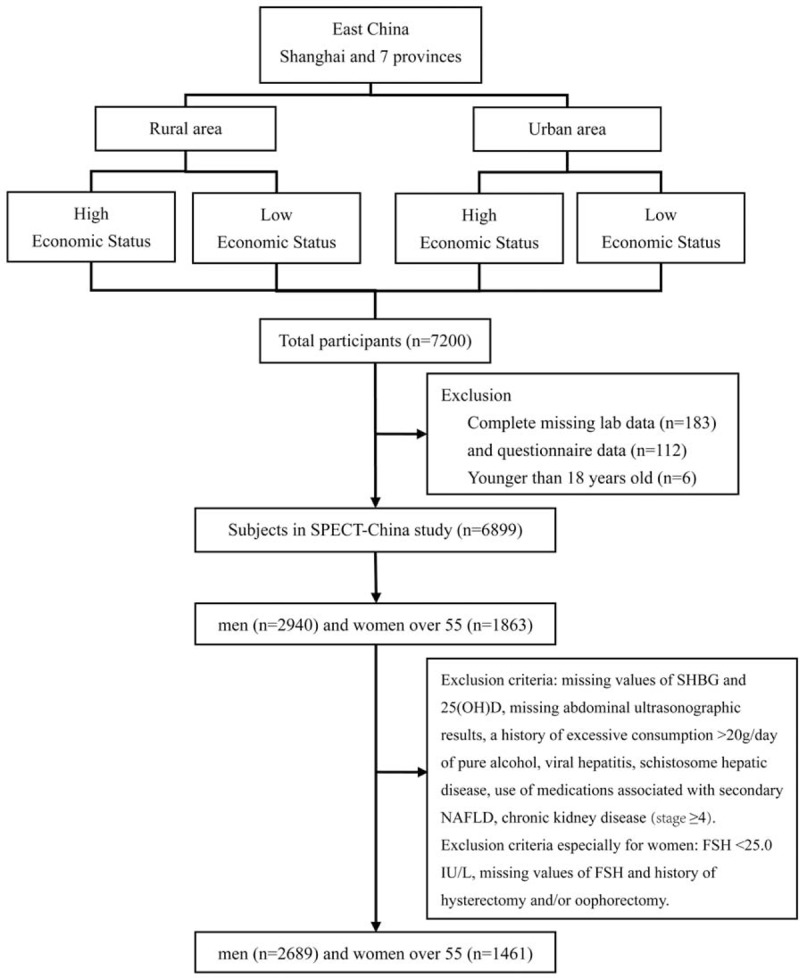
This study aimed to explore the combined associations of 25(OH)-vitamin D and sex hormone binding globulin (SHBG) with nonalcoholic fatty liver disease (NAFLD) in men and postmenopausal women. Our data, which were based on the population, were collected from 16 sites in East China in 2014. There were 2700 men with a mean age of 53 years and 1461 women over 55 who were considered postmenopausal enrolled in the study. Levels of 25(OH)D and SHBG were measured using chemiluminescence assay. NAFLD was measured using liver ultrasound. Multivariable-adjusted logistic regression models examined associations of 25(OH)D and SHBG tertiles with odds of mild and moderate-severe NAFLD. Both the low 25(OH)D and low SHBG groups were significantly associated with higher odds of mild NAFLD (men: OR 1.37, 95% CI 1.05, 1.78 in low 25(OH)D group; OR 1.73, 95% CI 1.23, 2.45 in low SHBG group; women: OR 1.51, 95% CI 1.08, 2.12 in low 25(OH)D group; OR 2.16, 95% CI 1.48, 3.14 in low SHBG group) and moderate-severe NAFLD (men: OR 1.61, 95% CI 1.24, 2.10 in low 25(OH)D group; OR 3.42, 95% CI 2.41, 4.87 in low SHBG group; women: OR 1.66, 95% CI 1.14, 2.42 in low 25(OH)D group; OR 6.84, 95% CI 4.31, 10.84 in low SHBG group). However, the combined association of low 25(OH)D and low SHBG was much larger, especially in moderate-severe NAFLD (men: OR 6.57, 95% CI 3.87, 11.18; women: OR 8.16, 95% CI 3.98, 16.73). The associations were independent of age, total testosterone, abdominal obesity, diabetes, and lipid profile. The negative associations of 25(OH)D and SHBG levels with NAFLD are strongest when viewed in combination in men and postmenopausal women. Further studies should determine the cause-effect relationship and investigate the underlying mechanisms of this finding.
本研究旨在探讨25(OH)-维生素D和性激素结合球蛋白(SHBG)与男性及绝经后女性非酒精性脂肪性肝病(NAFLD)的联合关联。我们基于人群的数据于2014年从中国东部16个地点收集。共有2700名平均年龄为53岁的男性和1461名55岁以上的绝经后女性纳入本研究。采用化学发光法测定25(OH)D和SHBG水平。通过肝脏超声检查NAFLD。多变量调整逻辑回归模型检验25(OH)D和SHBG三分位数与轻度及中度-重度NAFLD发生几率的关联。25(OH)D水平低和SHBG水平低的组均与轻度NAFLD的较高发生几率显著相关(男性:25(OH)D水平低的组中,OR 1.37,95%CI 1.05,1.78;SHBG水平低的组中,OR 1.73,95%CI 1.23,2.45;女性:25(OH)D水平低的组中,OR 1.51,95%CI 1.08,2.12;SHBG水平低的组中,OR 2.16,95%CI 1.48,3.14)以及中度-重度NAFLD(男性:25(OH)D水平低的组中,OR 1.61,95%CI 1.24,2.10;SHBG水平低的组中,OR 3.42,95%CI 2.41,4.87;女性:25(OH)D水平低的组中,OR 1.66,95%CI 1.14,2.42;SHBG水平低的组中,OR 6.84,95%CI 4.31,10.84)。然而,25(OH)D水平低和SHBG水平低的联合关联要大得多,尤其是在中度-重度NAFLD中(男性:OR 6.57,95%CI 3.87,11.18;女性:OR 8.16,95%CI 3.98,16.73)。这些关联独立于年龄、总睾酮、腹型肥胖、糖尿病和血脂谱。在男性和绝经后女性中,联合观察时25(OH)D和SHBG水平与NAFLD的负关联最强。进一步的研究应确定因果关系并探究这一发现的潜在机制。