Wray S, Grant P, Gainer H
Laboratory of Neurochemistry, National Institute of Neurological Disorders and Stroke, Bethesda, MD 20892.
Proc Natl Acad Sci U S A. 1989 Oct;86(20):8132-6. doi: 10.1073/pnas.86.20.8132.
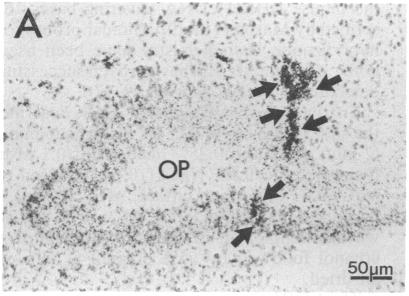
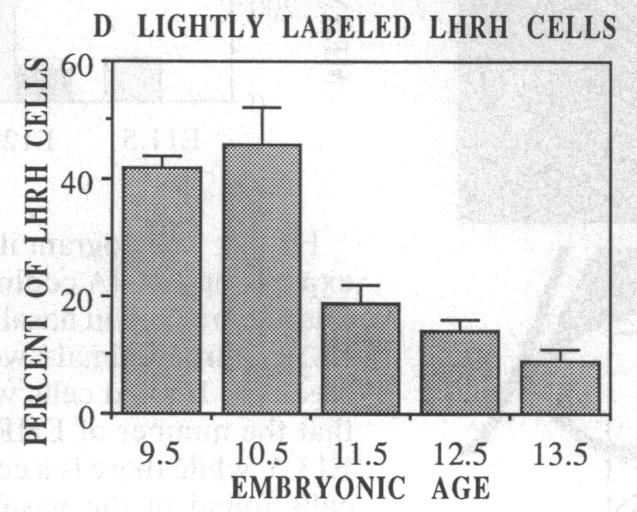
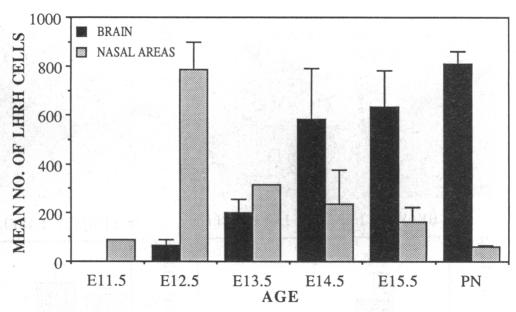
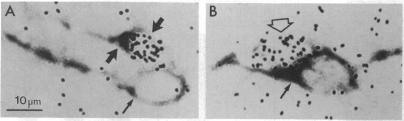
In situ hybridization histochemistry and immunocytochemistry were used to study the prenatal expression of luteinizing hormone-releasing hormone (LHRH) cells in the mouse. Cells expressing LHRH mRNA and peptide product were first detected on embryonic day 11.5 (E11.5) in the olfactory pit. On E12.5, the majority of LHRH cells were located on "tracks" extending from the olfactory pit to the base of the telencephalon. From E12.5 to E15.5, LHRH cells were detected in a rostral-to-caudal gradient in forebrain areas. Prior to E12.5, cells expressing LHRH mRNA were not detected in forebrain areas known to contain LHRH cells in postnatal animals. Quantitation of cells expressing LHRH mRNA showed that the number of labeled cells on E12.5 (approximately 800) equaled the number of LHRH cells in postnatal animals, but more than 90% of these cells were located in nasal regions. Between E12.5 and E15.5, the location of LHRH cells shifted. The number of LHRH cells in the forebrain increased, while the number of LHRH cells in nasal regions decreased over this same period. These findings establish that cells first found in the olfactory pit and thereafter in forebrain areas express the LHRH gene and correspond to the position of LHRH immunopositive cells found at these developmental times. To further examine the ontogeny of the LHRH system, immunocytochemistry in combination with [3H]thymidine autoradiography was used to determine when LHRH cells left the mitotic cycle. We show that LHRH neurons exhibit a discrete time of birth, suggesting that they arise as a single neuronal population between E10.0 and E11.0. Postnatal LHRH neurons were "birth-dated" shortly after differentiation of the olfactory placode and before LHRH mRNA was expressed in cells in the olfactory pit. Taken together, these studies support the hypothesis that all LHRH cells in the central nervous system arise from a discrete group of progenitor cells in the olfactory placode and that a subpopulation of these cells migrate into forebrain areas where they subsequently establish an adult-like distribution.
采用原位杂交组织化学和免疫细胞化学方法研究小鼠促黄体激素释放激素(LHRH)细胞的产前表达。在胚胎第11.5天(E11.5),首次在嗅窝中检测到表达LHRH mRNA和肽产物的细胞。在E12.5时,大多数LHRH细胞位于从嗅窝延伸至端脑底部的“轨迹”上。从E12.5到E15.5,在前脑区域按从前到后的梯度检测到LHRH细胞。在E12.5之前,在已知出生后动物中含有LHRH细胞的前脑区域未检测到表达LHRH mRNA的细胞。对表达LHRH mRNA的细胞进行定量分析表明,E12.5时标记细胞的数量(约800个)与出生后动物中LHRH细胞的数量相等,但这些细胞中90%以上位于鼻腔区域。在E12.5和E15.5之间,LHRH细胞的位置发生了变化。在此期间,前脑中LHRH细胞的数量增加,而鼻腔区域LHRH细胞的数量减少。这些发现证实,最初在嗅窝中发现、随后在前脑区域发现的细胞表达LHRH基因,并且与在这些发育阶段发现的LHRH免疫阳性细胞的位置相对应。为了进一步研究LHRH系统的个体发生,将免疫细胞化学与[3H]胸腺嘧啶放射自显影相结合,以确定LHRH细胞何时脱离有丝分裂周期。我们发现LHRH神经元具有离散的出生时间,这表明它们在E10.0至E11.0之间作为单个神经元群体出现。出生后的LHRH神经元在嗅基板分化后不久、且在嗅窝细胞中表达LHRH mRNA之前就已“确定出生时间”。综上所述,这些研究支持以下假说:中枢神经系统中的所有LHRH细胞均起源于嗅基板中一组离散的祖细胞,并且这些细胞的一个亚群迁移到前脑区域,随后在那里建立起类似成年动物的分布。