Landi Francesco, Calvani Riccardo, Tosato Matteo, Martone Anna Maria, Ortolani Elena, Savera Giulia, Sisto Alex, Marzetti Emanuele
Department of Geriatrics, Neurosciences and Orthopedics, Catholic University of the Sacred Heart, Rome 00168, Italy.
Nutrients. 2016 Jan 27;8(2):69. doi: 10.3390/nu8020069.
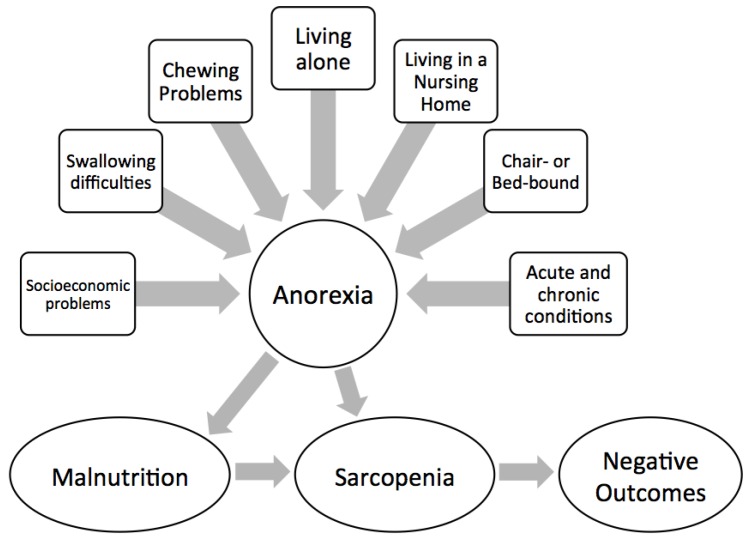
Older people frequently fail to ingest adequate amount of food to meet their essential energy and nutrient requirements. Anorexia of aging, defined by decrease in appetite and/or food intake in old age, is a major contributing factor to under-nutrition and adverse health outcomes in the geriatric population. This disorder is indeed highly prevalent and is recognized as an independent predictor of morbidity and mortality in different clinical settings. Even though anorexia is not an unavoidable consequence of aging, advancing age often promotes its development through various mechanisms. Age-related changes in life-style, disease conditions, as well as social and environmental factors have the potential to directly affect dietary behaviors and nutritional status. In spite of their importance, problems related to food intake and, more generally, nutritional status are seldom attended to in clinical practice. While this may be the result of an "ageist" approach, it should be acknowledged that simple interventions, such as oral nutritional supplementation or modified diets, could meaningfully improve the health status and quality of life of older persons.
老年人常常无法摄入足够的食物来满足其基本的能量和营养需求。老年厌食症,定义为老年人食欲和/或食物摄入量的下降,是老年人群营养不良和不良健康后果的一个主要促成因素。这种病症确实非常普遍,并且在不同临床环境中被认为是发病率和死亡率的独立预测指标。尽管厌食症并非衰老不可避免的后果,但随着年龄的增长,往往会通过各种机制促进其发展。与年龄相关的生活方式变化、疾病状况以及社会和环境因素有可能直接影响饮食行为和营养状况。尽管食物摄入以及更普遍的营养状况相关问题很重要,但在临床实践中却很少受到关注。虽然这可能是“年龄歧视”方法的结果,但应该认识到,简单的干预措施,如口服营养补充剂或调整饮食,能够切实改善老年人的健康状况和生活质量。