Lane-Donovan Courtney, Herz Joachim
Department of Molecular Genetics, University of Texas Southwestern Medical Center, Dallas, Texas, 75390, United States of America.
Department of Neuroscience, University of Texas Southwestern Medical Center, Dallas, Texas, 75390, United States of America.
PLoS One. 2016 Feb 1;11(2):e0148099. doi: 10.1371/journal.pone.0148099. eCollection 2016.
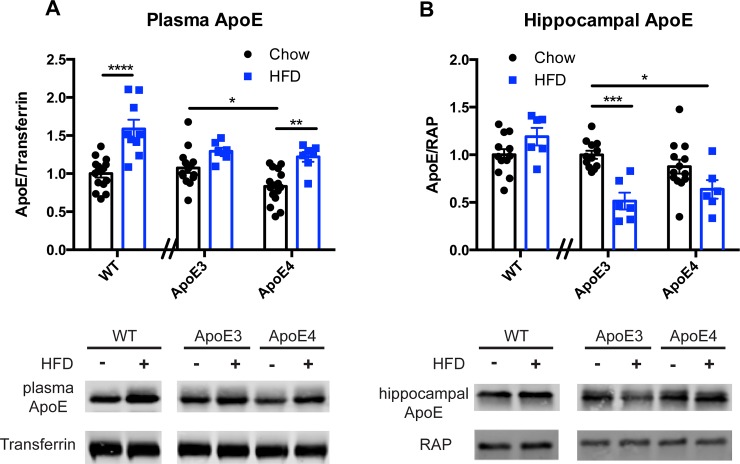
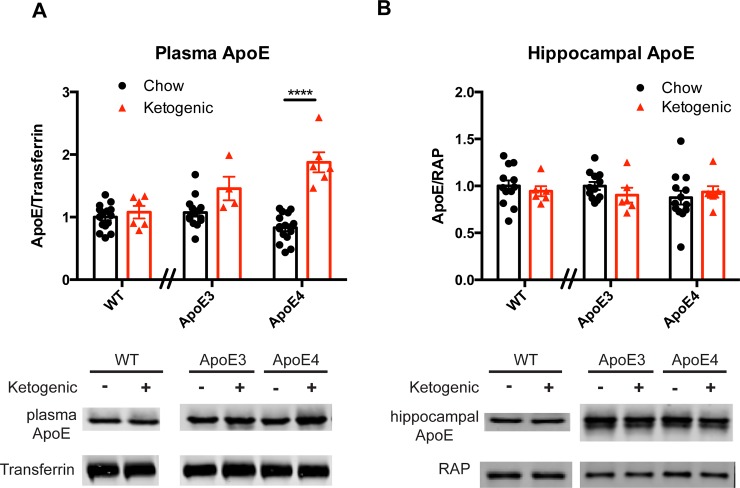
Alzheimer's disease is a currently incurable neurodegenerative disease affecting millions of individuals worldwide. Risk factors for Alzheimer's disease include genetic risk factors, such as possession of ε4 allele of apolipoprotein E (ApoE4) over the risk-neutral ApoE3 allele, and lifestyle risk factors, such as diet and exercise. The intersection of these two sources of disease risk is not well understood. We investigated the impact of diet on ApoE levels by feeding wildtype, ApoE3, and ApoE4 targeted replacement (TR) mice with chow, high-fat, or ketogenic (high-fat, very-low-carbohydrate) diets. We found that high-fat diet affected both plasma and hippocampal levels of ApoE in an isoform-dependent manner, with high-fat diet causing a surprising reduction of hippocampal ApoE levels in ApoE3 TR mice. Conversely, the ketogenic diet had no effect on hippocampal ApoE. Our findings suggest that the use of dietary interventions to slow the progression AD should take ApoE genotype into consideration.
阿尔茨海默病是一种目前无法治愈的神经退行性疾病,影响着全球数百万人。阿尔茨海默病的风险因素包括遗传风险因素,如携带载脂蛋白E(ApoE)的ε4等位基因而非风险中性的ApoE3等位基因,以及生活方式风险因素,如饮食和运动。这两种疾病风险来源的交叉点尚未得到很好的理解。我们通过用普通饲料、高脂或生酮(高脂肪、极低碳水化合物)饮食喂养野生型、ApoE3和ApoE4靶向替换(TR)小鼠,研究了饮食对ApoE水平的影响。我们发现,高脂饮食以异构体依赖的方式影响血浆和海马体中的ApoE水平,高脂饮食导致ApoE3 TR小鼠海马体ApoE水平出人意料地降低。相反,生酮饮食对海马体ApoE没有影响。我们的研究结果表明,使用饮食干预来减缓阿尔茨海默病的进展应考虑ApoE基因型。