Kohno M, Okita K, Morales A M, Robertson C L, Dean A C, Ghahremani D G, Sabb F W, Rawson R A, Mandelkern M A, Bilder R M, London E D
Department of Psychiatry and Biobehavioral Sciences, University of California Los Angeles, Los Angeles, CA, USA.
Veterans Administration of Greater Los Angeles Healthcare System, University of California Irvine, Irvine, CA, USA.
Mol Psychiatry. 2016 Nov;21(11):1554-1560. doi: 10.1038/mp.2015.223. Epub 2016 Feb 2.
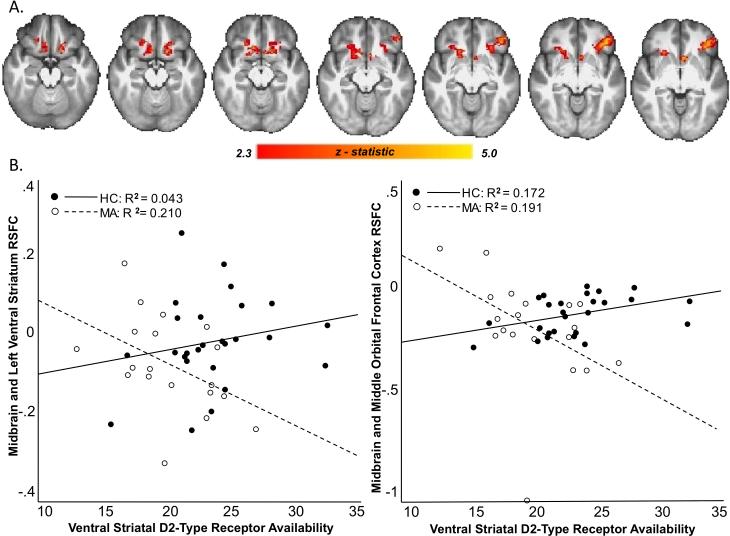
Stimulant use disorders are associated with deficits in striatal dopamine receptor availability, abnormalities in mesocorticolimbic resting-state functional connectivity (RSFC) and impulsivity. In methamphetamine-dependent research participants, impulsivity is correlated negatively with striatal D2-type receptor availability, and mesocorticolimbic RSFC is stronger than that in controls. The extent to which these features of methamphetamine dependence are interrelated, however, is unknown. This question was addressed in two studies. In Study 1, 19 methamphetamine-dependent and 26 healthy control subjects underwent [F]fallypride positron emission tomography to measure ventral striatal dopamine D2-type receptor availability, indexed by binding potential (BP), and functional magnetic resonance imaging (fMRI) to assess mesocorticolimbic RSFC, using a midbrain seed. In Study 2, an independent sample of 20 methamphetamine-dependent and 18 control subjects completed the Barratt Impulsiveness Scale in addition to fMRI. Study 1 showed a significant group by ventral striatal BP interaction effect on RSFC, reflecting a negative relationship between ventral striatal BP and RSFC between the midbrain and striatum, orbitofrontal cortex and insula in methamphetamine-dependent participants, but a positive relationship in the control group. In Study 2, an interaction of the group with RSFC on impulsivity was observed. Methamphetamine-dependent users exhibited a positive relationship of midbrain RSFC to the left ventral striatum with cognitive impulsivity, whereas a negative relationship was observed in healthy controls. The results indicate that ventral striatal D2-type receptor signaling may affect the system-level activity within the mesocorticolimbic system, providing a functional link that may help explain high impulsivity in methamphetamine-dependent individuals.
兴奋剂使用障碍与纹状体多巴胺受体可用性缺陷、中脑边缘叶静息态功能连接(RSFC)异常及冲动性有关。在甲基苯丙胺依赖的研究参与者中,冲动性与纹状体D2型受体可用性呈负相关,且中脑边缘叶RSFC比对照组更强。然而,甲基苯丙胺依赖的这些特征之间的相互关联程度尚不清楚。两项研究探讨了这个问题。在研究1中,19名甲基苯丙胺依赖者和26名健康对照者接受了[F]氟哌利多正电子发射断层扫描,以测量腹侧纹状体多巴胺D2型受体可用性(以结合潜能(BP)为指标),并进行功能磁共振成像(fMRI),使用中脑种子来评估中脑边缘叶RSFC。在研究2中,20名甲基苯丙胺依赖者和18名对照者的独立样本除了进行fMRI外,还完成了巴拉特冲动性量表。研究1显示,腹侧纹状体BP对RSFC存在显著的组间交互效应,反映出在甲基苯丙胺依赖参与者中,腹侧纹状体BP与中脑和纹状体、眶额皮质及脑岛之间的RSFC呈负相关,而在对照组中呈正相关。在研究2中,观察到组与RSFC对冲动性的交互作用。甲基苯丙胺依赖使用者中脑RSFC与左腹侧纹状体的认知冲动性呈正相关,而在健康对照者中呈负相关。结果表明,腹侧纹状体D2型受体信号可能影响中脑边缘叶系统内的系统水平活动,提供了一个功能联系,有助于解释甲基苯丙胺依赖个体的高冲动性。