Guinel Frédérique C
Department of Biology, Wilfrid Laurier University, Waterloo, ON Canada.
Front Plant Sci. 2015 Dec 22;6:1121. doi: 10.3389/fpls.2015.01121. eCollection 2015.
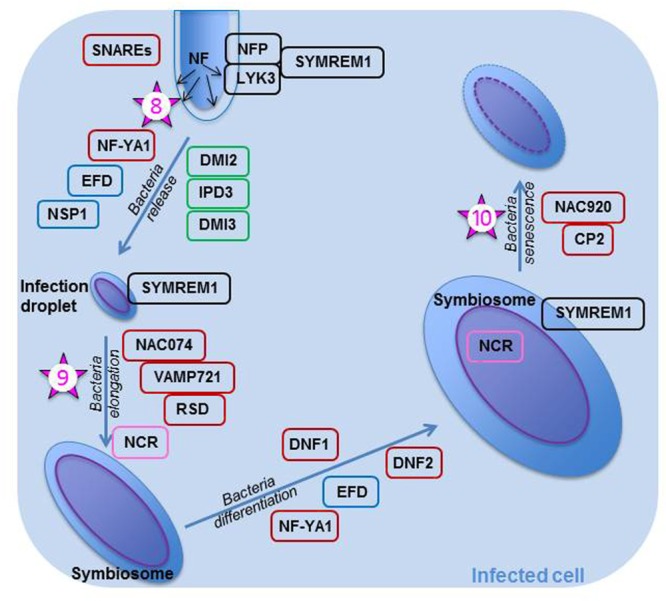
Nodulation is the result of a beneficial interaction between legumes and rhizobia. It is a sophisticated process leading to nutrient exchange between the two types of symbionts. In this association, within a nodule, the rhizobia, using energy provided as photosynthates, fix atmospheric nitrogen and convert it to ammonium which is available to the plant. Nodulation is recognized as an essential process in nitrogen cycling and legume crops are known to enrich agricultural soils in nitrogenous compounds. Furthermore, as they are rich in nitrogen, legumes are considered important as staple foods for humans and fodder for animals. To tightly control this association and keep it mutualistic, the plant uses several means, including hormones. The hormone ethylene has been known as a negative regulator of nodulation for almost four decades. Since then, much progress has been made in the understanding of both the ethylene signaling pathway and the nodulation process. Here I have taken a large view, using recently obtained knowledge, to describe in some detail the major stages of the process. I have not only reviewed the steps most commonly covered (the common signaling transduction pathway, and the epidermal and cortical programs), but I have also looked into steps less understood (the pre-infection step with the plant defense response, the bacterial release and the formation of the symbiosome, and nodule functioning and senescence). After a succinct review of the ethylene signaling pathway, I have used the knowledge obtained from nodulation- and ethylene-related mutants to paint a more complete picture of the role played by the hormone in nodule organogenesis, functioning, and senescence. It transpires that ethylene is at the center of this effective symbiosis. It has not only been involved in most of the steps leading to a mature nodule, but it has also been implicated in host immunity and nodule senescence. It is likely responsible for the activation of other hormonal signaling pathways. I have completed the review by citing three studies which makes one wonder whether knowledge gained on nodulation in the last decades is ready to be transferred to agricultural fields.
结瘤是豆科植物与根瘤菌之间有益相互作用的结果。这是一个复杂的过程,导致两种共生体之间的养分交换。在这种共生关系中,在根瘤内,根瘤菌利用作为光合产物提供的能量,固定大气中的氮并将其转化为植物可利用的铵。结瘤被认为是氮循环中的一个重要过程,已知豆科作物能使农业土壤富含含氮化合物。此外,由于豆科植物富含氮,它们被认为是人类的重要主食和动物的饲料。为了严格控制这种共生关系并使其保持互利共生,植物采用了多种手段,包括激素。近四十年来,激素乙烯一直被认为是结瘤的负调节因子。从那时起,在乙烯信号通路和结瘤过程的理解方面都取得了很大进展。在这里,我利用最近获得的知识,从宏观角度详细描述了这个过程的主要阶段。我不仅回顾了最常涉及的步骤(共同信号转导途径、表皮和皮层程序),还研究了了解较少的步骤(植物防御反应的感染前步骤、细菌释放和共生体的形成以及根瘤功能和衰老)。在简要回顾乙烯信号通路后,我利用从结瘤和乙烯相关突变体中获得的知识,更全面地描绘了该激素在根瘤器官发生、功能和衰老中所起的作用。事实证明,乙烯处于这种有效共生的中心。它不仅参与了导致成熟根瘤的大多数步骤,还与宿主免疫和根瘤衰老有关。它可能负责激活其他激素信号通路。我通过引用三项研究完成了这篇综述,这让人不禁思考,过去几十年在结瘤方面获得的知识是否准备好应用于农业领域。