Unay Jovelyn, Perret Xavier
University of Geneva, Sciences III, Department of Botany and Plant Biology, Microbiology Unit, 30 quai Ernest-Ansermet, CH-1211 Geneva 4, Switzerland.
Genes (Basel). 2020 May 7;11(5):521. doi: 10.3390/genes11050521.
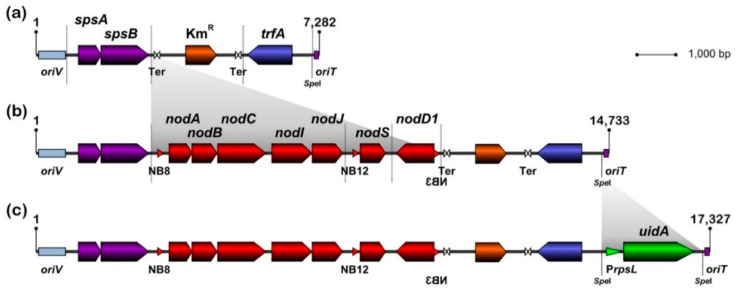
On legume crops, formation of developmentally mature nodules is a prerequisite to efficient nitrogen fixation by populations of rhizobial bacteroids established inside nodule cells. Development of root nodules and concomitant microbial colonisation of plant cells are constrained by sets of recognition signals exchanged by infecting rhizobia and their legume hosts, with much of the specificity of symbiotic interactions being determined by the flavonoid cocktails released by legume roots and the strain-specific nodulation factors (NFs) secreted by rhizobia. Hence, much of strain NGR234 symbiotic promiscuity was thought to stem from a family of >80 structurally diverse NFs and associated nodulation keys in the form of secreted effector proteins and rhamnose-rich surface polysaccharides. Here, we show instead that a mini-symbiotic plasmid (pMiniSym2) carrying only the , and genes of NGR234 conferred promiscuous nodulation to ANU265, a derivative strain cured of the large symbiotic plasmid pNGR234a. The ANU265::pMiniSym2 transconjugant triggered nodulation responses on 12 of the 22 legumes we tested. On roots of , and , ANU265::pMiniSym2 formed mature-like nodule and successfully infected nodule cells. While cowpea and siratro responded to nodule colonisation with defence responses that eventually eliminated bacteria, formed leghemoglobin-containing mature-like nodules inside which the pMiniSym2 transconjugant established persistent intracellular colonies. This data shows seven nodulation genes of NGR234 suffice to trigger nodule formation on roots of many hosts and to establish chronic infections in cells.
在豆科作物上,发育成熟的根瘤形成是根瘤细胞内建立的根瘤菌群体有效固氮的前提条件。根瘤的发育以及植物细胞随之而来的微生物定殖受到感染根瘤菌与其豆科宿主之间交换的一系列识别信号的限制,共生相互作用的许多特异性由豆科植物根释放的类黄酮混合物和根瘤菌分泌的菌株特异性结瘤因子(NFs)决定。因此,人们认为NGR234菌株的共生广谱性很大程度上源于一个由80多种结构多样的NFs以及以分泌效应蛋白和富含鼠李糖的表面多糖形式存在的相关结瘤关键因子组成的家族。相反,在这里我们表明,一个仅携带NGR234的、和基因的微型共生质粒(pMiniSym2)赋予了ANU265(一种去除了大型共生质粒pNGR234a的衍生菌株)广谱结瘤能力。ANU265::pMiniSym2转接合子在我们测试的22种豆科植物中的12种上引发了结瘤反应。在、和的根上,ANU265::pMiniSym2形成了类似成熟的根瘤并成功感染了根瘤细胞。虽然豇豆和西链豆对根瘤定殖产生了防御反应,最终消除了细菌,但形成了含有豆血红蛋白的类似成熟根瘤,pMiniSym2转接合子在其中建立了持久的细胞内菌落。这些数据表明,NGR234的7个结瘤基因足以触发许多宿主根上的根瘤形成,并在细胞中建立慢性感染。